

Hello friends! Happy New Year!
Welcome to the first Creators’ AI Edition in 2026.
Meta is dropping over $2 billion to acquire AI-agent startup Manus, FAL AI is open-sourcing FLUX.2 Turbo, while we’re diving into the trends that started shaping 2025 and are poised to accelerate even further in 2026.
But let’s get everything in order.
Featured Materials 🎟️
News of the week 🌍
Useful tools ⚒️
Weekly Guides 📕
AI Meme of the Week 🤡
AI Tweet of the Week 🐦
(Bonus) Materials 🎁
From our partners:
Recraft
Recraft is one of the best image generation models out there that comes with its own design tool, trusted by brands like Ogilvy, HubSpot, Netflix, Asana, and Airbus.
There, you can create marketing‑ready visuals with precise color control, vector-ready assets, and custom brand styles.
The platform removes friction from consistent tasks so anyone can generate visual content from text fast without any design experience.

Bring your ideas to life instantly!
Featured Materials 🎟️
Meta x Manus
Meta is buying AI-agent startup Manus. Sources put the deal at over $2 billion, though Meta isn’t disclosing exact terms.
Earlier in 2025, Manus really took off. It raised $75 million at a valuation close to $500 million and reported around $125 million in ARR. This happened after the launch of its universal AI agent, which users said felt faster and more autonomous than tools from OpenAI or Google.
Meta plans to plug Manus’ capabilities into its consumer and business products, including Meta AI. But Manus’ subscription model will continue to run independently.
At the same time, the company is about to gradually move the agent onto Meta’s own models, since Manus currently relies partly on third-party (including Chinese) tech. The startup will also cut its remaining ties to China despite being registered in Singapore.
Hm, Meta is also entering the race of AI agents, and now it’s about who gets to own the platform layer.
News of the week 🌍
Flux 2 Turbo image generator
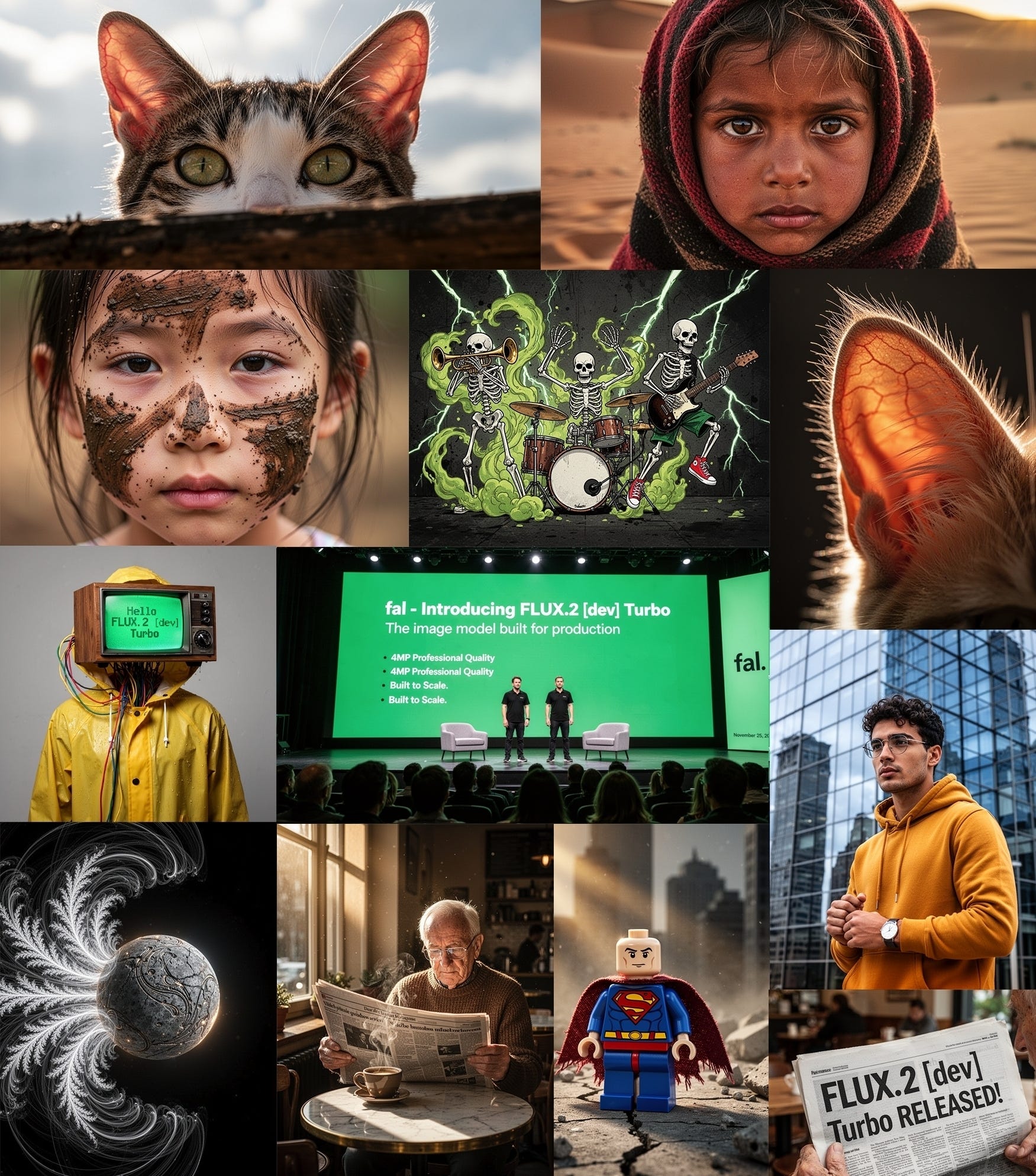
FAL AI has released and open-sourced FLUX.2 [dev] Turbo. It’s a faster version of FLUX.2 from Black Forest Labs, optimized for low-latency inference. Instead of the usual 40-50 diffusion steps, Turbo generates images in just eight.
According to the team, it runs about six times faster than the base model and keeps image quality largely intact.
It ranked 8th on Artificial Analysis, beating Nano Banana, and it’s currently the highest-ranked open-source model.
On benchmarks, Turbo delivers 1024×1024 images in 6.6 seconds at $0.008 per image, which puts it among the cheapest options available. Technically, it’s distributed as a LoRA and published on Hugging Face under a non-commercial license, so it’s easy to integrate and runs on consumer GPUs.
Full-scale code automation
The AI Futures Project has published a December update to its AI-2027 progress forecast.
In its April forecast, the group expected full automation of coding tasks to arrive in the late 2020s. In the new update, the midpoint for this shift is expected to occur around 2031.
The change stems from a rethink of how much pre-automation AI actually accelerates its own R&D. Previously, this effect was overstated, partly due to overly optimistic assumptions, and partly due to a bug that shaved off almost a year.
Important to mention that the revision doesn’t suggest that AI development is slowing down. Instead, the authors reassessed how much early AI assistance speeds up its own research. The new version spreads uncertainty more evenly: fast takeoff is still on the table, but limits like diminishing returns and practical constraints now weigh more heavily.
HyperCLOVA X SEED Think
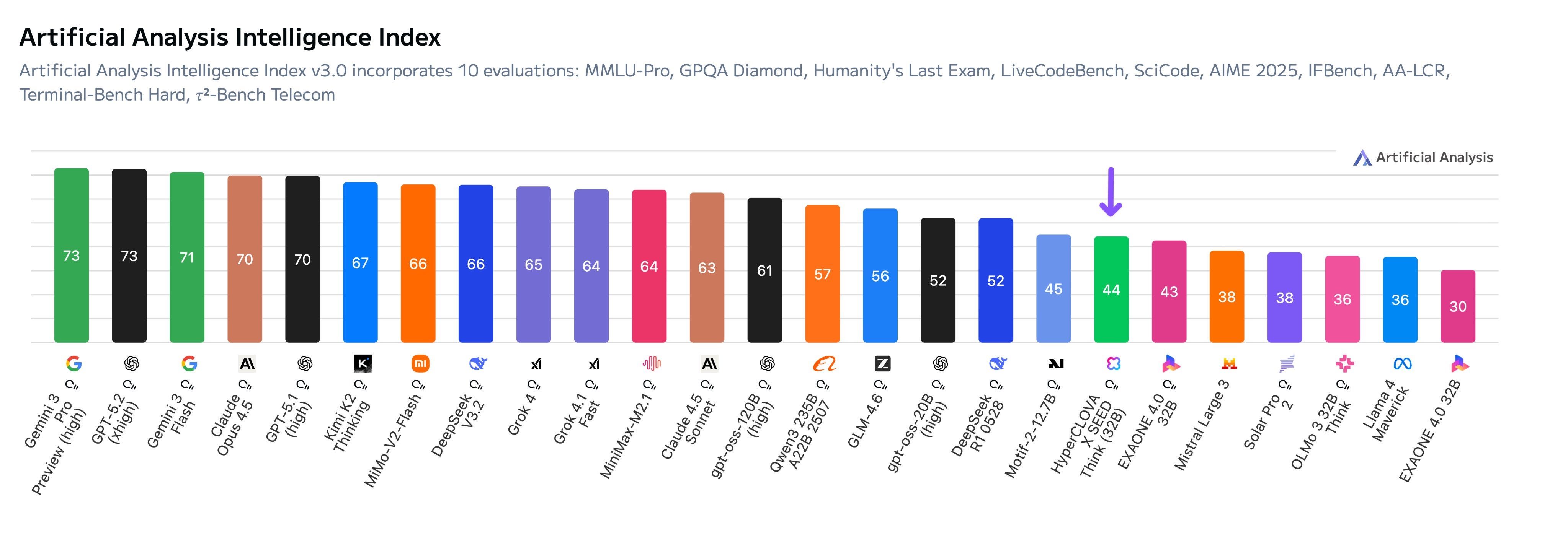
South Korea's Naver has introduced HyperCLOVA X SEED Think, a 32B open-weight reasoning model that's making waves in the AI scene.
It scored 44 on the Artificial Analysis Intelligence Index and beat out the previous Korean champion EXAONE 4.0 32B. What's really impressive is how efficient this thing is. It only burned through 39M reasoning tokens across the benchmark suite.
The model also crushes it on agentic tool-use tasks. It hit 87% on τ²-Bench Telecom and performed on par with Gemini 3 Pro Preview in that category.
The fact that Naver released this as open-source continues a broader trend we're seeing from Asian AI labs. They're open-sourcing their best models as competition heats up.
It's a solid signal that South Korea is staking its claim as a serious player in the global AI race.
The Shifts Behind the Headlines
Over the past year in our digests, you've been following plenty of news stories, but many of them have actually been adding up to bigger trends that are now impossible to ignore.
In our post on Wednesday, we covered the key players and tools that defined 2025, along with our predictions for the year ahead. But right now, I want to focus on the underlying processes that are quietly reshaping the entire AI landscape.
Memory Left The Chat
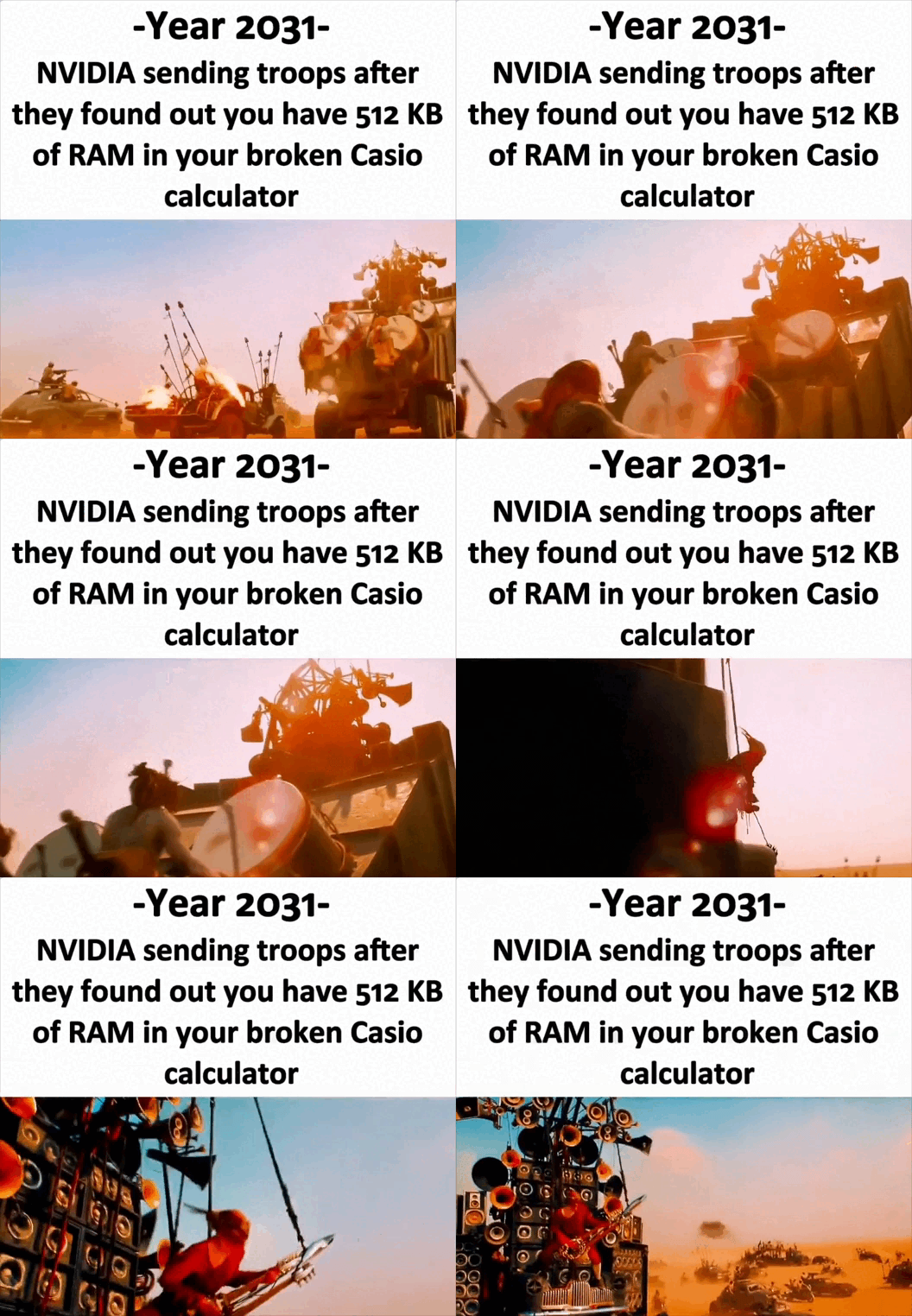
In 2025, the DRAM (dynamic random access memory) market will have completely lost its mind. Have you noticed that prices have skyrocketed by 80-170% in just a couple of months?
This isn’t some temporary spike, and that’s why I included this. Analysts are warning that by mid-2026, memory could get another 50% more expensive.
Of course, the main reason for it is the insane demand from the AI industry. Manufacturers have aggressively shifted their production capacity toward premium chips for data centers and HBM memory that companies like OpenAI are gobbling up. As a result, regular DDR4 and DDR5 for PCs are in deep shortage, and server orders are only being filled at about 70%.
Moreover, Dell and HP openly admit they’ve never seen price growth like this; SK Hynix has sold out all its stock for next year. Taiwanese sellers now only sell memory if you buy a motherboard with it.
I’ve already seen plenty of complaints from gamers about doubled prices, tech manufacturers are postponing releases, and cutting memory specs in their configs. Expanding fabs will take at least a year and a half, so the shortage isn’t going anywhere.
AI and Politics
We saw all the major tech CEOs lined up at Trump’s inauguration, the Musk-Trump drama, and Durov’s arrest in France. I know that all of this is more broadly connected to the tech sphere, but the AI sphere is its natural extension, and in 2026, it will actively shape who gets heard, how algorithms work, and which politicians can reach their audiences.
Governments are no longer just watching from the sidelines, they’re grabbing the steering wheel.
AI has become the new battlefield, where questions of security and national interests are already emerging. Washington is rolling out a $500 billion “Stargate” strategy, essentially using Nvidia’s dominance to create an exclusive tech club for allies. China is countering this by building an “Open Silk Road”. This time, Europe is stuck in a loop of endless paperwork. The EU is busy fine-tuning the AI Act with a massive investment gap.
I will not be surprised if we start seeing politicians personally showing up to sign off on the next round of massive tech and AI corporate deals.
The AI Bubble Everyone’s Whispering About
Throughout our digests, we’ve discussed numerous deals between market leaders (OpenAI, Nvidia, Anthropic) that are genuinely creating some monopolistic trends. And…the whole thing is starting to look like a classic economic bubble.
Despite billions being poured into generative models and data centers, several companies now admit that actual commercial returns from AI are falling well short of expectations. Many startups are releasing nearly identical products built on the same models and APIs, while large corporations are reevaluating their AI strategies after costly pilots brought minimal impact.
In short, analysts are warning about a cooldown in AI investment coming next year. But it’s not going to be a collapse (not so dramatic).
Top Reads & Insights
We also wrote about many different tools and experiments. If you missed some of them, here’s a short list of posts that stood out the most:
AI-Native Workflows
How Cursor Can Be Your AI Assistant & Knowledge Base
ChatGPT Agent Tutorial: Automated Research for Creators
How Claude Code Can Be Your AI Teammate
Creator Tools
ComfyUI: Free Node-based AI Workflow Tool
Sora 2 Is More Than Just Memes
Nano Banana Pro: What Makes It So Powerful?
Vibe Coding (and others)
Vibe Designing: AI Workflows with Figma & Others
Useful tools ⚒️
Brief My Meeting - AI meeting briefs delivered to your inbox. Open source
Giselle - Build and run AI workflows. Open source
Inspiration by Mind Dock - Live AI trends from HuggingFace, ArXiv, GitHub, and more
Creaibo - Create 10x better content that sounds like you, faster
Friendware - Tab-to-complete everywhere on MacOS
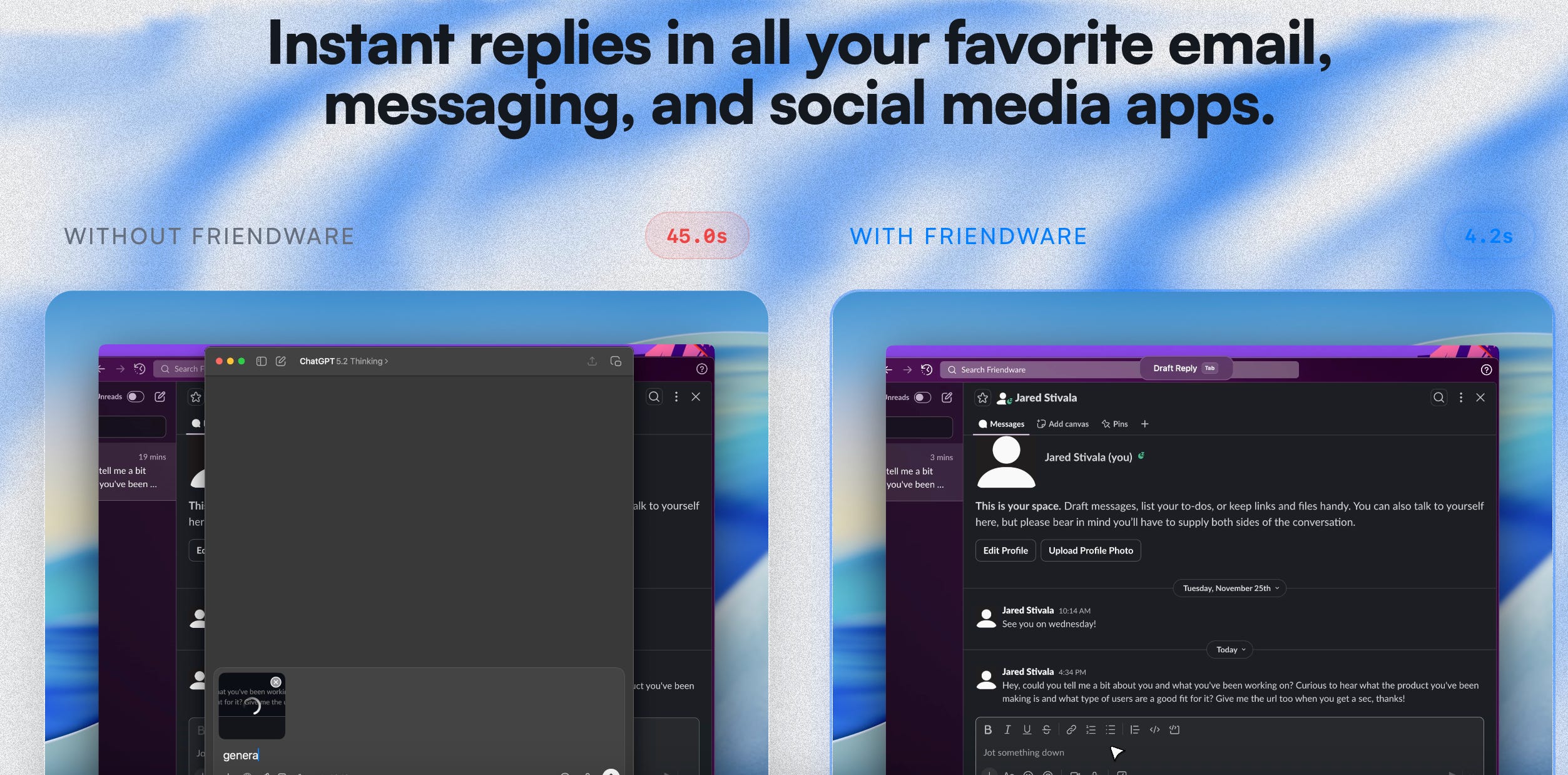
It acts as a proactive assistant that stays aware of your screen context. The idea is to stop wasting time on copy-pasting or re-explaining things to an AI.
Weekly Guides 📕

Make a Full 3D Cartoon Animation with FREE AI (Consistent Characters + Lip Sync)
LLM Benchmarks Explained: A Guide to Comparing the Best AI Models
Claude Opus 4.5 Tutorial for AI Agents and Coding
AI Meme of the Week 🤡
AI Tweet of the Week 🐦
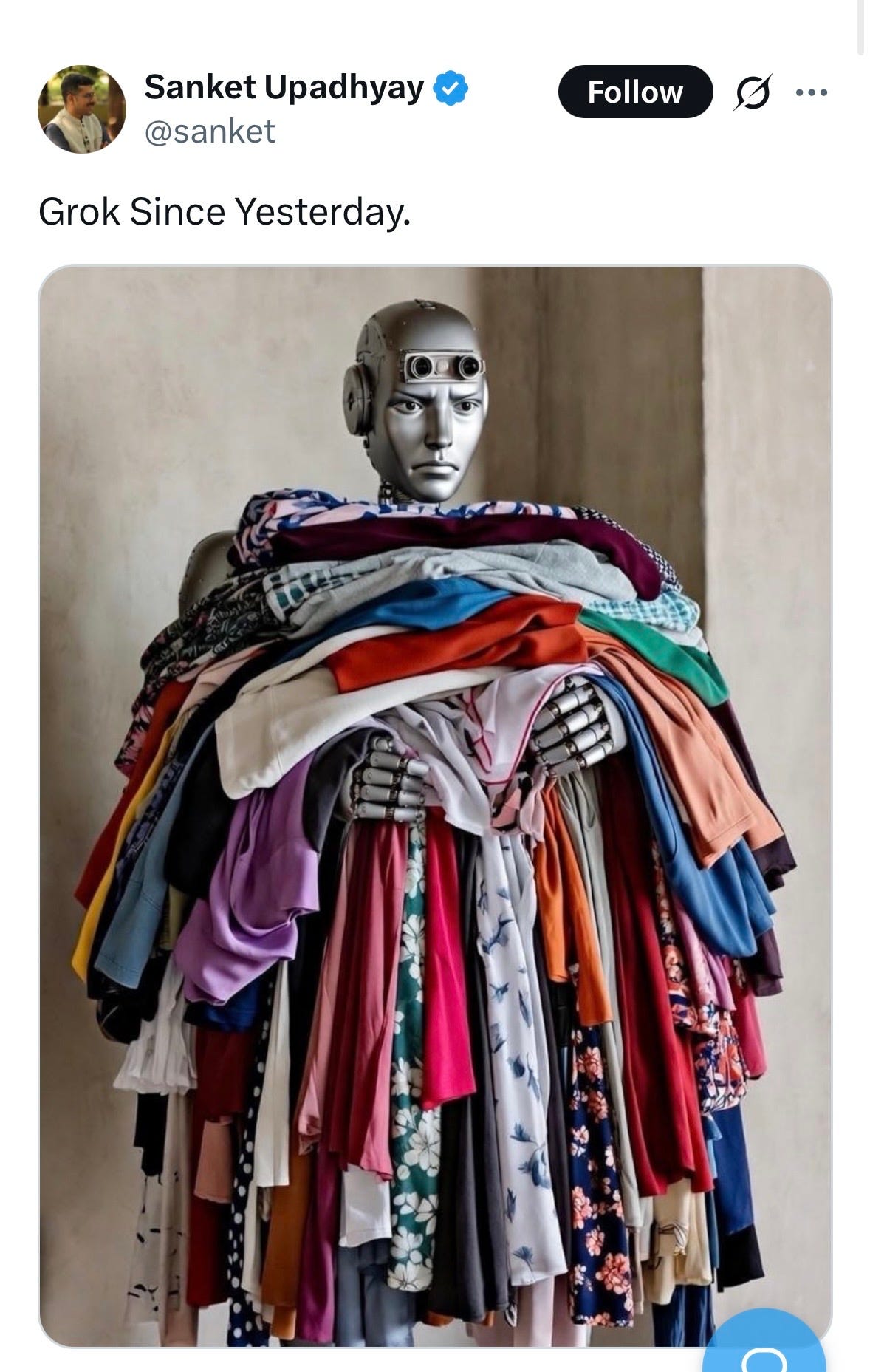
A crazy thing is happening in X (Twitter). Everyone is asking Grok to tweak pictures:
Bonus Materials 🎁
Gen AI Website Traffic Share - to find out how traffic share is shifting across GenAI platforms
AI Slop Report: The Global Rise of Low-Quality AI Videos - to read how AI slop is flooding global video platforms
AI Trends 2026: Quantum, Agentic AI & Smarter Automation - to explore groundbreaking trends and how they transform the industry
Where Is All the A.I.-Driven Scientific Progress? - to discover why AI probably won’t cure diseases anytime soon.
What’s next in AI: 7 trends to watch in 2026 - to check predictions from Microsoft
Four Predictions For How AI Will Change Software in 2026 - to listen to about how software will be built, who will build it, and what it will take for truly autonomous AI agents to become a reality
Thank you so much for featuring Giselle in your tools roundup!
As one of the co-founders, it's incredibly encouraging to see our open-source AI workflow platform recognized here.
We just hit #2 on Product Hunt Daily, and support like yours means so much to our team.
Wishing you and your readers a fantastic 2026! 🙌