

Hello friends!
The year is coming to an end. I hope you’ve had many happy moments and discovered even more things that piqued your curiosity. We wish you a Happy New Year filled with joy and discoveries!
Now, it’s time to wrap up 2025 in the AI world.
If 2024 felt more like a niche phase for AI, 2025 was the year it fully went mainstream.
AI started fueling competition between countries, powering entire multi-agent systems, and moving way beyond simple copilots. What used to take years of learning: coding, design, systems thinking, is now accessible more than ever with AI.
Today, we’ll look back at our personal takeaways, share our views on the key tools and products that defined the past year, and, of course, outline our bets on what will matter going forward.
Jump in!
The New Year is coming! Thank you for being with us, and enjoy our New Year offer for Creators AI Full Access (limited time).
Creators AI’s Wrapped
2025 was an incredible year of growth for us as well!
You’ve been with us through all 132 posts and 139 emails we shared, and we’re grateful for that.
It appears that OpenAI ecosystem products were mentioned most frequently in our posts.
We chased trends all year, but AI Agents was the one that never cooled down.
Your favorite topic turned out to be Practical Guides, based on engagement.
You’re now 13,000 strong, and we want to thank you for reading, engaging, and exploring how AI is no longer just a tool but a thinking partner.
Here are our favorite posts of the year:
AI Agents & Automation
How Solopreneurs Are Using Full AI Agents
How Claude Code Can Be Your AI Teammate
Creator Tools & Creative Workflows
Higgsfield AI Tutorial: Style Control of your Videos
ComfyUI: Free Node-based AI Workflow Tool
Business & Startups
How Tiny AI Startups Are Scaling to $10M+ ARR
Building $600K/Mo SaaS in One Year
Now, let’s break down what actually left a mark this year, and what could’ve been better.
Company | Google
Last year, our favorite was OpenAI, which isn’t surprising. ChatGPT has become a household name for AI chat.
But every situation has its “one year later” moment, and Google forced OpenAI off from what seemed like the winner’s throne. That’s what the “Сode red” at the end of the year told us, actually.
At the same time, let’s be real, Google also entered this race under pressure from OpenAI. We already wrote in the post on Insights from the AI Report 2025 that Google’s search monopoly is under threat, and, I suppose, Google felt the heat.
We didn’t sleep on this race and kept a close eye on the products:
Person | Sam Altman
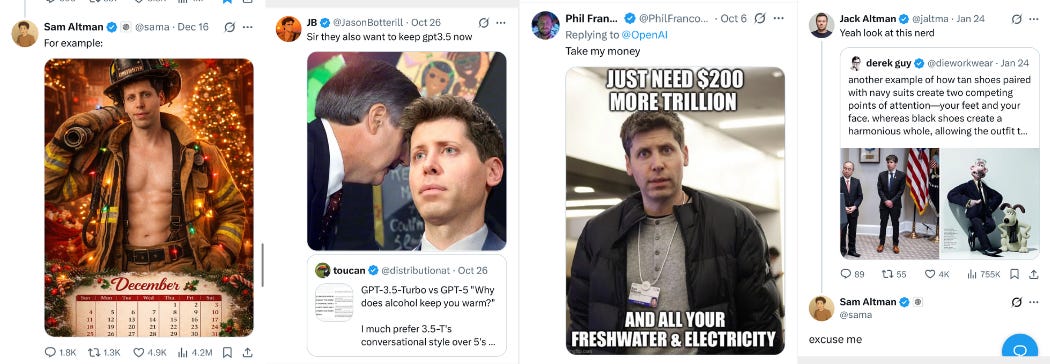
But even if OpenAI didn’t take first place, its CEO, Sam Altman, holds a special spot in the AI world. I swear I saw his face and memes about him on Twitter more than anyone else.
TIME magazine named him one of the 100 Most Influential People in AI 2025. But he’s not just OpenAI’s CEO. He’s changing the way people now interact with software. We can surely say this is the guy steering AI to become full-blown infrastructure.
Just think about:
Apps in ChatGPT + Instant checkout
Photo Generator | Nano Banana Pro
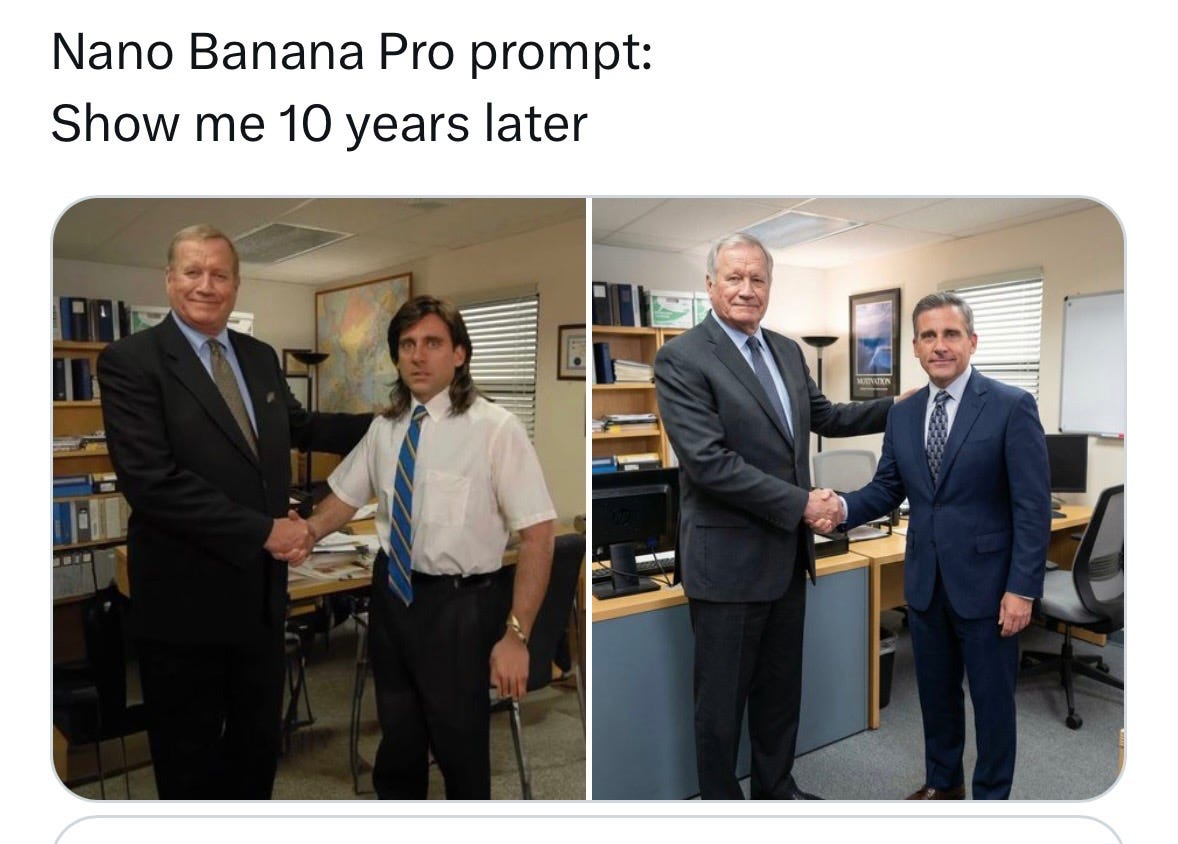
It’d be weird not to kick off with one of this year’s biggest spotlights, especially after all the noise about how it’s getting harder and harder to tell if an image is AI-generated. We talked about deepfakes before, but after Nano Banana Pro dropped, I seriously saw people feeling a bit lost.
Let’s hope this stays in the art lane, because it’s extremely powerful:
Nano Banana Pro nailed the text issue.
It makes outputs as natural as possible
The model pulls live data from Google Search.
We got way more control: tweak camera angles, shift focus, change aspect ratios, pick depth of field, even on existing photos.
It no longer messes up Chinese, Japanese, Korean (and other scripts that don’t look like English).
Check out this breakdown of what you can actually build with Nano Banana:

Video Generation | Sora 2
Both photo and video models were a bit too much this year. New releases dropped almost every week, and at some point, it just became noise. It’s hard to stay excited when everything updates nonstop.
But Sora 2 clearly stood out and sparked the biggest reaction. It wasn’t just a logical continuation of Sora; it also landed as an app, which changed how people actually interact with it. Under the hood, Sora 2 runs on an upgraded DiT architecture with 3D-aware space-time attention, and the results speak for themselves.
It ended up with 10M+ users in a single month via ChatGPT Plus, plus viral across TikTok and YouTube.
We’ve covered how the model works and how you can actually use it:
Sora 2 Is More Than Just Memes
A Startup and New Technology | 1X
I’ve seen LinkedIn crown Perplexity as their Top Startup of 2025; some folks are still giving the trophy to Lovable.
For me, it goes to whoever made me stop scrolling and feel excited. This year, that was 1X. They announced their home-first humanoids (NEO), which was kind of insane for me.
What the real breakthrough is:
1. Consumer-first
2. Safety as a core design constraint
3. It’s that the model is learning through a body, inside real homes.
Discover more in this piece:

In 2026, 1X plans to bring NEO into real customer homes through a wider Early Access rollout. So, we’ll keep you posted about what the new year will bring us.
LLM | Gemini 3 Pro
Gemini 3 Pro is Google’s flagship LLM. It’s the latest generation that rolls everything from versions 1, 2, and 2.5 into one model and nails everything from high-level tasks to photorealistic image gen. Google is calling it their smartest and most fact-accurate AI so far.
This year we saw a lot of models. No, wait, A TON of models. And since I’m way more used to reaching for ChatGPT (and I’m guessing you are too), you can’t help but benchmark everything against it. But ChatGPT 5.1 actually received noticeably more negative feedback than Gemini 3 Pro. And that’s saying something.
