


Hey there!
I wanted to write about the topic for a while since my stack is constantly changing. Writing this edition, I am testing and have already tested more than 10 different new agentic tools.
Last month, Zoë Schiffer's AI assistant noticed Alaska Airlines had moved her flight 90 minutes earlier. She hadn't seen the change. It made her eligible for a full refund, so the agent cancelled the ticket, got about $550 back and rebooked her flight home.
It also cancelled her delayed DoorDash order, even though she'd said to cancel only if she got a refund. She lost $64. The assistant apologized. Profusely.
That's personal AI assistants in October 2026, all in two texts: pretty magical, and a little terrifying.
I spent the past week reading hundreds of posts, reviews and benchmark threads from people who gave these things access to their inbox, calendar and credit card. So, what's actually happening?
Nine months ago, a hobby project called Clawdbot went viral because it lived in your messenger and could actually do things. We covered it then: Clawdbot: the viral AI agent that lives in your messenger.
Now Meta, OpenAI, xAI and Anthropic all have one. A startup that's barely half a year old is valued at $10 billion. And one guy in California is testing the same tasks on 29 assistants to see which one is worth texting.
Have a seat. This is going to be interesting :)
At a Glance
In today's issue:
How personal assistants became the hottest market in AI in ~10 weeks
The money: Instinct's $1B round, Town's unicorn, and 20+ startups raising
My own setup: what Town does for me
The benchmark: who actually performs (spoiler: not the most expensive one)
What real users love and hate
Claude Duet, which launched last week
Which one you should try first
From Siri Jokes to a Gold Rush
Let's look at the timeline. It all happened very fast:
Jan 27: Clawdbot (later Moltbot, now OpenClaw) goes viral
Jul 29: Zuckerberg says "billions of people" will have personal agents within five years
Aug 11: xAI ships Grok Bot in beta
Sep 8: Meta launches Muse
Sep 28: Instinct raises $1B at a $10B valuation. Same day, Fo opens to the public
Sep 29: OpenAI announces Dots at DevDay
Oct 7: Tab comes out of stealth at a $300M valuation
Oct 19: Town raises $108M at $1B
Oct 21: Anthropic launches Claude Duet
Four of the biggest AI companies in the world shipped the same kind of product within ten weeks. This doesn't happen by accident.
We followed the OpenClaw story from day one: Moltbook and the OpenClaw ecosystem
So why now?
Three things came together.
1. Every assistant now gets its own computer. Muse, Dots, Grok Bot and Claude Duet all run on their own cloud machine, with a browser. Your laptop can be closed and the agent keeps working.
2. The interface is a text message. You don't need to learn a new app. You text it like a friend, or a very patient intern. TechCrunch titled it "the AI agents that can live in your text messages."
3. They can spend money. This is the big one. More than a quarter of Muse users have bought something through it, with an average order above $200. Instinct says it's approaching $1B in annual transaction volume. Once an assistant can buy things, it starts looking less like a chatbot and more like a business model.
We wrote about where this is heading back in April: Agentic Commerce: the shift you can't opt out of
Eugenia Kuyda, the Replika founder who's now building Wabi, put it simply: the technology has finally caught up with what she pitched at TechCrunch Disrupt 12 years ago.
Keep your mailbox updated with practical knowledge & key news from the AI industry!
Follow the Money
Now let's get to the part that made me write this post.

Instinct: $10B and no user numbers
Instinct is a San Francisco startup founded by Noah Shinn. You can text or call it on iMessage or WhatsApp. It plans trips, orders groceries, cancels subscriptions and books dinner.
The funding path is wild:
August: $250M at a $2.5B valuation (Index Ventures, Benchmark)
September 28: $1B at a $10B valuation (Sequoia, Coatue, Benchmark)
That's a 4x valuation jump in about five weeks for a product that's still invite-only.
So what do we know about traction? Shinn said on the Invest Like the Best podcast that Instinct has spent $0 on marketing and is approaching $1B in annual transaction volume. Important detail: that's money going through the agent, for flights, hotels and groceries. It's not Instinct's revenue. The company hasn't shared user numbers.
Sounds pretty good, right?.. But then you read the fine print. TechCrunch flagged concerns about Instinct's security model and terms of service back in August. One VC also got banned from Resy after his Instinct pinged it about 200 times an hour while trying to get a table. 😬
Everyone else
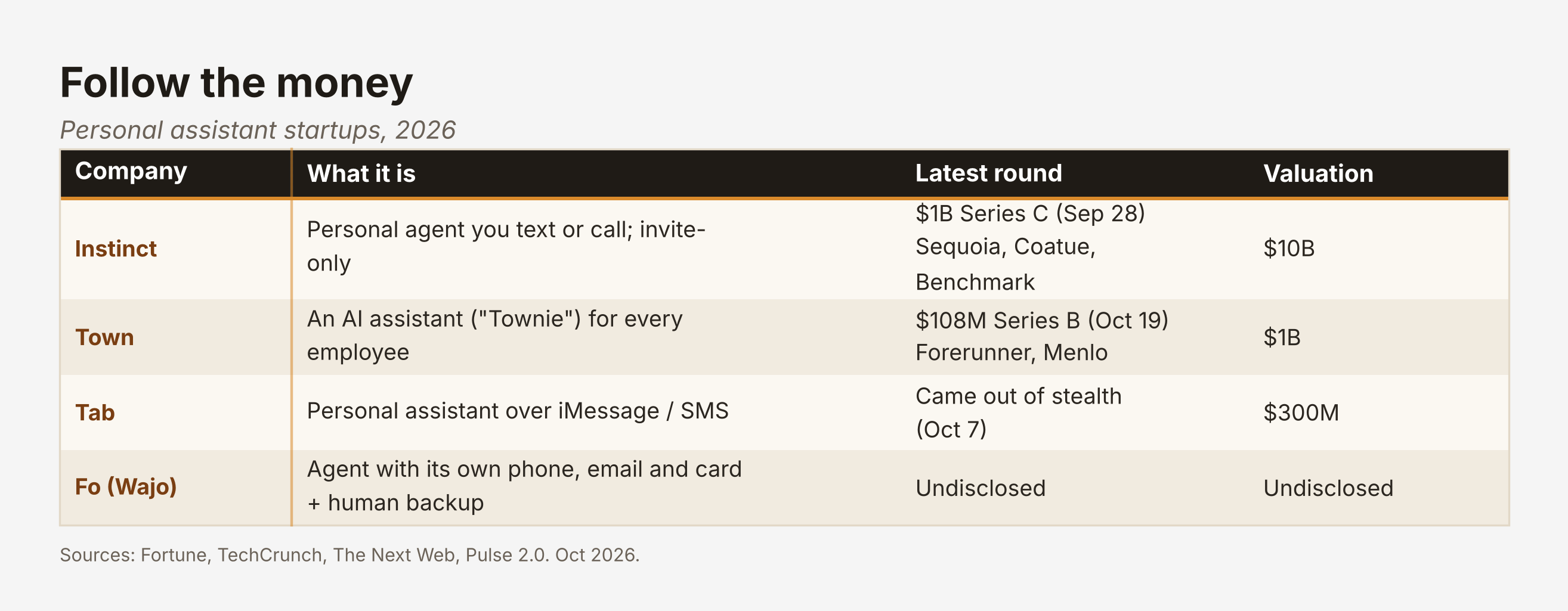
Dealroom counts 9 big-tech launches and 21 startups raising money in this category in 2026 alone.
The Players, Briefly
Muse (Meta)
Launched Sep 8, US only, 18+. 10M+ users in its first month, with about 25% using it daily. There's a free tier, plus $20 and $100 plans. Strongest at shopping. We covered it in Meta's Muse Wonder | Weekly Digest.
Dots (OpenAI)
Announced at DevDay on Sep 29. These are always-on ChatGPT agents, each with its own cloud computer. You need ChatGPT Pro or Business Premium, with no free tier. Good at email, weaker at tasks that need a credit card. More in OpenAI Ships Dots | Weekly Digest.
Grok Bot (xAI)
It's been in beta since Aug 11. You get a team of named bots that work in parallel and hand tasks to each other. It's bundled with SuperGrok and some Cursor plans. Good at chained tasks, not so strong on integrations. Launch coverage: Grok Ships 24/7 Coworkers | Weekly Digest.
Town
This one's less "personal" and more "work." Each employee gets a "Townie" connected to email, docs and calendar. The Townies can talk to each other, too. Four months after launch, it's a unicorn.
Fo (by Wajo)
Fo was founded by Shivani Poddar, who led engineering at Google DeepMind. My favorite design decision in this whole category: Fo has its own email, phone number and payment card, so you don't hand over your credentials. And if it gets stuck, a human assistant takes over.
Instinct
See above. It's invite-only. The best at running routines and being proactive. The worst at privacy, more on that below.
Here's how I'd sum them up, based on what users report:
Muse: the one to give a non-technical friend. Free, fast (7-second replies), great at shopping. Check the privacy defaults first.
Instinct: the most proactive. Early users call it "OpenClaw for normies." Also the one most likely to do something you didn't ask for.
Dots: more a coworker in Slack than a personal assistant. Great at email triage; payments "do not really work yet."
Grok Bot: the nerdiest. Best if you want a small team of bots running routines while you sleep.
Town: for work, not life. Fans love it (94% public opinion); critics say it rarely leaves email.
Fo: the one that picks up the phone. Slower (31-second replies), but it'll call FedEx so you don't have to.
Share this post with friends, especially those who still think AI assistants are just Siri with better grammar!
My Setup: Town
So which one do I actually use? Town. I connected several of my inboxes and calendars to it, and now all my routine sits in one place where the agent can see it. It analyzes what I do every day and turns the repeating stuff into skills (Town calls them Powers): a sponsorship tracker for Creators AI, a monthly subscription audit, a weekly news short, a weekly scan for speaker opportunities. And in the For You tab it keeps recommending what to set up next, like a weekly status note for every active client or a tracker for our guest-column pipeline.
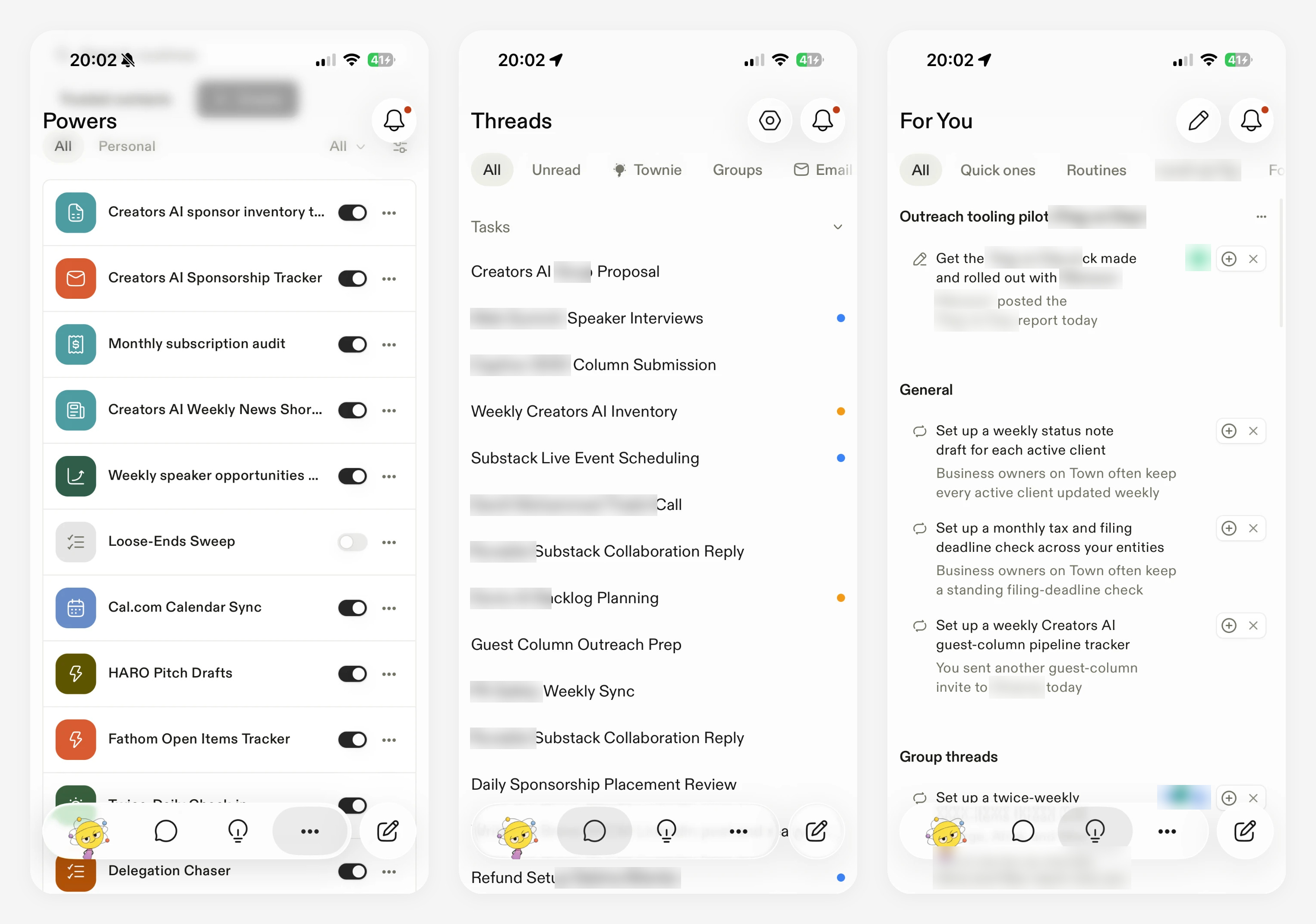
Then it started doing the talking. My Townie now handles the inbound traffic for me: it replies to incoming requests, keeps the communication going and moves deals forward, from sponsorship placements to collaboration replies. Which is kinda funny, because the main complaint I found about Town in user reviews was that it rarely leaves email 😁
If you want to try it, here’s my referral link to Town. Yes, it’s my ref link, and yes, I use Town myself, so I’m only recommending what I actually run my work on.
The Benchmark: Who Actually Performs
Every assistant demos a different task, so comparing them is hard. David Pawlan decided to do something about that with Assistant Benchmark, a free scorecard for “the assistants you can text.”
