


Hey everyone. Today’s post comes from a board advisor and investor who spends her days thinking about what actually creates durable advantage in an AI-first world — not in theory, but for the leaders and founders she works with.
At a Glance
In this piece, you will learn:
Why the model layer is no longer a competitive advantage — and what is
What taste, trust, and judgement look like in practice (with 5 real examples)
Three concrete moves to start building your own moat this week
This post is prepared with Guest Author — Raffaela Rein, founder of BoardLens and writer of The AI Leadership Edge. If you also want to write for Creators AI — send us email here
Marc Andreessen has been making this point for months: foundation models are commoditising fast, and the model layer is not the moat. If everyone using AI has access to roughly the same intelligence, what is left to compete on?

This is the question every creator now sits with. I write The AI Leadership Edge on Substack (for business leaders, investors and boards) and I am building BoardLens (intelligence for board directors and funds). So I spend a lot of time thinking about how to make a dent.
I believe the answer is:
Taste. Trust. Judgement.
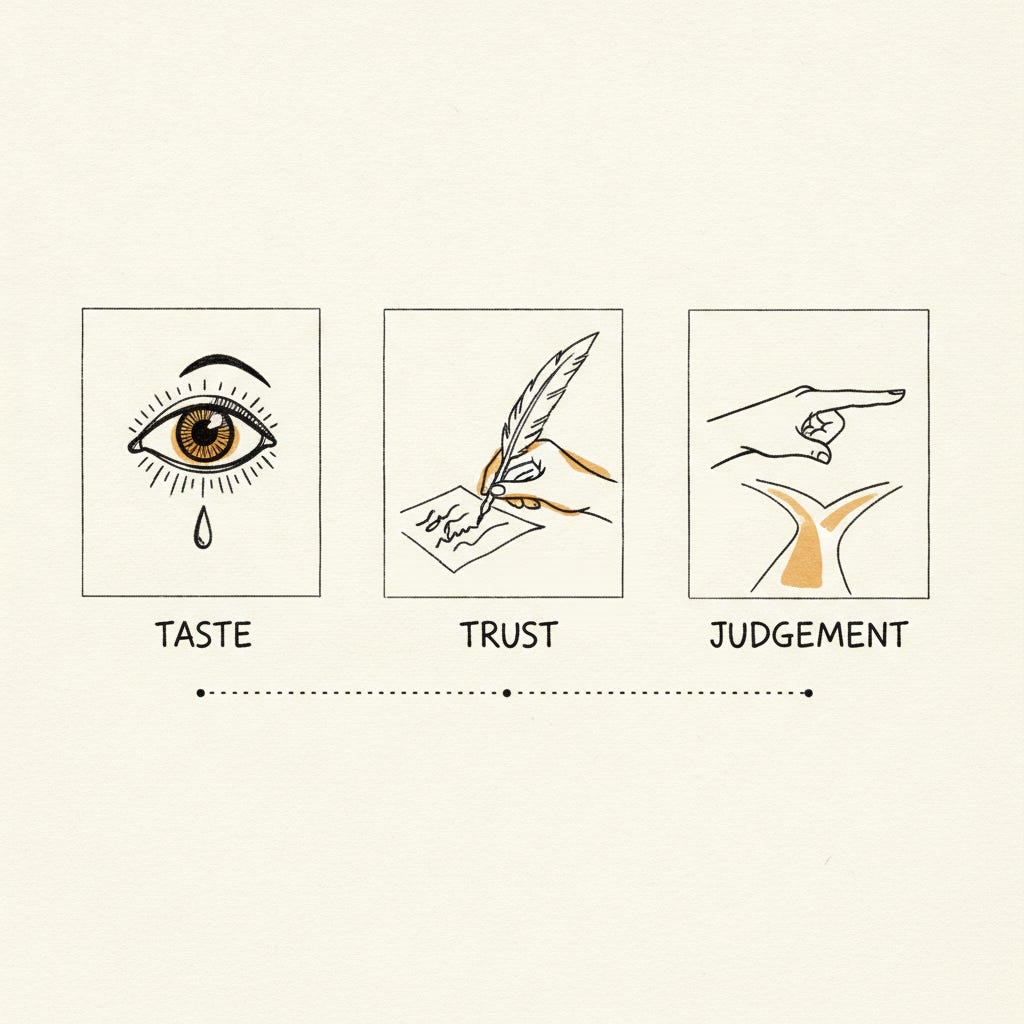
The thing that decides which writers still get paid in an age when anyone can generate a thousand passable words in thirty seconds.
This is not a soft answer. It is the only answer left.
What “the model is not the moat” actually means
Paul Graham made this argument earlier this year about technology more broadly. When the technical differences between products collapse, brand is what remains. He used Swiss watches as the case study. Quartz killed accuracy as a differentiator in the 1970s. The Swiss survivors stopped being precision instrument makers and became something else entirely: storytellers in metal and leather. The watches still tell time. That is the least interesting thing about them.
The same shift is happening to software, content and creators, all at once, in the same decade. Anyone with a Claude or ChatGPT subscription can now produce a passable essay, a workable app, a watchable video. The mechanical floor of “is this any good?” has risen. The ceiling of “is this yours?” matters more than ever.
What the moat looks like in practice
Look at where attention and money are sticking in 2026 and the pattern is consistent.
Ruben Hassid. There are thousands of AI tutorial accounts online. Most blur together instantly: same hooks, same recycled prompts, same “10 AI tools that will change your life” energy. Ruben’s edge is not access to secret technology. His edge is filtration. He consistently finds workflows ordinary professionals will actually use, strips away the technical clutter, and packages them into clear, usable actions. Every post passes the same test: would a senior leader who has never opened ChatGPT be able to use this by Friday morning? He understands where the friction really sits for non-technical users. That is taste, applied weekly, in public.
Shaan Puri. Shaan’s advantage is not information scarcity. Half the internet reads the same tweets and articles he does. His edge is pattern recognition. He spots ideas earlier than most, frames them memorably, and packages them in a way that feels obvious after he has said it. The moat is not the raw information. The moat is the lens.
Granola. There are dozens of AI notetakers, using similar transcription models hooked up to similar LLMs. Granola stands out because every detail — how it summarises, how the cursor moves, the moments where it stays silent during your meeting, the choice not to clutter your screen with assistant chrome — feels deliberate. It does less than most of its competitors, and people choose it for exactly that reason.
Linear. Not standing out because it has more features than every competitor. Quite the opposite. Its reputation comes from restraint, clarity and an unusually strong product taste. Keyboard-first, fast, opinionated, no bloat. In a category where competitors are racing to bolt AI onto everything, Linear holds attention by being more deliberate, not more crammed. Teams pick it not for what it adds, but for what it refuses to add.
Ben Thompson. Thousands of analysts cover tech. Very few have built the level of trust Ben has with executives and investors. Stratechery sits on the desks of senior operators because Ben’s frame for the day is the one they want loaded into their head before they walk into the meeting. The output is not “more information.” It is a frame they trust enough to act on.
These five are not exceptions. They are the shape of the next decade.
We’ve covered how the best creators are building systems that compound their edge over time: How Solopreneurs Are Using Full AI Agents
The fashion-house economy
There is a useful way to think about what this means in practice. The companies and individuals who compound year after year look less like classic startups and more like fashion houses.
A fashion house ships a new collection multiple times a year. There is no compounding product moat. What you showed last season is history. What matters is the next drop, and the next, and the next. The creative director at the centre does not do every job. They touch every decision, because the only thing that holds the brand together over twenty collections a year is a coherent point of view, executed at velocity.
That is what every creator building with AI is now doing. Every essay is a collection. Every product update is a collection. Every video, every tool, every newsletter is one more drop where your taste shows or it doesn’t. AI lets you ship more drops, faster. It cannot decide which drops are worth shipping. It cannot decide what makes them yours.
The brand age is not gentle. Speed is no longer optional. The creators who will compound over the next five years will be the ones who can hold a recognisable point of view at industrial volume. Taste plus velocity. Not one or the other.
Related: 4 Ways to Monetize AI Agents in 2026 — how creators are turning consistent POV into actual revenue
Share this with a founder who’s still trying to out-feature their competition.
Three moves to start this week
Theory is cheap. Three concrete moves that work whether you are a one-person newsletter or a venture-backed founder:
1. Write down your filter in one sentence. What makes something pass your bar, versus get cut? Ruben Hassid’s is roughly “would a non-technical professional actually use this on Monday.” Ben Thompson’s is roughly “would this frame change a senior operator’s decision today.” If you cannot name your filter in a sentence, you do not have one. Once you can, every drop gets sharper, because you stop guessing what to ship.
2. Cut your next drop in half. Then cut it again. The instinct in an AI age is to add: more sources, more sections, more features. Taste reveals itself in what you remove. Linear ships fewer features than its competitors on purpose. Granola does less than every notetaker on the market. The compression is the signal that something was chosen, not generated.
3. Sign every drop, and stand behind it. AI can co-write a paragraph, a function, a thumbnail. AI cannot stand behind a judgement. Every drop should carry a clear point of view your name is attached to. The test: would you defend it in a room of the five sharpest people in your space? If not, do not ship it. The signature, and the willingness to be wrong in public, is the moat.
Do these three for ninety days and something the foundation models cannot copy starts to compound: a reader, customer or investor who keeps coming back because of you, specifically.
Also read: Your AI Agent Stack Is Spaghetti — here’s how to fix it
The question for you
If you are a creator, founder or investor staring at the same models everyone else has, the question to sit with this week is uncomfortable but useful: in a world where the model is not the moat, what is yours?
Your taste, distilled into something only you would ship. Your trust, earned one drop at a time. Your judgement, used at the speed of the tools you now have.
Everything else is going to get commoditised. That part has already started.
What’s your filter? The one sentence that decides what makes the cut — drop it in the comments.
Raffaela Rein writes The AI Leadership Edge, a Substack for 13,000+ leaders, directors and investors making sense of AI in the boardroom and on the cap table. She is also building BoardLens — intelligence for board directors and funds.
Thanks for featuring my humble thoughts :)