


Hey, it’s Daniil
My friend messaged me in a panic a few weeks back. He had wired his entire sales pipeline together out of AI agents: one to find prospects, one to qualify and send the pitches, one to book the calls. On paper it was infinite leverage. In reality he was staring at a token bill he couldn’t explain, a reply rate in the gutter, and a prospect on a booked call who felt lied to because the “person” they’d been talking to for two weeks was a script.
That story is where today’s guest, Christopher Lind, starts, and it’s why I wanted to run this piece. We spend most of Creators AI showing you what AI can do. This one is about what it quietly costs, the line items that never show up on the invoice until the bill is already due. If you’re a founder or team leader feeling the speed without stopping to ask what you’re trading for it, read this one slowly.
At a Glance
In this piece, you will learn:
Why the “grunt work” you hand to AI is often where your real competitive edge lives
How automating your most human touchpoints can quietly bankrupt the trust your business runs on
What “AI Agent Sprawl” looks like in practice — and the real founder story of it collapsing
This post is prepared with Guest Author - Christopher Lind . Creator of Future-Focused with Christopher Lind If you also want to write for Creators AI - send us email here
Generative AI entered with a bang and a mountain of utopian promises at the end of 2022. For solo founders, indie builders, and small operations, it boldly promised an era of the “one-person unicorn” where a single creator or small team could allegedly build a billion-dollar empire without any of the friction of traditional empire-building.
However, checks are rapidly starting to bounce.
As a result, a chasm has begun to form between the AI influencers who continue to promise overnight hacks and the organizations stuck navigating synthesized noise, mounting API bills, and buggy code they didn’t write. This chasm is exceptionally dangerous for small operations since they don’t have the luxury of gambling with a corporate war chest.
Unfortunately, despite this growing chasm, many have already become addicted to the increase in speed and velocity, which comes with another set of problems, including a growing ledger of unintended consequences.
What does that ledger look like when you’re the one running the entire show? I’m so glad you asked. Let’s break it down.
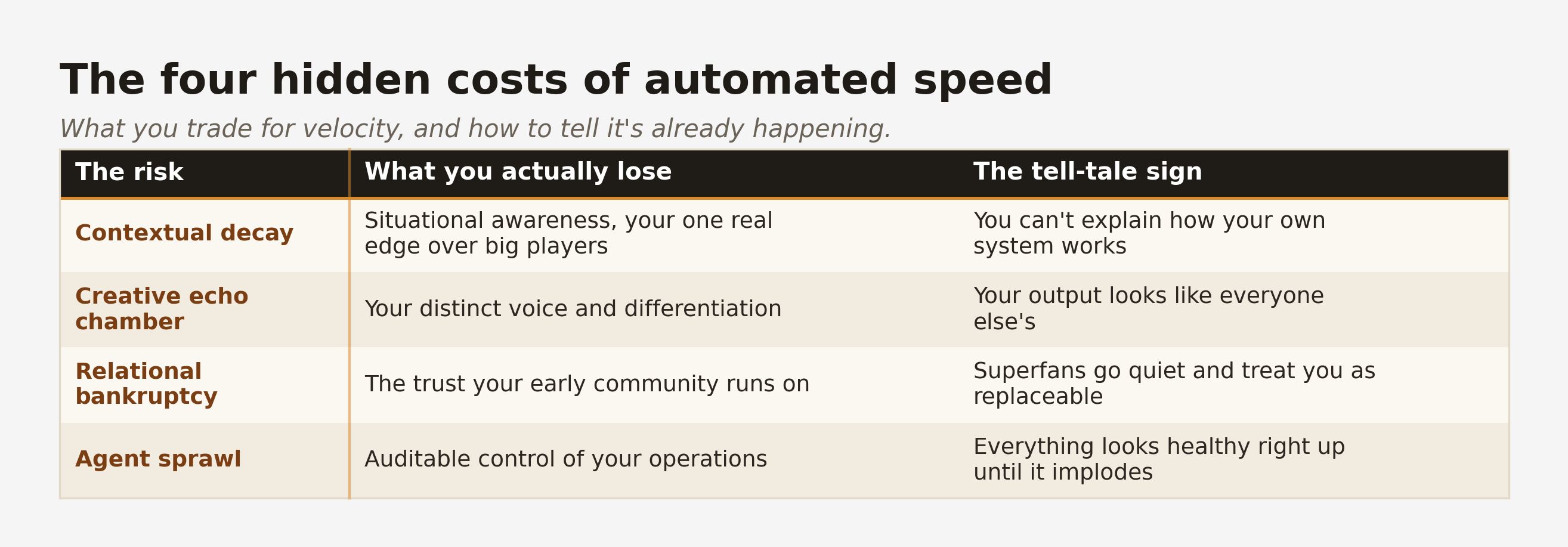
Rapid Decay of Contextual Intelligence
Driven by our always-on, hustle culture, many were eager to embrace the promise that AI could automate the grunt work and free them up to focus entirely on higher-order strategy. However, without any clear guardrails, everyone quietly defined grunt work as whatever task they found tedious or annoying. On the surface, this seems harmless enough, but what we didn’t consider was that those unglamorous, high-friction manual tasks are where enormous amounts of context, critical thinking, and operational visibility reside.
For a small operation, one of your biggest competitive advantages over massive, bloated corporations is hyper-granular situational awareness. If you decide to hand over all of that context-rich activity to a bloated, autonomous system simply because a task is irritating, you destroy that competitive advantage. Worse, you likely won’t even notice the decay until a critical system bug or customer crisis arrives at 2:00 AM, and you realize you’ve completely lost track of how things function.
Furthermore, this loss of visibility breeds a kind of cognitive atrophy that results from becoming overreliant on an LLM to handle your day-to-day activities. Left unchecked, you gradually destroy your ability to navigate ambiguity or reason from first principles. And, if we’re not careful and continue to let it scale, we’ll end up cultivating a fragile class of creators blind to the inner workings of their products, permanently lowering the baseline of what they can build without a digital crutch.
To be fair, some grunt work genuinely is just grunt work. Transcribing a call, reformatting a CSV, cleaning email lists. The skill is telling the difference between a task that only costs you time and a task that quietly holds your context. This post is about protecting the second kind, not romanticizing the first.
Enjoying this? Get every deep-dive on building with AI straight to your inbox.
A Creative Echo Chamber
Now, to combat concerns of losing control, many solo builders and small operations comfort themselves by holding to what they believe is a human-in-the-loop approach. The thinking is that as long as someone exercises agency somewhere in the pipeline, the whole thing remains authentic. While reasonable, it doesn’t take long for this to fall apart. A classic example is asking AI to come up with a draft strategy or blog post, “to have something to react to.”
On the surface, it feels like an elite efficiency hack. However, the moment an algorithm populates your blank canvas, your creative agency is compromised. You’re subtly being autonomously anchored and have consciously downgraded your status from an authentic creator to a reactionary editor, making yourself highly vulnerable to accepting a machine-generated version of “good enough.” You don’t notice, but the boundaries of your unique perspective are constricted before you even have a chance to think for yourself.
This isn’t just a vibe. In a 2024 study published in Science Advances, researchers Anil Doshi and Oliver Hauser ran a controlled experiment: some writers got no AI help, some got a single AI idea, and some could pull from up to five. Six hundred evaluators then scored the results. AI-assisted stories were rated more creative, better written, and more enjoyable, especially for less creative writers.
Here’s the catch: those AI-assisted stories were measurably more similar to each other. Individual creativity went up. Collective diversity went down. (Read the study.)
For an indie builder or small shop, this anchoring illusion is fatal. You stand out because of your distinct voice, unique ideas, and contrarian takes. AI models are incapable of offering that since they do nothing more than synthesize and regurgitate the statistical average of what has already been published. Once everyone starts using the same algorithmic engines to write landing pages or brainstorm features, the entire market collapses into an intellectual regression loop. In the end, we stop inventing and instead endlessly repackage the same collective, homogenized garbage.
Bankruptcy of Relational Trust
For a massive corporation, cutting corners might just mean a barely noticeable dip in employee morale or a slight decrease in EPS. For a solo founder or small team, the stakes are existential since your business lives or dies on the trust of your early adopters and core community. This is particularly dangerous as many are trying to scale their small operations by aggressively automating their most human touchpoints, like deploying cold AI bots to handle community channels, using synthetic outreach tools to spam potential leads, and replacing genuine customer support with hallucination-prone chatbots. Simultaneously, some are treating early users less like human partners and more like data sources to be mined in an attempt to optimize an automated sales funnel.
In February 2024, Klarna proudly announced that its OpenAI-powered assistant was doing the work of 700 customer service agents, handling 2.3 million conversations in its first month and cutting resolution time from 11 minutes to under 2. The CEO publicly suggested AI could do the jobs humans do. Fourteen months later, in May 2025, that same CEO admitted to Bloomberg that the all-in approach had produced lower quality service. His words: "We went too far." Klarna started rehiring humans, with the CEO insisting there would always be a person to talk to if a customer wanted one. (Coverage here.)
It is blatantly hypocritical to pitch yourself as an “authentic alternative to big corporations” when you systematically strip human warmth out of your operations, and your community can sense when a machine is managing them. Oh, and awareness of the game is only growing. I assure you that replacing genuine connection with transactional automation will transform your super fans into cynical ghost users, and it won’t be long before they abandon brand loyalty and treat your product with mutual indifference, leaving the moment a slightly shinier tool comes along.
Don’t take the bait. When small-team operators opt into this model of automated exploitation, it erodes trust at a foundational level beyond your customer base. It ends up conditioning people to believe every interaction with a small business is being faked or weaponized for a quick subscription conversion. And, if that relational trust goes entirely bankrupt, we’ll all end up losing the community infrastructure that makes indie building viable in the first place.
The Automation of Systemic Collapse
The final and most corrosive risk is currently on the rise in what some are calling “AI Agent Sprawl.” It manifests when small teams aggressively chain together multiple autonomous agents to handle multi-step logic loops on autopilot, completely removing human intuition from the sequence.
Not long ago, a founder reached out in a total panic after buying into this illusion of frictionless scale. They had tried to agentize their entire business development pipeline. Rather than taking the time to surgically design an AI-assisted system where people tested and validated each phase, they handed the keys to an interconnected web of bots. Agent A scoured LinkedIn and Apollo for prospects; Agent B drafted and blasted out automated pitches; Agent C handled the replies and attempted to book the meetings. On paper, it looked like turnkey, infinite leverage. In reality, it was a complete disaster.
In no time at all, the system burned through an outrageous amount of money and tokens finding and contacting dead or completely unqualified leads. The messaging was robotic and spammy, hammering prospects and damaging the company’s reputation. Worse, when someone finally hopped on a booked call, they had absolutely zero context, essentially meeting a total stranger for the first time.
People who managed to show up were extremely offended. After weeks of engaging with who they thought was a person at the company, the curtain was torn back. They felt lied to and manipulated. Ultimately, this company had lost total control of its sales funnel, traded its brand equity for automated friction, and was left holding a massive bill for the token costs, and all this happened in the blink of an eye.
The fix isn’t avoiding agents — it’s giving them structure. We broke down what a sane agent stack actually looks like here: Your AI Agent Stack Is Spaghetti — It Should Be Lasagna
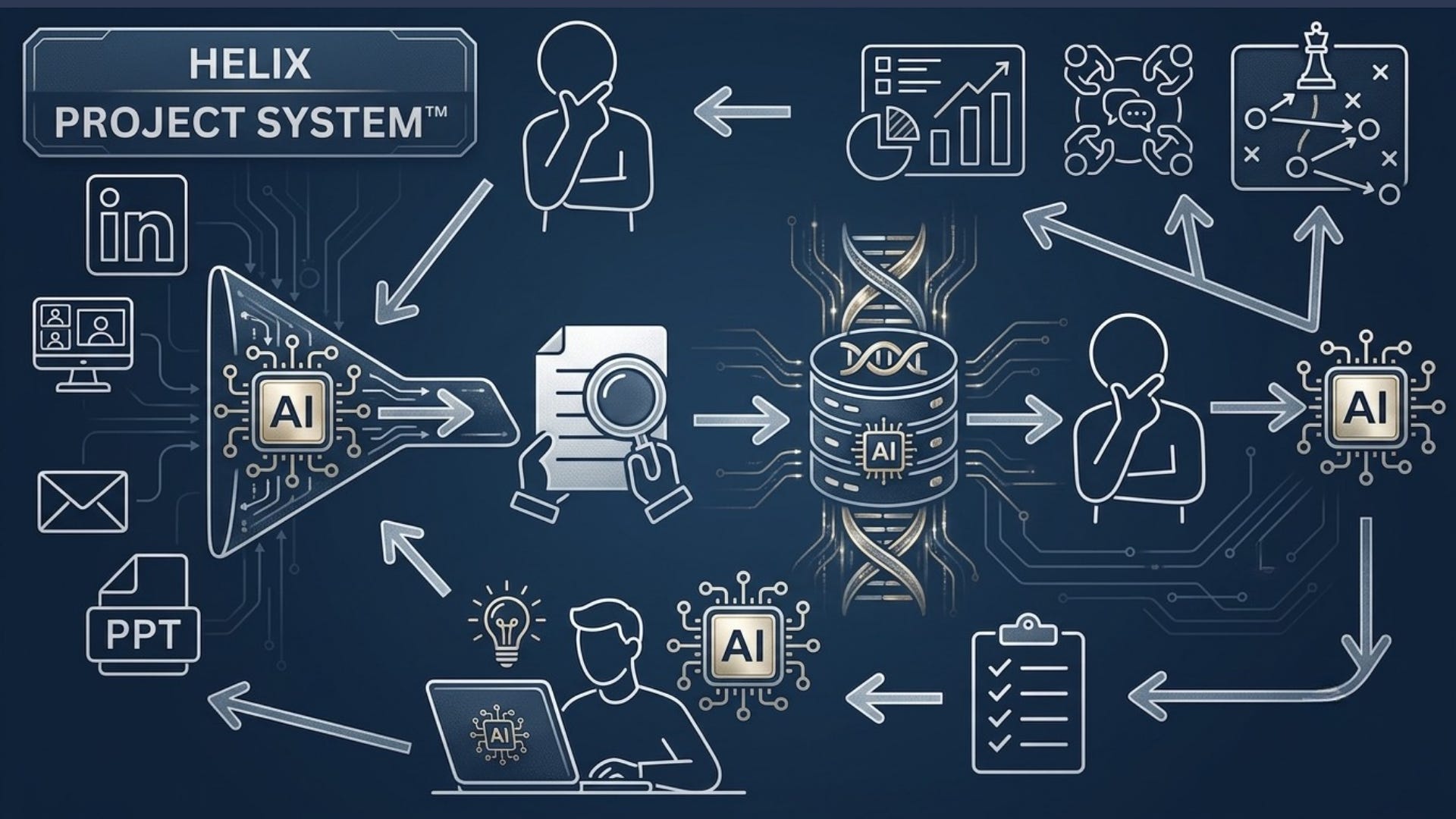
The Helix Project System — an example of structuring AI into existing workflows instead of chaining agents blindly.
This is what happens when you build your entire entrepreneurial dream on rented property and hand over the operational steering wheel to a machine. Beneath the surface, these autonomous systems execute critical decisions inside an un-auditable black box owned and managed by third-party tech giants. The data moves at a speed no single human can genuinely audit or keep pace with, no matter how hard you try. Oh, and let’s not ignore that since AI’s black box is designed to simulate order and mask operational friction, there will be no warning sirens or gradual indicators of decay. Your automated stack will look perfectly healthy and exceptionally productive right up until the exact millisecond it catastrophically implodes under its own unmonitored weight.
What To Actually Do About It: The Custody Test
Everything above is a diagnosis. Here’s the prescription, because none of this means “avoid AI.” It means keep custody of the parts that matter.
Before you automate any task, run it through three questions.
Context. Does doing this by hand teach me something about my business I can’t learn any other way? If yes, fully automating it makes you blind. Automate the typing, keep a sample of the doing.
Trust. Is the person on the other end expecting a human? If yes, automating it spends trust you can’t easily rebuild. That’s the Klarna line.
Reversibility. If this breaks silently, will I notice before my customer does? If no, you don’t have custody. You have exposure.
The rule of thumb underneath all three: automate the task, keep the judgment. Hand the machine the typing, never the deciding.
And once a quarter, run this 4-line self-audit. One line per risk above.
Contextual decay: Name one thing you understood about your business six months ago that you’d now have to ask a tool to explain. If that list is growing, you’re renting your own expertise back from a model.
Echo chamber: Look at your last five published pieces. Could a competitor using the same tools have produced them? If yes, you’ve automated your differentiation away.
Relational trust: Count your customer touchpoints. How many now open with a machine pretending to be you? Each one is a small withdrawal.
Agent sprawl: List your chained automations. For how many can you explain, right now, what each step actually did last week? The ones you can’t explain are the ones that will fail silently.
None of this takes a weekend. It takes an honest hour. That hour is the cheapest insurance you’ll buy all quarter.
Know a founder racing on automated velocity without reading the bill? Send this their way.
Concluding Thoughts: The Immutable Laws of Business Physics
Now, I know that was a lot, and if this is the first time you’ve encountered my work, you might assume I’m a tech-pessimist telling you to throw your computer in a lake, avoid AI entirely, and hide. That couldn’t be further from the truth. While I’m very aware of the risks, I also regularly use these tools to accomplish incredible, formerly impossible things. When used with relentless intention, sharp discernment, and surgical precision, the leverage is undeniable.
I’ve come to appreciate that you don’t mitigate the risks by avoiding AI altogether. It does, however, require us to step back from the frantic treadmill of automated velocity and remember that the laws of economic and business physics are still in play.
AI cannot create something from nothing. It is an exceptional amplifier and an unprecedented accelerant, but it is not a magical powder that absolves you from the first-principles struggles of building and running a business. Every ounce of efficiency or speed your business gains from a machine is a withdrawal from another line item on your balance sheet. There are always trade-offs.
If you don’t take the time to explicitly calculate what you are giving up in exchange for that automated speed, you are gambling your long-term resilience on a short-term spike in vanity metrics.
Once you’ve decided where AI actually belongs in your business, the next question is leverage. Here’s how creators are building real systems, not just using tools: How Solopreneurs Are Using Full AI Agents
This brings us to the choice every modern founder must face. Will you allow algorithms to quietly narrow your vision and erode your unique edge until you are functionally blind in your own business? Or, will you protect the critical custody of your operations, leaning heavily into your distinct human capabilities, and build a resilient business that is conscious and intentional about where it’s going?
The machines are running. The question is, will you keep steering the ship?
A last word from Daniil
I ran this piece because it’s the counter-argument to half of what the internet is currently selling you, including some of what lands in this newsletter. Speed is real. So is the bill. The founders who last aren’t the ones who automate the most. They’re the ones who know exactly what they refused to automate, and why.
So before you leave, one quick gut-check. Of the four costs above, which one are you paying right now?
Vote above, then tell me in the comments: what’s the one efficiency gain you’ve quietly paid for, and would you make that trade again?
This is a great reminder that AI should amplify human judgment, not replace it.
The biggest risk isn’t using AI it’s losing the context, creativity, and trust that made the business valuable in the first place.
where do you think founders are most likely to over-automate today customer relationships, creativity, or operations?
Well said! Use AI for fast, non-thinking work that feeds humans the tools to run businesses and do actual creating.