

Hey! Welcome to the latest Creators’ AI Edition.
Finally, late January is delivering some actual model releases. This week, Moonshot’s Kimi K2.5 and Alibaba’s Qwen3-Max-Thinking are both claiming to beat GPT-5.2 and Opus 4.5 on benchmarks, Moltbot is taking AI agents to the next level, Google’s weaving Gemini into Chrome, Figure dropped a unified neural system for humanoid robots, and more.
But let’s get everything in order.
Featured Materials 🎟️
News of the week 🌍
Useful tools ⚒️
Weekly Guides 📕
AI Meme of the Week 🤡
AI Tweet of the Week 🐦
(Bonus) Materials 🎁
Featured Materials 🎟️
AI Agent That Can Operate Your PC & Messengers
A developer named Peter Steinberger has released an open-source project called Clawdbot (now Moltbot after Anthropic asked them to change the name).
Clawdbot/Moltbot is an open-source AI assistant designed to run in the background and actively operate a user’s device rather than just respond to prompts. It can write code, process email, and control applications via MCP connections, acting as a persistent agent instead of a chat interface.
The main feature: Moltbot remembers project context and user preferences over time, adapts its behavior, and learns from past mistakes.
The agent is model-agnostic, allowing users to plug in models from OpenAI, Anthropic, DeepSeek, Qwen, Google, and others. It can be connected to virtually any messenger (Telegram, WhatsApp, Slack, Discord, Signal, and iMessage), where you can send commands and monitor progress from chat.
Covered this already, read here: Click
Chinese Monster Model
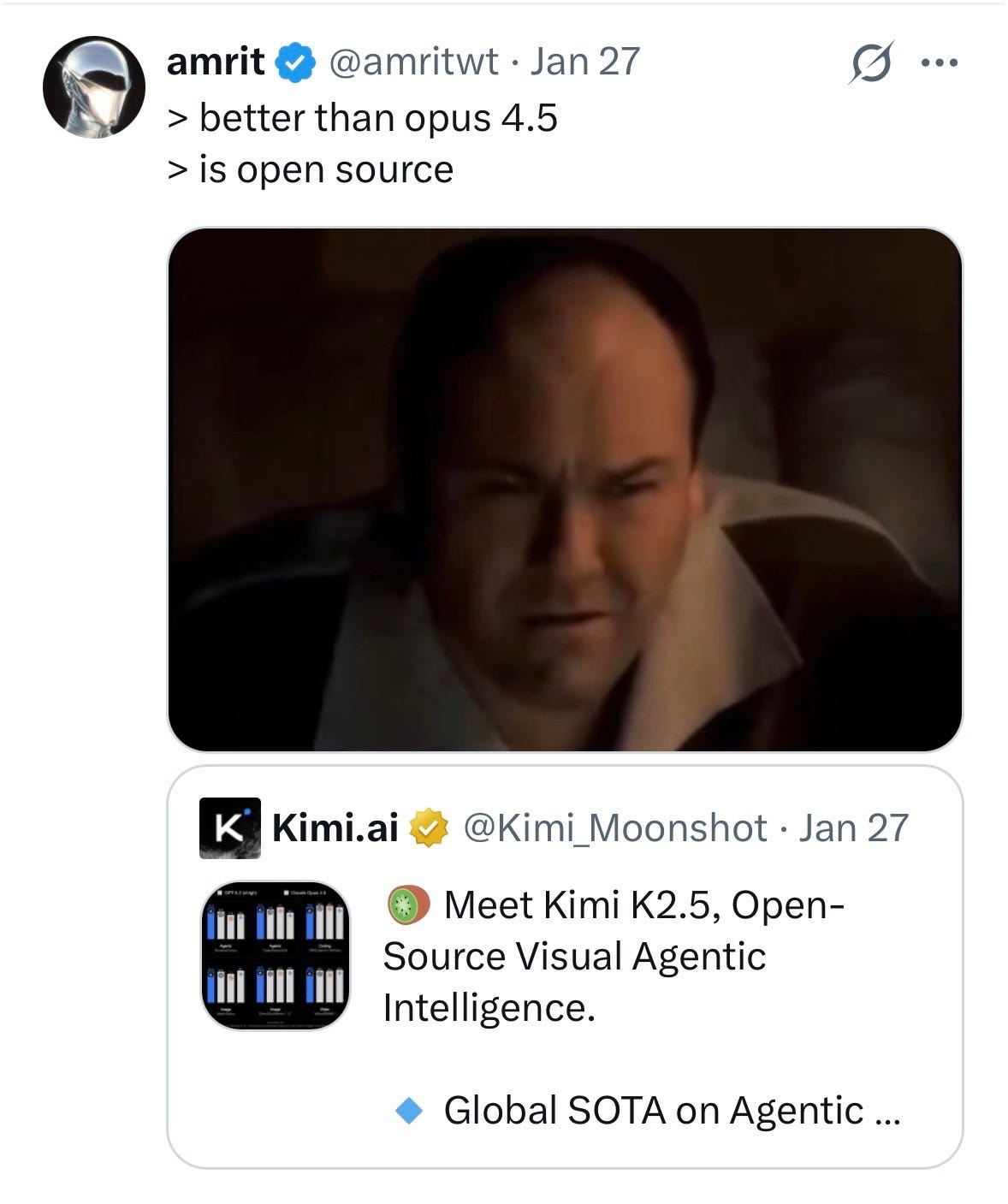
Moonshot AI released Kimi K2.5, an open-source multimodal model built for agent swarms, not just chat. What really caught attention is that, on several key benchmarks, it outperforms GPT-5.2 and Claude Opus 4.5 (well-well-well, it’s already sparked millions of memes on X)
Instead of one AI doing everything step by step, it can spin up to 100 agents in parallel and coordinate 1,500 tool calls, cutting complex tasks down by about 4.5×. It works with text, images, and video, can generate code from screenshots or screen recordings, and even fix UI issues by visually checking its own output.
You can try it in the Kimi chatbot (basic and reasoning modes are free), via API, or through Kimi Code, an open-source CLI/IDE assistant. The full Agent Swarm mode is paid (from $31/month), and the model weights are available on Hugging Face.
News of the week 🌍
Gemini Browser Assistant

Google has integrated its AI assistant Gemini directly into the Chrome browser. Now, Gemini can also understand what’s on your screen.
It can:
summarize articles and discussion threads
explain complex content, compare options
help with writing
In fact, the sidebar design and activation work just like Atlas.
What sets Gemini apart is its deep integration with Google’s ecosystem. It works across Gmail, Google Calendar, Maps, YouTube, and other apps. You pull flight details from emails, add events to their calendar, and draft messages in one flow.
Plus, Nano Banana can generate or modify images directly on a webpage without downloading files.
Google also unveiled auto-browsing, a feature that lets Gemini complete multi-step tasks on the user’s behalf, while pausing for confirmation before critical actions.
The assistant is already available for all Chrome users, but advanced capabilities, including autonomous browsing, are currently limited to Google AI Pro and Ultra subscribers in the U.S.
Another Chinese Model Claiming GPT-5.2 Performance
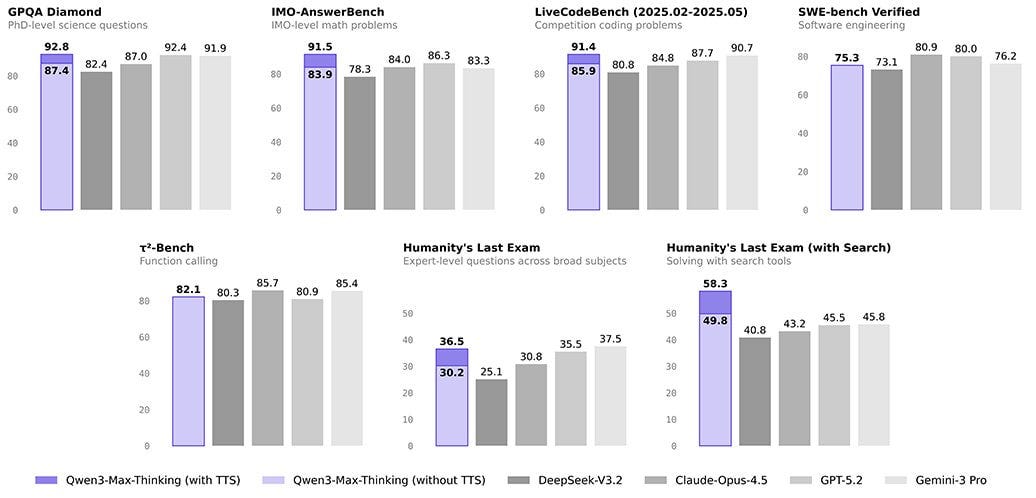
Alibaba presented Qwen3-Max-Thinking, their latest heavyweight AI, designed for deep reasoning, coding, and agent-style workflows.
It not only matches GPT-5.2 and Claude Opus 4.5 on core benchmarks, but the test-time scaling option lets the model reflect and iterate on its own reasoning like GPT Pro or Grok Heavy.
Qwen3-Max-Thinking comes with adaptive tool-use, so it can automatically pull info, remember context, and run code without your reminders. You can interact with it via Qwen Chat or plug it into your workflow through APIs that are OpenAI- and Anthropic-compatible, making it super flexible for coding, research, or multi-step agent tasks.
Google opens Project Genie
Google DeepMind just opened up Project Genie to Google AI Ultra subscribers in the US. It’s a web app that lets you generate interactive 3D worlds from text or images, and then actually walk, fly, or drive through them in real time. Unlike static 3D snapshots, Genie 3 (the model powering it) generates the environment ahead of you as you move.
You can sketch your world using prompts and Nano Banana Pro for fine-tuning, explore it from first- or third-person perspective, and remix other people’s creations. It’s capped at 60-second generations and runs at 720p/20-24fps, so it’s still early, but it’s a glimpse at where world models are heading.
So far, it costs $249.99/month (🤨) as part of Ultra, and there are limitations: worlds don’t always look realistic or follow physics perfectly, character control can be wonky, and some promised features like “promptable events” aren’t live yet.
Unified Brain for the Whole Robot
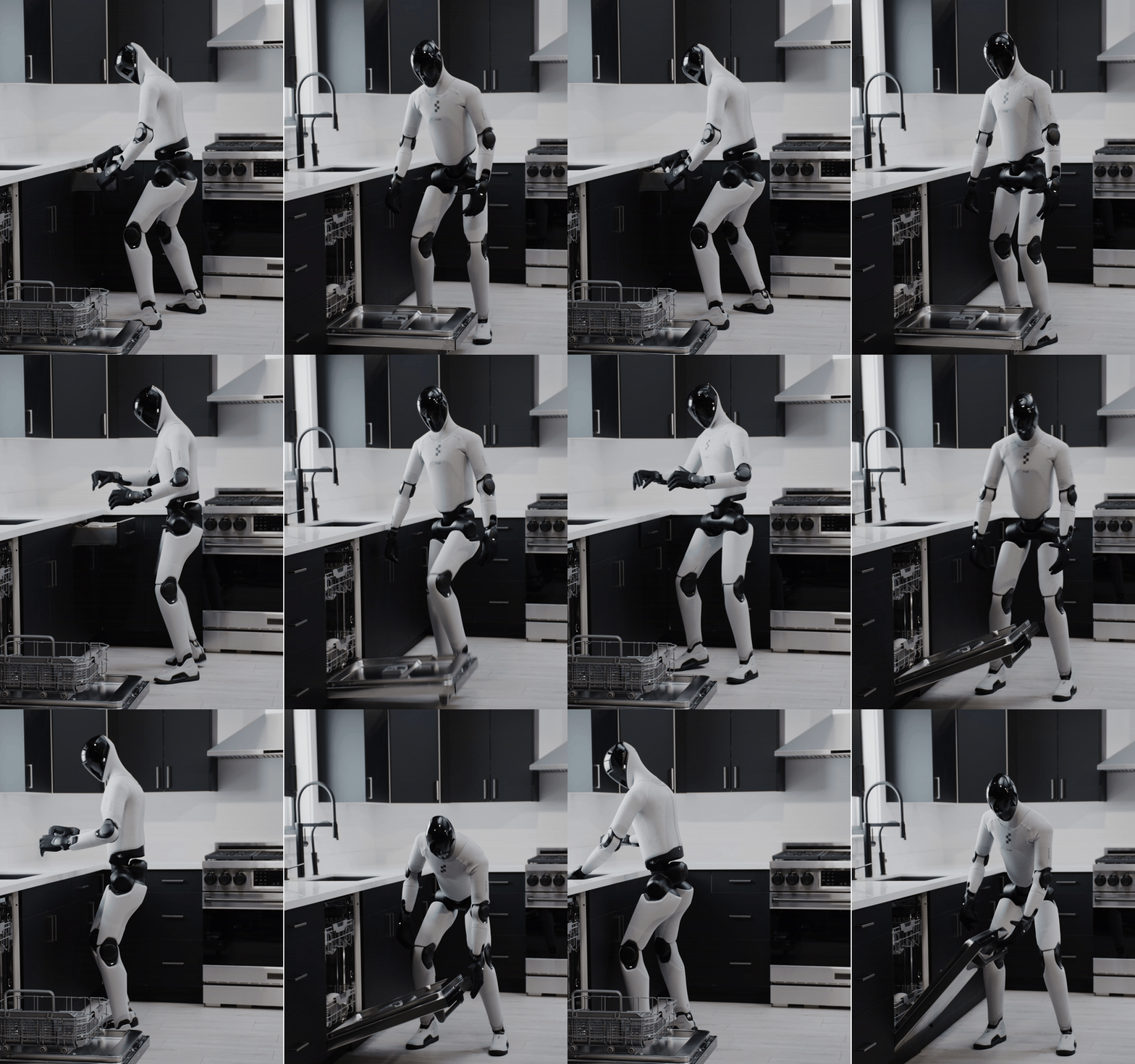
Figure’s Helix 02 takes humanoid robots to the next level by giving a single neural system control over the entire body.
Helix 02 unifies everything into one continuous system: it can walk, reach, grasp, and balance at the same time while performing multi-minute tasks like unloading and reloading a dishwasher. The company says it’s fully autonomous without humans in the loop.
The secret sauce is its three-layer architecture.
System 2 plans goals and interprets scenes
System 1 translates them into full-body joint targets, and the new System
0 executes precise motions at 1 kHz using over 1,000 hours of human motion data
With new hardware like palm cameras and fingertip tactile sensors, Helix 02 can pick up tiny objects, handle syringes, or sort cluttered items.
Autonomous Team on Your Desktop
MiniMax just dropped a full-fledged AI agent for the desktop that can handle computer work. We’re talking organizing and sorting files, creating graphics, writing social media posts, and publishing them, all on its own.
The interesting bit is that it can also spin up cloud AI agents and distribute tasks in parallel. One agent thinks, another executes, a third validates. It’s like having a little autonomous team running on your machine instead of just a chatbot that occasionally fumbles through basic tasks.
Useful tools ⚒️
Imagine - Build something real with the most complete AI builder
Pandada AI - Build data wealth: Turns files into McKinsey-level insights
Alfi - Group chat app that remembers plans and helps you meet IRL
The Prompting Company - Customers now get recommendations from AI, not Google.
AutoSend - Email for Developers, Marketers, and AI Agents
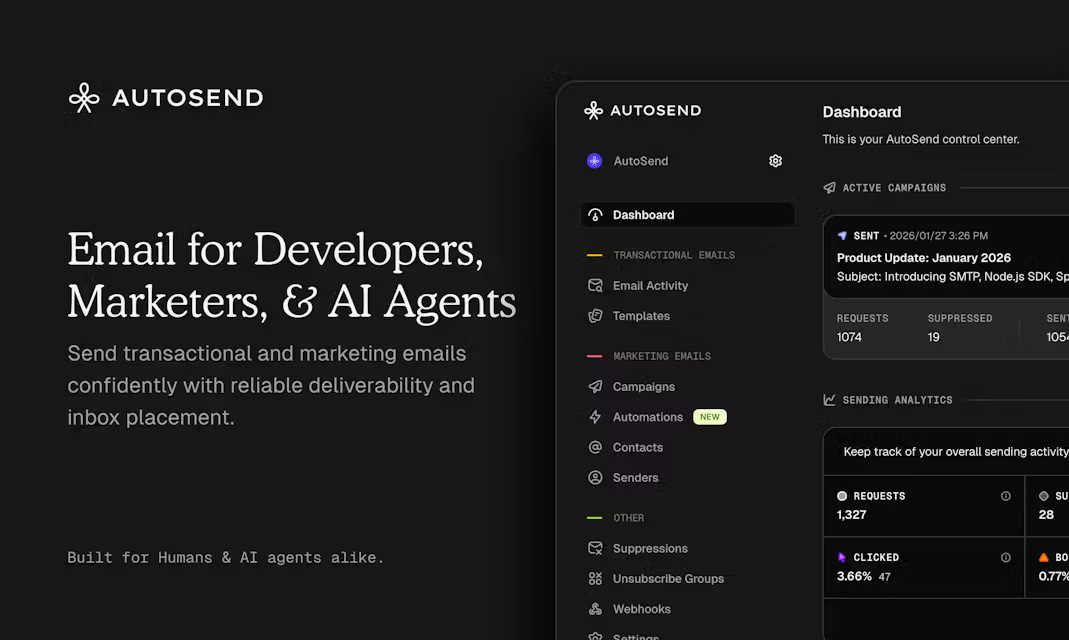
AutoSend is an email platform for devs and growing teams that makes it easy to send transactional and marketing emails without overpaying. You pay only for how many emails you send, not how many contacts you store, and it handles the annoying stuff automatically: validation, bounces, suppression.
Weekly Guides 📕

I Built an AI Influencer From Scratch (Full Guide)
I Played with Clawdbot all Weekend - it's insane
Claude in Excel: Anthropic’s AI Excel Assistant
AI Meme of the Week 🤡

AI Tweet of the Week 🐦

Bonus Materials 🎁
The assistant axis: situating and stabilizing the character of large language models - to discover how forcing models to stay in "assistant mode" cuts harmful responses by 60%
How Adaptable Are American Workers to AI-Induced Job Displacement? - to find out why programmers and analysts will be fine, but secretaries won't
Tech in 2026: Inside the Al bubble - to learn how the major LLM challenges will unfold this year