


Hey!
Today we’re digging into something that changes how we work with LLMs and the content they help us produce
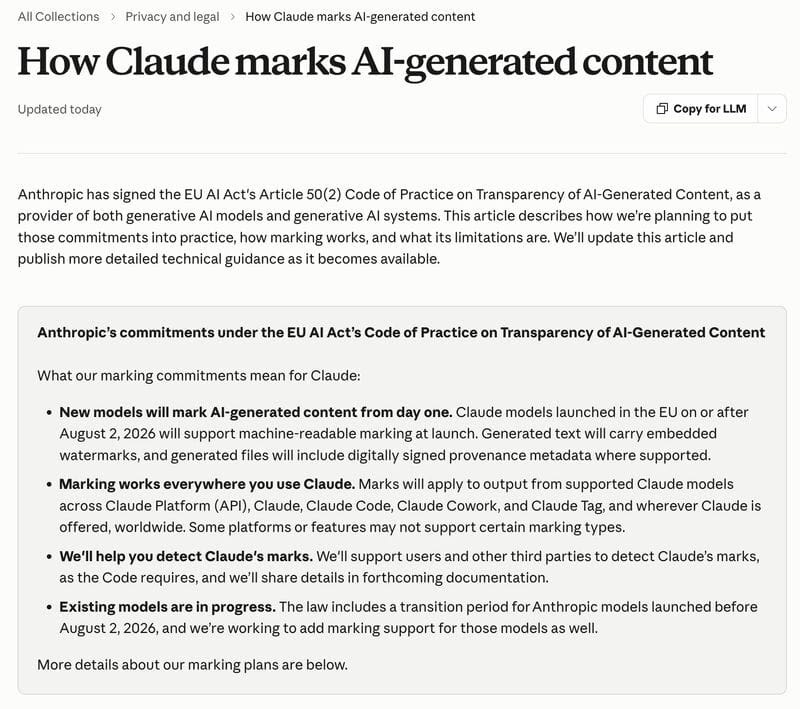
On August 2, Anthropic started adding an invisible AI watermark to content generated by its models. Quietly, without much fanfare, the company flipped a switch that affects every Claude user.
The internet’s reaction was entirely predictable.
“Can clients detect my writing now?”
“What if I paste it through Notion first?”
“Which humanizer removes it?”
Fair questions, all of them. But they’re slightly missing the point.
Anthropic is embedding invisible marks into supported Claude outputs as part of its EU AI Act commitments. Text can carry a model-level watermark that survives copy and paste. Supported image files can carry signed C2PA provenance metadata.
Here’s the catch: the mark is not a reliable authorship detector. Claude could have written the entire article, or it could have fixed three commas in a piece you drafted yourself. And right now, Anthropic hasn’t released the public detector you’d need to check the text watermark on your own.
So this is not the arrival of an AI lie detector.
It’s the arrival of a new kind of workflow risk.
For creators, agencies, ghostwriters, newsletter operators, and anyone selling AI-assisted work, the real question is this: what happens between Claude’s first draft and the file you actually publish?
Let’s break down what changed, why creators should care, and which removal methods people are already kicking around, from humanizers and translation loops to second-model rewrites and metadata-stripping exports.
At a Glance
Claude now marks supported outputs using an invisible text watermark or C2PA metadata for supported image files.
The rollout applies to new models launched in the EU on or after August 2, 2026; older models are being updated over time.
A positive result means Claude may have processed the content. It does not prove Claude authored it.
A negative result does not prove the content is human. Heavy editing, paraphrasing, translation, mixing, short passages, and file conversion can weaken detection.
Anthropic’s public text detector is still forthcoming, so no “AI humanizer” can credibly prove that it removes Claude’s specific mark today.
Research suggests that neural paraphrasing, cross-model rewriting, and translation can break several published text-watermarking schemes.
Dedicated humanizers mostly optimize against GPTZero-style classifiers. That is not the same thing as removing Claude’s watermark.
C2PA file metadata is much easier to lose through re-exporting, screenshots, and incompatible tools, but a missing manifest does not make an asset human-made.
What Anthropic Actually Announced
Anthropic signed the EU’s voluntary Code of Practice for marking and labeling AI-generated content. The transparency obligations in Article 50 of the EU AI Act started applying on August 2, 2026.
Claude’s implementation runs on two separate systems.
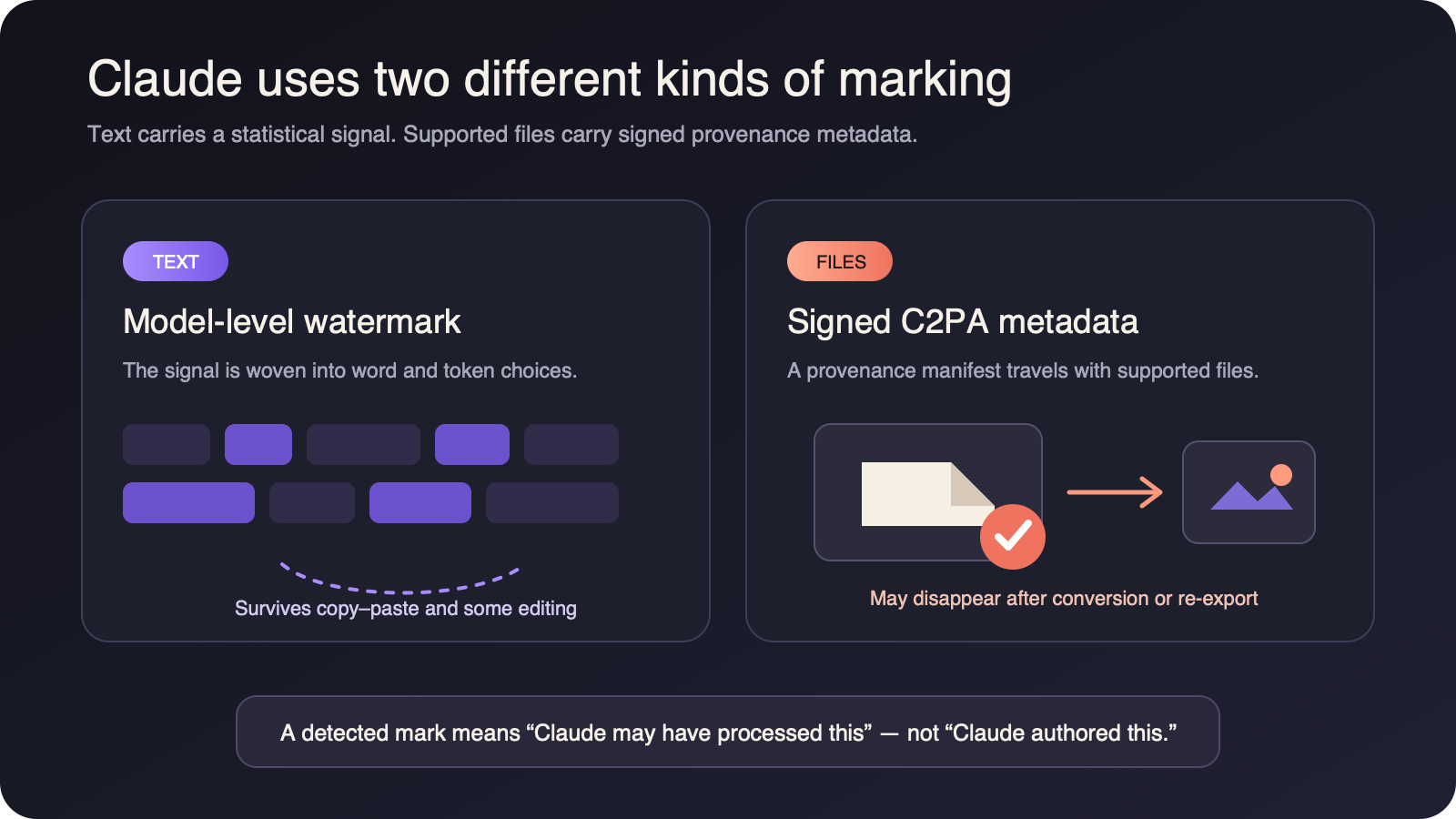
1. An invisible watermark inside text
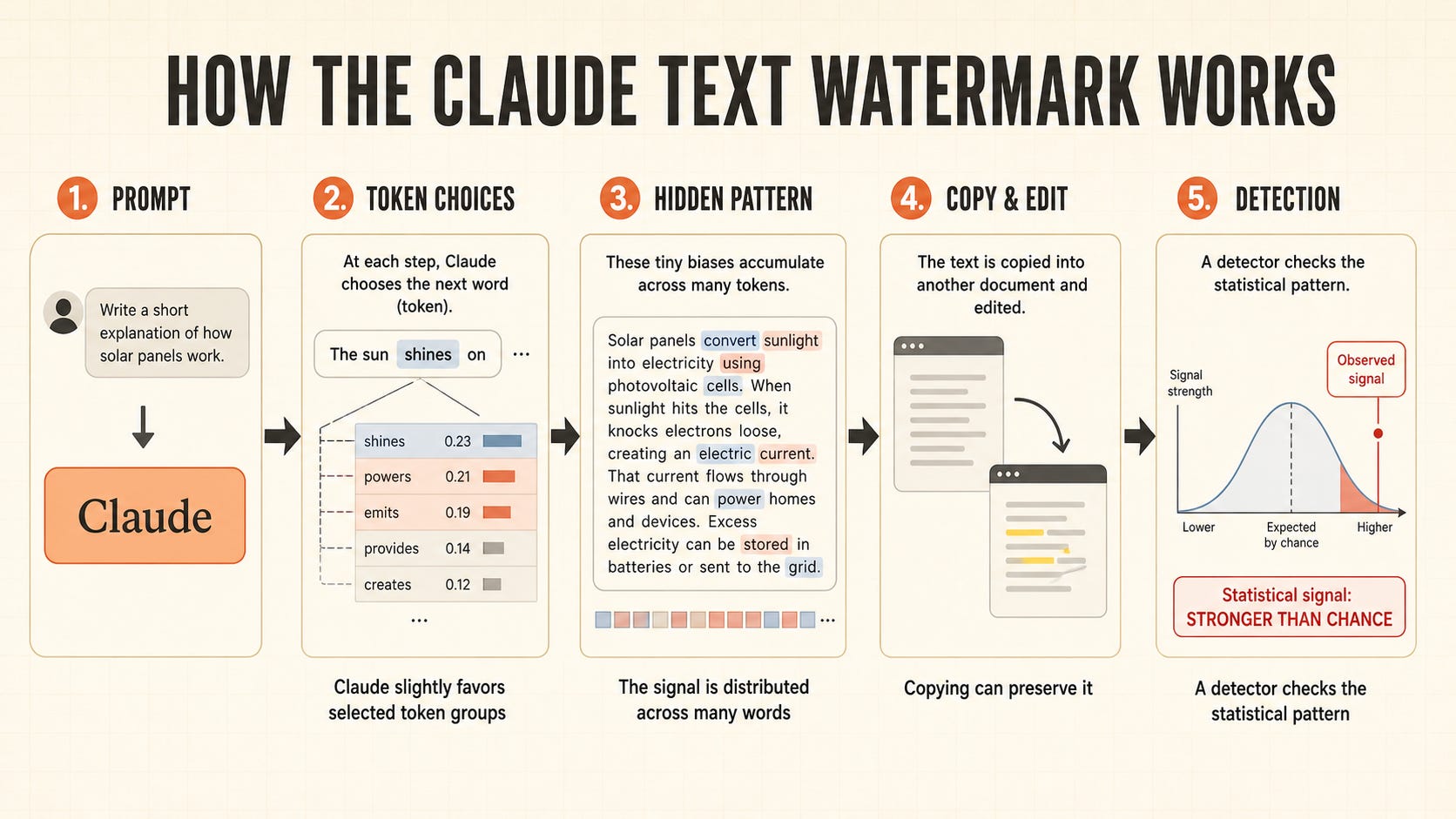
Anthropic says the watermark lives in the text itself at the model level. It’s not a hidden HTML tag or a piece of metadata that vanishes the moment you paste into Google Docs.
It travels with copied text and may survive some editing.
Anthropic hasn’t publicly described the exact mechanism. So if someone tells you it’s “just zero-width characters,” or promises that saving the text as plain text will strip it out, they’re guessing.
The rollout covers Anthropic’s own products, including Claude, Claude Code, Claude Cowork, Claude Tag, and the Claude API, as supported models are updated. Anthropic also says embedded text watermarks travel through model access on AWS, Google Cloud, and Microsoft Foundry.
The nuance matters: this does not mean every answer from every Claude model has been marked since day one. New models launched in the EU on or after the deadline are marked at launch; the transition for older models is still in progress. Anthropic says it is applying the marks worldwide wherever the technique is supported, not only to users in Europe.
2. C2PA provenance metadata in supported image files
For supported .png, .jpg, and .svg files, Claude can add signed C2PA metadata.
Think of this as a tamper-evident provenance record. A compatible verifier can show that the asset was processed by Claude and whether the signed file has changed since.
This is far more inspectable than the text watermark. You can already check C2PA-enabled files with the official Content Credentials verifier or the open-source c2patool command-line utility.
But file metadata has an obvious weakness: it can disappear during ordinary processing. Exporting into another format, re-saving through unsupported software, optimizing an image, or taking a screenshot may strip it.
That does not retroactively make the image human-made. It only means the provenance record is no longer attached.
A Claude mark can tell you that Claude touched the content. It cannot tell you who had the idea, who did the research, or who accepted responsibility for the final result.
This distinction is going to cause a lot of confusion.
Imagine you write a 2,000-word essay yourself, then ask Claude to tighten the introduction. The final draft may test positive.
Now imagine someone generates an entire article, heavily rewrites it with another model, and mixes in a few human paragraphs. The watermark may no longer be detectable.
The first person did more original work, yet the second may be harder to flag.
That is why this technology is useful for provenance, but weak as a verdict on authorship, effort, or integrity.
What It Means for Creators
Creators rarely use AI in a clean binary way.
A newsletter might combine an original interview, Claude-assisted research, a rewritten paragraph, human editing, and an AI-generated illustration. A YouTube script might begin as a voice note, pass through transcription, get organized by Claude, and then be rewritten during recording.
The watermark collapses all of that into one crude signal: Claude may have touched this. A client or platform may then interpret “AI detected” as “fully AI-generated,” even though Anthropic says the mark cannot establish authorship.
That is why creators will look for removal tools first. The issue is not only disclosure. It is the risk that minor editing assistance receives the same label as a copy-pasted first draft.
I wrote before about using Claude as an active teammate in How Claude Code Can Be Your AI Teammate and Claude Cowork: Complete Guide & Practical Use Cases. The important word is teammate. You want Claude contributing to a process, not impersonating the final owner of the work.
The obvious next question is whether the mark can be removed, and which tools might actually help.
I went through Anthropic’s disclosures, the current humanizer tools, watermark-removal research, and the largest Reddit discussions. Below is the practical map.
