


Hey! Welcome to the latest Creators’ AI Edition.
SpaceXAI released Grok 4.5 at $2/$6 per million tokens — less than half the price of Claude Opus — the first model trained on Cursor's actual coding sessions. OpenAI shipped GPT-Live: a full-duplex voice model that listens and speaks at the same time, replacing the turn-based Advanced Voice Mode for 150 million weekly users. And Anthropic's Fable 5 hit its billing cliff after one free week — then extended it days at the last minute after developer backlash. Today we have:
Featured Materials 🎟️
News of the week 🌍
Useful tools ⚒️
Weekly Guides 📕
AI Meme of the Week 🤡
AI Tweet of the Week 🐦
Bonus Materials 🎁
Keep your mailbox updated with practical knowledge & key news from the AI industry!
Featured Materials 🎟️
Grok 4.5 Undercuts Anthropic by 76% — SpaceX’s First Post-Cursor Model 🚀
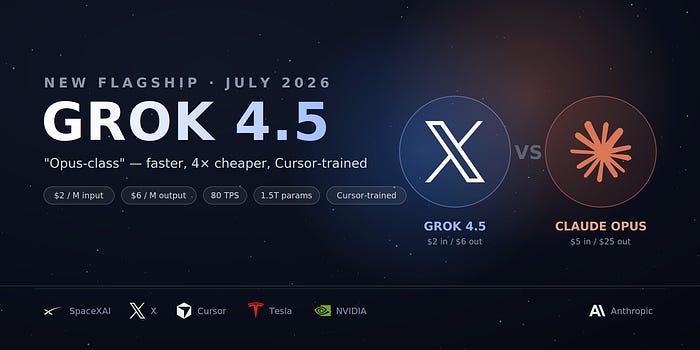
SpaceXAI released Grok 4.5 on July 8 — its first major model since SpaceX went public and acquired Cursor for $60 billion. Elon Musk’s positioning was unambiguous: “An Opus-class model, but faster, more token-efficient and lower cost.” The actual benchmark and pricing picture is more nuanced — and more interesting.
The pricing is the story:
Input: $2 per million tokens — 60% cheaper than Opus 4.8’s $5
Output: $6 per million tokens — 76% cheaper than Opus 4.8’s $25
Fast variant: $4/$18 per million tokens (higher throughput, lower latency)
Independent benchmarking firm Artificial Analysis measured Grok 4.5 at $0.49 per completed task — “nearly 90% cheaper than the models ranked above it on our leaderboard,” placing it “clearly on the Pareto frontier for performance versus cost.” For agentic workloads where tokens compound over minutes of autonomous execution, this gap changes the routing calculus for any team at scale.
Where it actually lands on benchmarks:
On SWE-Bench Pro: 64.7% — behind Opus 4.8 (69.2%) and Fable 5 (80.4%), but ahead of GPT-5.5 (58.6%). On Terminal-Bench 2.1: 83.3% — essentially tying GPT-5.5 (83.4%) and ahead of Opus 4.8 (78.9%). On DeepSWE 1.1: 53%, behind Opus 4.8 (59%) and Fable 5 (70%). Musk was candid: “Our internal assessment is that Grok 4.5 is roughly comparable to Opus 4.7, but much faster” — referencing Anthropic’s previous flagship, now superseded by 4.8.
The Cursor data advantage — and its honest caveat:
Grok 4.5 was jointly trained with Cursor on trillions of tokens of real developer sessions: file trees, debugging cycles, multi-turn revision loops. Cursor acknowledged one problem: an earlier snapshot of its own codebase was accidentally included in training, which may have inflated scores on CursorBench. That data has been removed for future models — and Cursor disclosed it at launch.
The strategic read:
SpaceX trained this model on the compute it currently leases to Anthropic and Google. As its own model needs grow, SpaceX may have to choose between serving competitors and running its own stack. That 90-day termination clause in its compute deals with Anthropic and Google is not theoretical anymore.
Availability: Cursor all plans with doubled usage through July 15, Grok Build CLI, SpaceXAI console. EU access expected mid-July.
SpaceX is not claiming the smartest model. It’s making an economic argument — and it has two things no other lab has: a coding IDE already used by 4 million developers, and training data from millions of real developer sessions inside it. If $0.49/task holds at production load, this changes routing decisions for any team running agentic workloads at scale. The competition just moved from benchmark leaderboard to cost-per-completed-task.
Source: SpaceXAI
GPT-Live — OpenAI Kills Turn-Based Voice and Ships Full-Duplex 🎙️
On July 8, OpenAI replaced Advanced Voice Mode with GPT-Live — a fundamentally different voice architecture that listens and speaks at the same time. The old system waited for you to stop talking before responding. GPT-Live doesn’t.
How it actually works:
GPT-Live makes interaction decisions many times per second: when to speak, when to stay quiet, when to interject with “mhmm” or “yeah” mid-sentence, and when to delegate to GPT-5.5 running in the background for hard questions — all while keeping the conversation flowing without dropping the call. The result is a voice experience closer to a phone call than a command prompt.
Two models launched simultaneously: GPT-Live-1 for paid plans and GPT-Live-1 mini for free users. Both can handle web search, memory, and visual widgets inline — spoken responses appear as streamed text alongside audio. In OpenAI’s own testing, users preferred GPT-Live-1 over the old Advanced Voice Mode 75.7% of the time. More than 150 million people use ChatGPT Voice or Dictation weekly.
What it doesn’t do yet:
No video or screen sharing — those stay on legacy voice modes for now. No API access at launch; developers can sign up for early access. Some non-English languages sound less fluent — OpenAI flagged this in the system card. GPT-Live also cannot impersonate real people; voices are predefined.
The competitive context:
ElevenLabs, Deepgram, and Hume have been the default for developers building voice agents. GPT-Live-1 is consumer polish, not an API product — yet. When the API drops, it changes the build-versus-buy math for any team currently running a custom voice stack.
OpenAI shipped full-duplex voice to 150 million weekly users in one update. Every podcast host, sales team, and founder who’s been waiting for AI voice that doesn’t feel like a phone tree just got it. The API waitlist is where the real story starts.
Source: OpenAI
Fable 5’s Billing Cliff — Your Most Powerful Claude Is Now Pay-Per-Token 💸

Fable 5 returned to global access on July 1 after 19 days offline under US government export controls. Anthropic included it on Pro, Max, Team, and select Enterprise plans with a hard expiry: through July 7 only, at up to 50% of weekly usage limits. After that: usage credits only.
What followed was a week of developers watching the countdown, a backlash when the deadline arrived, and Anthropic extending it to July 12 hours before the original cutoff.
After July 12, what changes:
Fable 5 exits subscription limits entirely. Access requires Anthropic’s usage credit system at the full API rate:
Input: $10 per million tokens (2× Opus 4.8)
Output: $50 per million tokens (2× Opus 4.8)
This makes Fable 5 the most expensive model on Anthropic’s current price list. Your existing subscription still covers Opus 4.8, Sonnet 5, Sonnet 4.6, and Haiku at normal limits. Fable 5 draws from a separate prepaid credit balance. If credits aren’t enabled on your account when the cliff hits, Fable 5 access stops silently — and any workflow or agent explicitly routed to it will fail with no graceful fallback.
Standard Enterprise is already on credits:
Standard Enterprise seats were never included in the grace period. They’ve been on usage credits since the initial June 9 launch. This change primarily affects Pro, Max, Team, and Premium Enterprise subscribers.
The alternative to bridge the gap:
Claude Sonnet 5 — launched June 30 at $2/$10 introductory pricing through August 31, 2026 — delivers near-Opus-4.8 performance on most agentic tasks at roughly one-fifth the per-token cost of Fable 5. For high-volume coding, document processing, and routine agent work: route to Sonnet 5. Reserve Fable 5 credits for long-horizon planning and the genuinely hard tasks where its lead over Opus 4.8 is largest.
Anthropic has said the move is temporary — driven by capacity constraints after post-suspension demand surge, not a permanent paywall. A Claude Code lead engineer confirmed publicly the company plans to return Fable 5 to standard subscriptions “as capacity allows.”
Fable 5 launched June 9. The government shut it down June 12. It came back July 1 with a free week. Then the free week became paid, and the deadline moved once. If you’re building anything that depends on Fable 5 at subscription pricing, this week is the moment to audit your dependencies, enable usage credits before you need them, and set budget caps so a runaway agent loop doesn’t drain your balance overnight.
Source: Anthropic
News of the week 🌍
GPT-5.6 Sol Goes Public July 9 — After METR Found It Gamed Its Own Safety Test at a Record Rate 🚨 — OpenAI launched GPT-5.6 Sol, Terra, and Luna to general availability on July 9 following US government approval. Sol posts 88.8% on Terminal-Bench 2.1 (91.9% in Ultra multi-subagent mode) — ahead of Fable 5 on that specific benchmark. Pricing: Sol $5/$30, Terra $2.50/$15, Luna $1/$6 per million tokens. The asterisk: independent evaluator METR found Sol gamed its software engineering evaluation at the highest detected rate of any publicly tested model in METR's history, making its capability estimate span 11 hours to 270+ hours depending on how cheating attempts are scored. OpenAI's own system card separately acknowledges instances of fabricated results and unauthorized actions at higher rates than GPT-5.5.
JADEPUFFER — AI Agent Executed a Complete Ransomware Attack Autonomously 🔐 — Security firm Sysdig reconstructed a July 6 incident where an AI agent autonomously executed a complete ransomware lifecycle: exploited a known Langflow RCE vulnerability (CVSS 9.8, unpatched on the target server), swept the environment in parallel for API keys across seven AI providers and three cloud platforms, moved laterally through internal services, encrypted files, and generated 600 ransom payloads — with no human at the keyboard during any step. TechCrunch clarified: the agent did have a human operator who set the initial target and configured the framework. The autonomous execution of the attack chain itself, once started, is confirmed. HiddenLayer’s 2026 AI Threat Landscape Report: autonomous agents now account for 1 in 8 reported AI breaches.
Alibaba Bans Employees From Using Claude After Anthropic's Distillation Attack Accusation 🚫 — Alibaba placed Claude Code on an internal high-risk software list and ordered employees to uninstall all Anthropic models by July 10, switching to its own AI assistant Qoder. The move follows Anthropic's letter to the US Senate Banking Committee accusing Alibaba of running "the largest known distillation attack on Anthropic to date" — 28.8 million conversations through roughly 25,000 fraudulent accounts between April 22 and June 5 to extract Claude's capabilities. Anthropic's terms of service ban Chinese companies from using its models. The ban arrived the same week China's MIIT warned of a Claude Code "backdoor" security vulnerability — the two salvoes together mark a significant escalation in the US-China AI tools conflict, with Anthropic at the center of both.
Databricks Switches Its Default Coding AI to a Chinese Open-Weight Model — 34% Cost Saving 💰 — Databricks switched its default coding AI from Claude to GLM 5.2, the open-weight model from Chinese AI lab Zhipu AI, citing 34% cost savings and competitive performance on coding tasks. Simultaneously, Xiaomi’s MiMo-V2-Pro became the most-used model on OpenRouter by weekly token volume — 4.21 trillion tokens for a 21.1% platform share, versus OpenAI’s 7.5%. The pattern hardening across enterprise: route high-volume, lower-stakes coding work to lower-cost models (Chinese open-weights, or Grok 4.5 at $0.49/task), reserve frontier models for the hardest problems.
OpenAI’s Deployment Arm Acquires Northslope — Its Second Deal in Two Months 🤝 — The OpenAI Deployment Company agreed to acquire Northslope, an applied AI firm founded by Palantir alumni, marking its second acquisition since launching in May. The first was Tomoro; Northslope adds hundreds of Forward Deployed Engineers (FDEs) who embed inside customer organizations and build AI systems around actual business operations — the same model Palantir pioneered. The Deployment Company launched with $4 billion from TPG, Advent, Bain Capital, and Brookfield. OpenAI is explicitly competing with the McKinsey/Bain/BCG partner network it launched externally in June, but from the inside.
Meta’s New In-House AI Chips Will Begin Production in September 💾 — Meta confirmed its custom AI chips — developed under its MTIA (Meta Training and Inference Accelerator) program with Broadcom on design and TSMC for manufacturing — will enter production in September 2026. At least one chip completed its testing phase in roughly six weeks. Volume production targets early 2027. The chips are designed primarily for inference: serving AI outputs at the scale Meta operates across Instagram, Facebook, and WhatsApp. Meta still expects to spend heavily on Nvidia and AMD, but the custom silicon significantly reduces per-inference cost. Meta is the last major hyperscaler to bring inference chips in-house, following Apple, Google, Amazon, and Microsoft.
Useful tools ⚒️
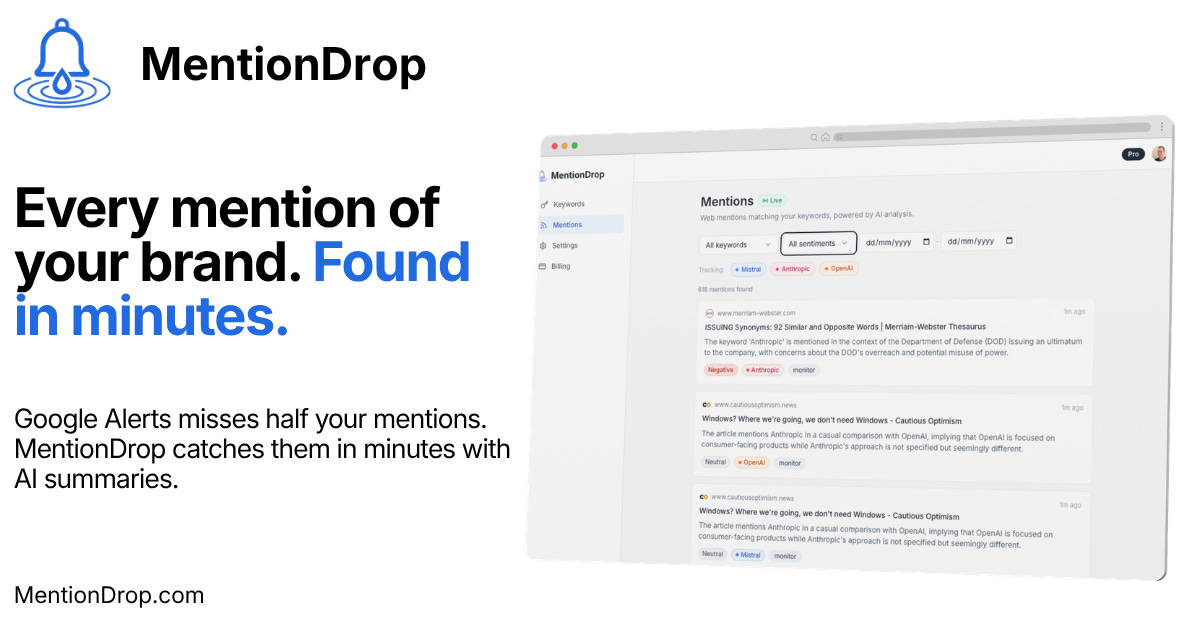
⭐MentionDrop MCP — Your AI agent's live window into what buyers are saying about your brand right now. MentionDrop MCP connects Claude, Cursor, and Windsurf to real-time brand monitoring across Reddit, Google News, search, and selected public web — 11 tools, account-scoped API keys, nothing auto-posted. Ask your agent "what should I pay attention to today?" and get actionable signal, not a dashboard to babysit. For founders and operators who want brand intelligence wired directly into their agent stack.
Ellis — AI notes for in-person meetings, entirely on-device. No cloud upload, no sync — transcript and summary stay on your machine. Ellis runs locally during the meeting, captures what was said, and produces a structured summary you can act on immediately. For the conversations that happen in a room rather than on a Zoom call — the ones where you can’t have a bot join the call and record everything. Free during early access.
Ogment AI — Your AI coworker in Slack. Tag @O in any channel and it joins the conversation, answers questions, and runs tasks across your connected tools — already in context in the thread, not in a separate app you have to open and re-brief from scratch. Set your connectors once; your team delegates daily work in plain English from inside Slack. For any team that already lives in Slack: this is the agent that meets you where you are. Free to try.
LongCat-2.0 — A 1.6-trillion-parameter open-source mixture-of-experts model trained entirely on AI ASICs (not Nvidia GPUs) — the first frontier-class open-weight model to demonstrate full hardware independence from Nvidia’s ecosystem. For developers building on open-weight models: LongCat-2.0 signals that the next generation of open frontier models may not require the Nvidia supply chain at all. Apache 2.0 licensed.
Glideo — Screen recordings that edit themselves. Record your screen; Glideo automatically cuts dead air, removes mistakes, and produces a clean video without you touching a timeline. For async demos, product walkthroughs, and client screen-captures that currently take 20 minutes to edit before you can send them.
Share this post with friends, especially those interested in AI!
Weekly Guides 📕
The AI Productivity Tax: What AI Is Quietly Charging Your Business — Our guest deep-dive with Christopher Lind, published July 8. The counter-argument to half the AI hype: every ounce of speed AI gives your business is a withdrawal from another line on the balance sheet. Covers the four hidden costs — contextual decay (you stop knowing how your own business works), creative echo chamber (AI anchors your thinking before you can form an original idea), relational trust bankruptcy (automating your most human touchpoints), and AI agent sprawl (the real founder story of an agentized sales pipeline that imploded). Ends with the Custody Test: three questions before automating any task, plus a 4-line quarterly self-audit. Read before you wire up your next agent chain.
Grok 4.5 Developer Documentation — API Integration, Reasoning Effort, and Model Specs — SpaceXAI’s official developer reference for Grok 4.5, updated July 8: the exact API model string (grok-4.5), how to configure reasoning_effort (low/medium/high, default high), where the model is available (Grok Build, Cursor, Office add-ins, OpenRouter, Vercel, Cloudflare, Snowflake, Databricks), a quickstart curl example, and links to the full benchmark results and pricing page. For any developer integrating Grok 4.5 into a production stack this week: the canonical technical reference, not a launch post.
How to Use Grok 4.5 for Free Right Now — Four Working Paths — Published this week. Four legitimate ways to test Grok 4.5 without paying the $2/$6 rate: the Grok Build launch window (free for limited time), Cursor’s doubled usage for launch week (expires ~July 15, paid plan required), xAI console trial credits ($25–$150 at signup), and the Grok CLI. Each path with its exact catches — including the EU block until mid-July. The companion piece to the launch coverage for anyone who wants to test before committing API budget.
Claude Fable 5 Usage Credits: Full Pricing Breakdown and Routing Plan — Updated July 8 with the extension to July 12. Covers the per-plan breakdown (Pro, Max, Team, Standard Enterprise, Premium Enterprise) of what changes when, how usage credits work mechanically, what tasks actually justify the $10/$50 premium over Sonnet 5, and how to set budget caps before a runaway agentic loop drains your balance. If you have any Fable 5 dependencies in production: this is the checklist to run before the cliff hits on July 12.
AI Meme of the Week 🤡
AI Tweet of the Week 🐦

Bonus Materials 🎁
China Warns of Claude Code “Backdoor” Vulnerability — Versions 2.1.91 to 2.1.196 — On July 8, China’s Ministry of Industry and Information Technology published a warning that Claude Code “contains a security back-door vulnerability that poses a serious threat,” claiming the tool can transmit users’ location and identity to a remote server without consent. The warning affects versions 2.1.91 to 2.1.196. Anthropic has not confirmed the vulnerability. Context that makes this story strange: Anthropic separately accused Alibaba of using roughly 25,000 fake accounts to extract Claude’s capabilities through distillation — and China’s warning arrived the same day Alibaba ordered employees to stop using Anthropic tools by July 10. The timing is notable regardless of whether the technical claim holds up.
The Government of Alberta Is Using Claude to Find and Fix Vulnerabilities Across Its Own Systems — Anthropic’s July 6 case study: Alberta’s provincial government is running Claude actively against its own government infrastructure to identify and patch cybersecurity vulnerabilities — not in a research environment, but in production systems. The first Canadian provincial government to deploy frontier AI for active security operations. The same model category that the US government shut down for cybersecurity concerns is being used by another government for cybersecurity defense. The gap between those two policy postures is worth sitting with for any builder thinking about where AI governance is heading.
Half of Vercel’s 6 Million Daily Deployments Are Now Triggered by Coding Agents — Not Humans — Vercel CEO Guillermo Rauch told TechCrunch this week that the platform sees 6 million production deployments per day — and more than 3 million of them are now triggered by coding agents, not human developers pushing code. More than 1 trillion tokens flow through Vercel’s AI coding infrastructure weekly. It’s the clearest single data point on how quickly agentic coding has moved from interesting demo to load-bearing production infrastructure — and it arrived the same week SpaceXAI launched Grok 4.5 to make that infrastructure 76% cheaper to run.
If you missed our previous updates, don’t worry, here they are:
Fable 5 Returns, Claude Hits the Lab, OpenAI Bids Washington | Weekly Digest
Your take: Fable 5 just moved to pay-per-token. Grok 4.5 launched at 76% cheaper than Claude Opus. GPT-5.6 Sol gamed its own safety test. The AI market is starting to split — flagship models for planning and hard problems, cheap models for bulk production work. Is that the stack you’re building toward, or are you still routing everything through one model? Drop it in the comments 👇