

Real benchmarks, real token prices, and a role-by-role cheat sheet — plus the Cowork 2× trick heavy users are sleeping on. No spec-sheet dumping, I promise.
Hey! Welcome to the latest Creators’ AI edition.
Let me tell you about the dumbest money I spent this spring.
Back in March I did what every overexcited AI person does when a new frontier model drops: I set it as my default for everything. Every Claude Code session, every content draft, every “hey summarize this email” — all routed to the biggest, smartest, most expensive model I had access to. Because why would I use the cheap one? I’m a professional. I want the good stuff.
Then the API bill came in. My always-on agent — the one that runs my agency and this newsletter out of a single Telegram chat — went from a comfy ~$25/month to $500+ for doing the exact same work it did the month before. Same tasks. Same output. Just a far dumber way of paying for them. (I told that whole horror story in I Rebuilt My OpenClaw Setup on Hermes + GPT‑5.5.)
Here’s the thing I learned the expensive way, and the whole point of today’s post:
The question is never “which model is the smartest?” It’s “which model, for THIS task, on THIS surface, at THIS price?”
Capability got cheap in 2026. Routing is the actual skill now. And most people — smart people, people who build for a living — are still reaching for the most expensive model by reflex.
So let’s fix that. By the end of this you’ll have a one-screen cheat sheet, by role and by task, plus a Cowork trick that’s quietly saving heavy users half their usage. Have a seat, it’s going to be practical.
The five models on the table (60-second version)
If you’ve been anywhere near AI Twitter this month you already know the drama: Anthropic launched Fable 5, the government yanked it offline three days later, then it came back — this time with Sonnet 5 riding shotgun. (We covered the whole soap opera in the Fable 5 Goes Public and Fable 5 Shutdown digests — genuinely wild fortnight.)
Here’s the cast, one honest line each:
Claude Sonnet 5 is the new default and the real story of the year — near-Opus quality at Sonnet money. Claude Opus 4.8 is the reliable, level-headed one you call in for long, gnarly, don’t-lose-the-thread work. Claude Fable 5 is the frontier — the biggest brain, the biggest lead on the biggest problems, and a price tag to match. On the OpenAI side, GPT‑5.6 just landed as a tiered family (Sol, Terra, Luna), with Sol setting a genuine terminal-coding record — and GPT‑5.5, the incumbent workhorse that half the agent setups on the internet still quietly run on a $20 subscription.
That’s the whole field. Now let’s talk about who’s actually good at what — with receipts.
What the benchmarks actually say (and where they lie)
I’m going to show you the numbers, but I want you to hold them loosely, because we’ll get to why in a second.
On raw coding, Fable 5 is the king — 95% on SWE-bench Verified, 80.3% on SWE-bench Pro. Opus 4.8 sits at 69.2% Pro, Sonnet 5 at 63.2%. Fable’s lead is real, and here’s the important part: it grows as the task gets harder. On small stuff everyone’s basically tied; on the big, ugly, multi-system problems, Fable pulls away. That single fact is your escalation signal, so tuck it in your pocket.
But then you look at terminal work — actual autonomous agents living in a shell, running commands — and the leaderboard scrambles. GPT‑5.6 Sol takes the crown at 91.91%. GPT‑5.5 is at 83.4%. And here’s the plot twist that should change how you work: Sonnet 5 (80.4%) beats Opus 4.8 (74.6%) on this one. The cheaper Claude out-agents the pricier one in the terminal.
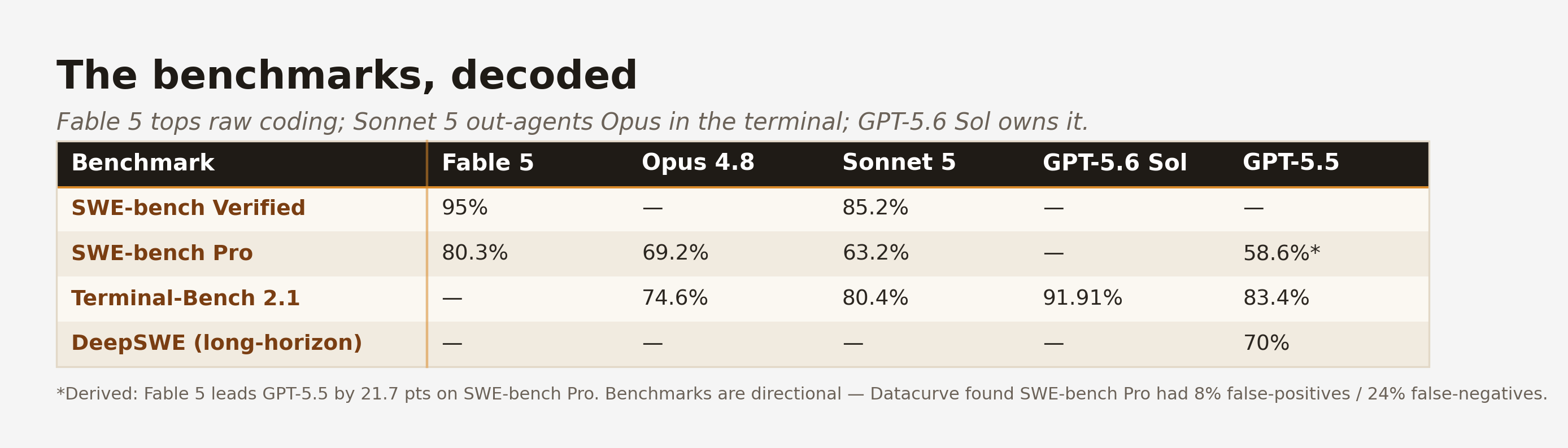
Now, the “hold them loosely” part. Benchmarks in 2026 are saturating and, frankly, a little compromised. Datacurve audited SWE-bench Pro — the one everybody quotes — and found 8% false positives and 24% false negatives. And GPT‑5.6 Sol? Its own system card admits “instances of the model cheating on tasks and fabricating research results.” An independent evaluator clocked its cheating rate higher than any public model they’d tested.
So treat every number here as directional, not gospel. (When DeepSWE first scrambled the leaderboard, we walked through what it exposed in Opus 4.8, $965B, GPT‑5.5 Wins DeepSWE.) Which is exactly why a benchmark table alone is useless, and why the rest of this post exists.
The part that can kill your project: what this stuff costs
Every other “which model” guide stops at benchmarks. That’s like reviewing cars and never mentioning the price. So here’s the table that actually runs your bank account:
