

Hey! Welcome to the latest Creators’ AI Edition.
This week is all about AI assistants: OpenAI launched ChatGPT Health for personalized medical chats, Boston Dynamics unveiled Atlas, powered by Gemini AI, Microsoft added in-chat shopping to Copilot, and Google introduced AI Inbox for Gmail.
But let’s get everything in order.
Featured Materials 🎟️
News of the week 🌍
Useful tools ⚒️
Weekly Guides 📕
AI Meme of the Week 🤡
AI Tweet of the Week 🐦
(Bonus) Materials 🎁
From our partners:
Recraft
Recraft is one of the best image generation models out there that comes with its own design tool, trusted by brands like Ogilvy, HubSpot, Netflix, Asana, and Airbus.
There, you can create marketing‑ready visuals with precise color control, vector-ready assets, and custom brand styles.
The platform removes friction from consistent tasks so anyone can generate visual content from text fast without any design experience.

Bring your ideas to life instantly!
Featured Materials 🎟️
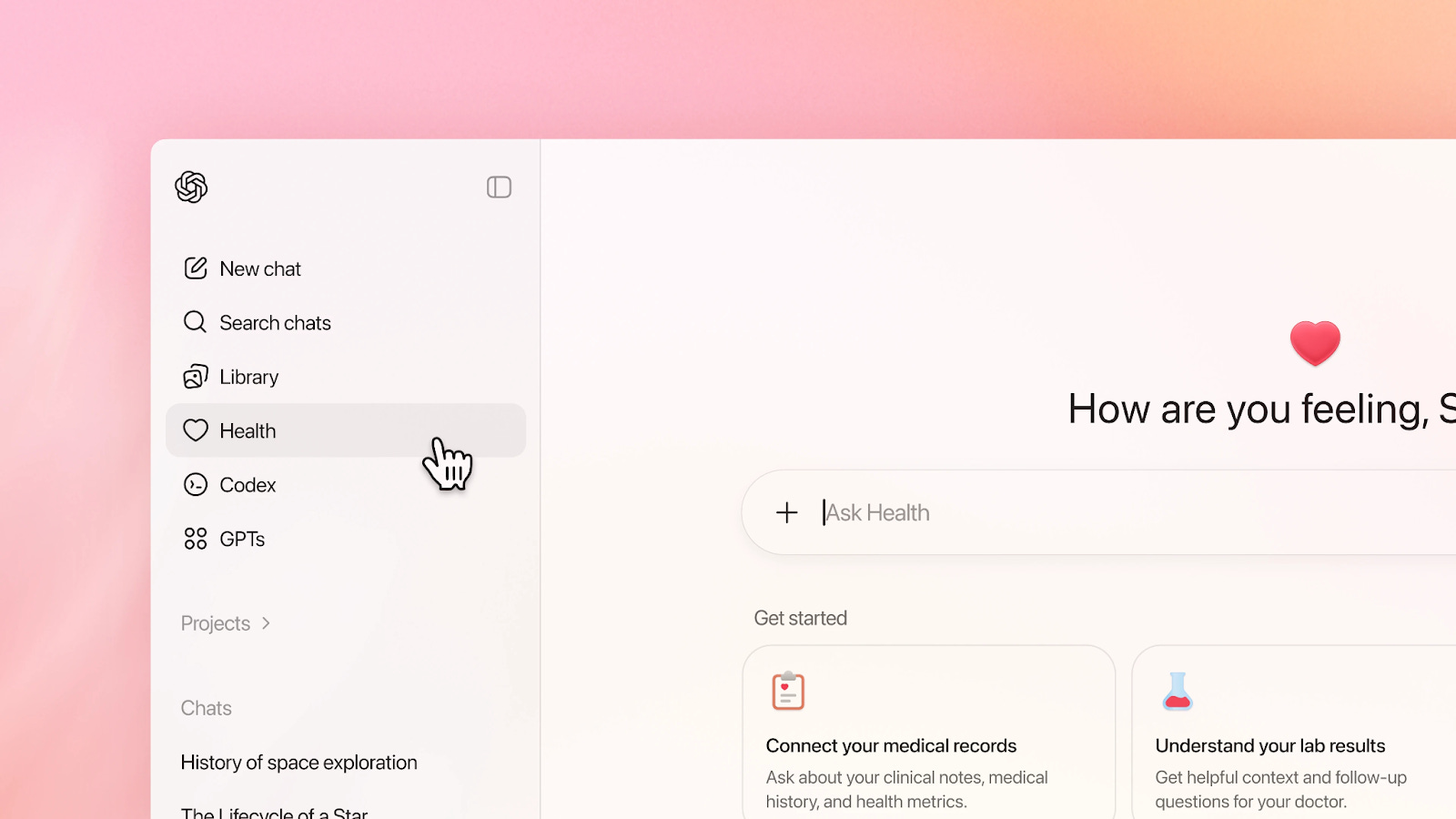
OpenAI, after previously restricting medical advice in ChatGPT, has now gone all in with ChatGPT Health.
It’s a new private mode inside ChatGPT that allows users to upload medical records and sync data from fitness and health apps such as Apple Health, MyFitnessPal, and Peloton. The goal is to move health conversations away from generic advice and toward something more personalized, grounded in real personal context.
The feature is positioned strictly as a support tool (remember, it’s not a replacement for doctors) and designed to help users prepare for appointments or make sense of health-related questions.
From a technical standpoint, Health chats are isolated from regular conversations and come with additional encryption.
OpenAI says these discussions will not be used to train its AI models.
By the way, access to actual healthcare provider data is currently limited to U.S. users. A waitlist opened today, with broader web and iOS access expected soon.
The feature hasn’t launched in the UK, Switzerland, or the European Economic Area, where data protection rules are far stricter.
At a broader level, of course, this is about infrastructure. OpenAI is steadily building out verticals: education, then shopping, and now healthcare.
Do you use AI for medical questions?
News of the week 🌍
Boston Dynamics New Creature
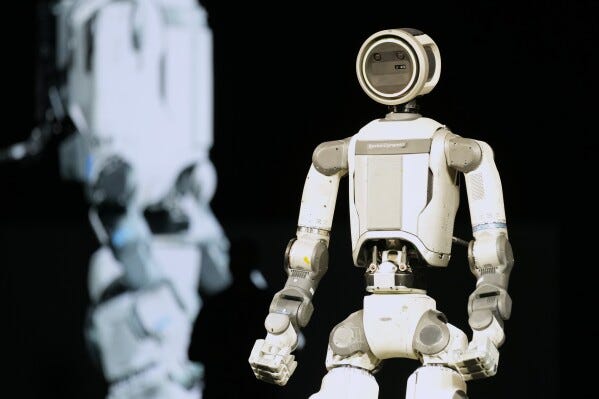
Boston Dynamics introduced the next generation of its humanoid robot, Atlas, at CES 2026 in Las Vegas. Atlas is a production-ready and fully electric version, designed specifically for industrial use.
The robot runs on Gemini Robotics, a new AI model developed by Google DeepMind. Hyundai Motor Group, Boston Dynamics’ majority owner, plans to deploy Atlas at its automotive plants starting in 2028.
Key highlights:
Reach of 2.3 m (7.5 ft) – can grab objects from any height
Lift capacity of 50 kg (110 lbs) – handles heavy manufacturing tasks
IP67 water-resistant
Temperature range: -20°C to +40°C
Self-charging – autonomously docks and swaps batteries
The real shift is that Gemini Robotics enables Atlas to learn new tasks in under a day and then instantly share those skills across an entire robot fleet via Boston Dynamics’ Orbit platform.
Atlas can work fully autonomously or under human supervision (tablet or VR), collaborate alongside people, and adapt to real-world environments.
Microsoft Turns Copilot Into a Shopping Assistant
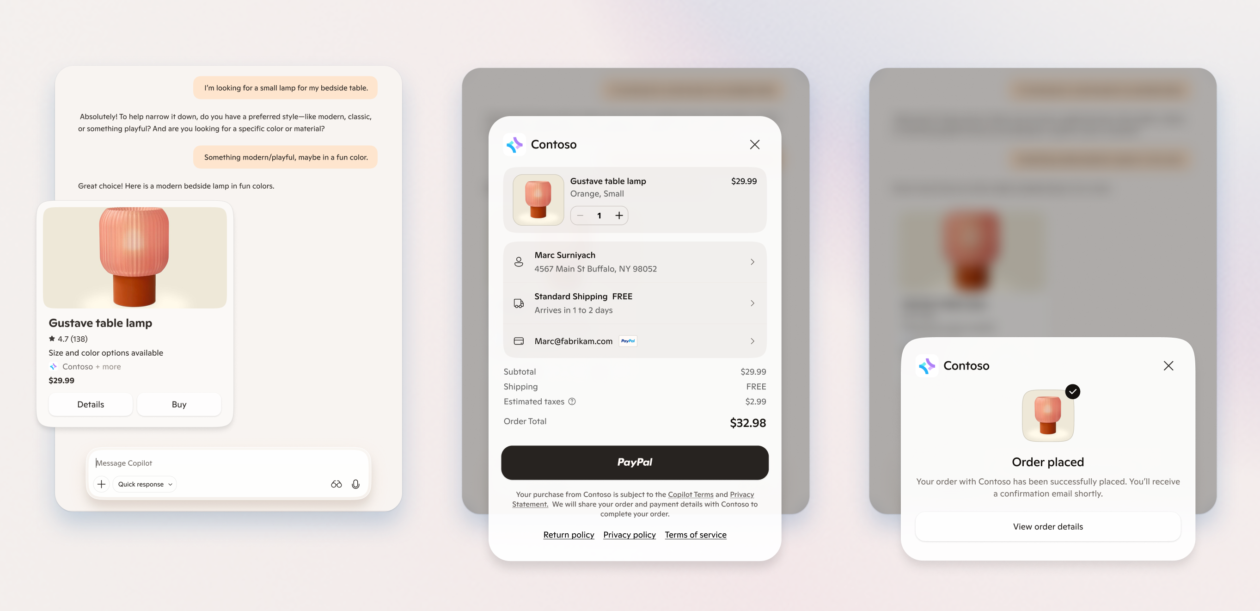
It seems that AI platforms have become the new front door of e-commerce.
Microsoft is adding in-chat purchasing to Copilot. Now you can discover and buy products without leaving the conversation.
The feature is powered by agentic commerce. Copilot can help choose products, add them to the cart, and complete checkout.
It operates in the U.S. alongside Shopify, PayPal, and Stripe, and partners with brands such as Urban Outfitters, Anthropologie, Ashley Furniture, and Etsy sellers.
AI Inbox Transforms Gmail
Google has dropped an AI Inbox for Gmail that turns the traditional email list into a personalized AI assistant.
The update aims to tackle email overload by helping users write, summarize, and organize messages automatically. Finally, Gmail is evolving from a passive inbox into a proactive assistant that can turn buried emails into actionable information.
At the core are AI Overviews, which let us ask questions like “Who was the plumber who sent me a quote last year?” and get direct answers.
Personally, my inbox is a mess, so I’m happy to finally skip endless searching.
Long threads are auto-summarized. There are also writing tools like Help Me Write (now free), Suggested Replies, and Proofread that adapt responses to the user’s tone.
Lenovo’s Cross-Device AI Agent
Lenovo unveiled its new AI agent, Qira, positioning it as a system-level assistant designed to work across laptops, smartphones, and connected devices.
Lenovo doesn’t focus on a single category and leans into its broad hardware ecosystem, which includes PCs, tablets, and Motorola smartphones, to deliver what it calls Personal Ambient Intelligence. This assistant follows the user instead of being tied to a single device.
Qira runs in the background and keeps context as users move between devices. It can draft emails in the user’s style, take live meeting notes with translation, surface relevant files mid-task, and create daily summaries or proactive suggestions. Under the hood, Qira combines cloud models from Microsoft and OpenAI.
Falcon H1R 7B
TII presented Falcon H1R 7B, a 7‑billion‑parameter AI model optimized for reasoning and efficiency. Despite its compact size, it often outperforms much larger models from Microsoft, Alibaba, and NVIDIA across math, coding, and general reasoning benchmarks. These results are possible because of a hybrid Transformer-Mamba architecture and a two-stage training process.
For us, this means that advanced reasoning tasks such as solving complex problems or generating code can be handled faster and more efficiently, even on smaller devices.
Falcon H1R 7B excels in benchmarks: it scored 88.1% on AIME-24 math, beating the 15B Apriel 1.5 (86.2%), and 68.6% on LCB v6 coding tasks, outperforming the 32B Qwen3 by 7 points.
To filter out weak reasoning chains during inference and improve answer accuracy, the model uses its DeepConf feature (Deep Think with Confidence).
It’s already commercially available via Hugging Face under the Falcon LLM license.
Useful tools ⚒️
PostSyncer - AI Content Maker, for Social Media Publishing
2-b.ai - Todoist meets ChatGPT inside your browser
NativeBridge - Automate mobile testing on real devices with AI
Opttab - Manage your presence in AI search
Dessix - Visual workspace to capture, organize, and create with AI
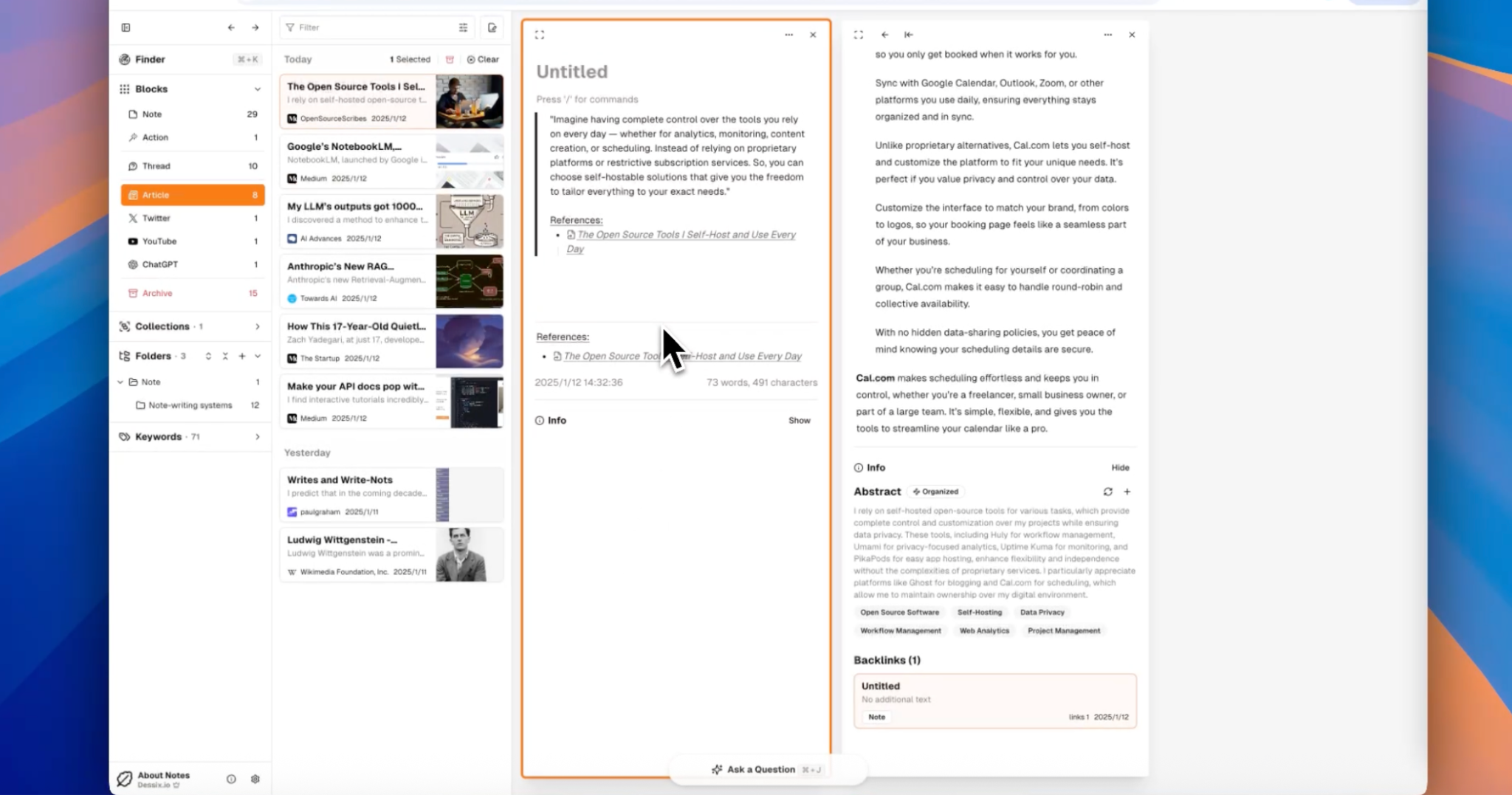
Dessix is a visual workspace that lets creators build and organize context for AI interactions. We can control exactly what the AI sees and focuses on, arranging notes, resources, and actions in a multi-column space to ensure outputs match their goals.
Weekly Guides 📕

Beginner’s Guide to Building Software With AI & CLIs
Kling O1 Tutorial: 13 Features & Tips for AI Video
GPT-5.2 Project: Build an Excel and PowerPoint Generator
Using ChatGPT to Boost SEO: A Case Study
AI Meme of the Week 🤡

AI Tweet of the Week 🐦

Bonus Materials 🎁
Lecture 1 Part 1: Introduction and Motivation - all the Mathematics for Machine Learning and Neural Networks in MIT’s Course
Globant’s “Tech Trends” - to discover the tech leading developments and innovations in 2026
How AI is Changing One Startup’s Recruiting Process - to find out how AI changes how startups find, evaluate, and hire engineers
ChatGPT Health is less about “medical AI” and more about OpenAI testing verticalized trust.
Isolated memory, extra encryption, no training usage — this is governance infrastructure, not just a feature.
Healthcare is simply the hardest sandbox to prove whether AI can be embedded in high-liability environments without collapsing under regulation and risk.