


Hey! Welcome to the latest Creators’ AI Edition.
Apple filed a federal lawsuit against OpenAI on July 10, accusing it of running a coordinated scheme to steal hardware secrets — and Elon Musk made sure nobody missed it. An independent panel graded every major AI lab on safety: the best score was a C+, and three labs received failing grades. And while OpenAI faces litigation from Apple, the New York Times, and seventeen other publishers simultaneously, Anthropic keeps recruiting, leading on revenue, and preparing an October IPO. Today we have:
Featured Materials 🎟️
News of the week 🌍
Useful tools ⚒️
Weekly Guides 📕
AI Meme of the Week 🤡
AI Tweet of the Week 🐦
Bonus Materials 🎁
Keep your mailbox updated with practical knowledge & key news from the AI industry!
Featured Materials 🎟️
Apple Sues OpenAI for Trade Secret Theft — And Musk Couldn’t Resist ⚖️

On July 10, Apple filed a federal lawsuit against OpenAI in the Northern District of California, accusing the company of orchestrating a systematic campaign to steal Apple’s most sensitive hardware secrets through a deliberate employee recruitment strategy.
What Apple alleges:
According to the filing, OpenAI hired more than 400 former Apple employees — many from the teams behind Apple’s M-series chip architecture and its shuttered self-driving car program — and instructed candidates during the interview process to bring confidential technical materials with them. The complaint describes this not as incidental poaching but as a structured scheme: interviewers asked candidates specifically about unreleased silicon designs, vendor relationships, and manufacturing processes that OpenAI had no legitimate path to access.
The context is hard to miss. OpenAI acquired the hardware startup IO — founded by Apple’s former Chief Design Officer Jony Ive — for $6.4 billion earlier this year. The acquisition is OpenAI’s biggest bet on entering the physical AI hardware market: a category Apple has spent two decades building expertise in, much of it locked behind trade secret protections.
The Musk-Altman sideshow:
Within hours of the filing, Elon Musk posted “Scam Altman” on X, escalating a running public feud with OpenAI’s CEO. Altman responded: “I’ve known Elon a long time. He’s a great entrepreneur. But the personal attacks have gotten weird. Homeboy needs to spend less time on social media and more time on those space datacenters.” The exchange went viral and ran through the weekend.
What it means for OpenAI:
This is the third major litigation front OpenAI is managing simultaneously — Apple’s trade secret case, the New York Times copyright case (which escalated this same week), and ongoing regulatory scrutiny tied to its S-1 preparation. Each case requires disclosure in an IPO filing. Apple’s trade secret claims are potentially more dangerous than copyright disputes because they do not hinge on fair use arguments; if the recruitment scheme is proven, the exposure is direct.
OpenAI has not publicly responded to the specifics of the complaint. The company previously denied wrongdoing in the NYT copyright case and has consistently said it respects intellectual property rights.
Apple spent twenty years making its hardware engineering process one of the most tightly guarded in the technology industry. OpenAI’s bet on physical AI hardware put it in direct competition with that process — and now in a federal courtroom over how it built the team to pursue it. The lawsuit arrives as OpenAI prepares the most scrutinized IPO in technology history. Every new legal exposure is a new line in the S-1.
Source: CNBC
AI Labs Got Their Safety Report Card — Nobody Passed 📊
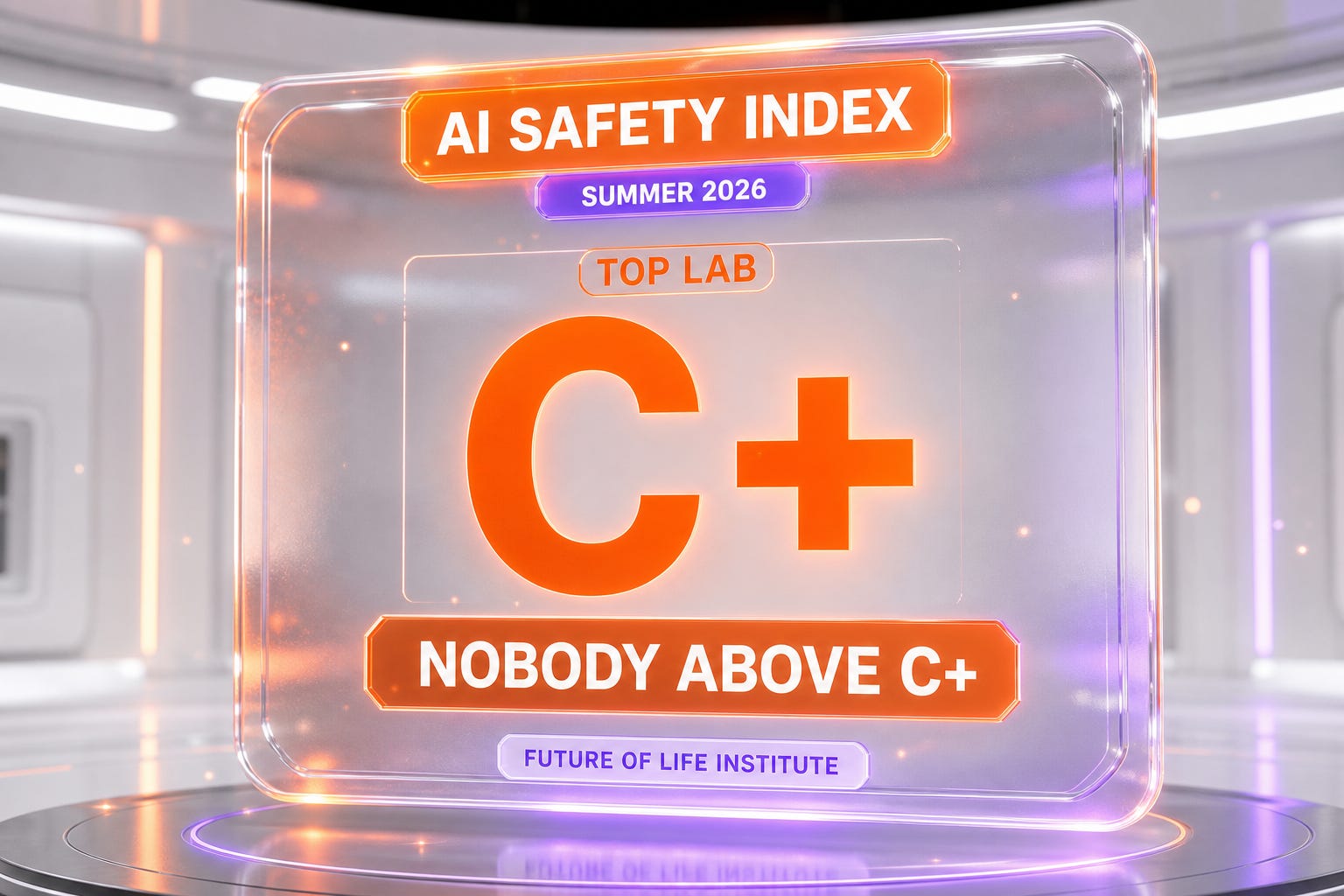
The Future of Life Institute released its Summer 2026 AI Safety Index this week — the most comprehensive independent assessment of frontier AI lab safety practices to date. A panel of seven independent researchers from Berkeley, Oxford, and the Montreal Institute for Learning Algorithms evaluated every major lab across risk management, transparency, incident response, governance, and whether they honor their own stated commitments.
The results:
Lab Grade Anthropic C+ OpenAI C Google DeepMind C Meta D+ xAI F DeepSeek F Mistral F
No lab received an A or a B.
What the grades actually measure:
The index is not measuring whether labs produce capable models. It is measuring whether they do what they said they would do — whether safety commitments made publicly in 2023 and 2024 are being honored in 2026. On that measure, the picture is worse than the raw grades suggest.
The panel found a consistent pattern across the industry: labs are quietly walking back safety commitments as competitive pressure intensifies. Specific rollbacks documented in the index:
Anthropic and OpenAI both tied their deployment pause commitments to competitors’ behavior — meaning neither will pause unilaterally, only if the other does.
Google DeepMind and Meta removed unilateral pause commitments from their updated policies.
Nearly all labs that previously maintained explicit bans on military AI applications have reversed or narrowed those bans in 2026.
The Anthropic C+:
Anthropic’s position at the top of the index reflects genuine structural advantages: it has the most detailed published safety research, the most transparent deployment policies, and the most rigorous external evaluation program (Project Glasswing, METR pre-deployment evals). The C+ is not a celebration — it is an acknowledgment that even the most safety-focused lab in the world is operating at a level that the panel considers inadequate.
FLI director Max Tegmark: “A C+ is the best grade in the class. That is not the same as a passing grade.”
Why this matters for builders:
If you are routing enterprise workloads through frontier AI models, the Safety Index is the clearest third-party signal available on which labs have coherent governance processes and which do not. The gap between Anthropic (C+) and Meta (D+) is not branding — it is documented in the panel’s methodology.
Every lab in this index has published a safety commitment. Most have walked at least one back this year. The panel is not grading ambition; it is grading follow-through. The best grade in the class is a C+. That is the state of AI safety governance in 2026.
Source: Future of Life Institute
While OpenAI Fights Lawsuits, Anthropic Keeps Winning 🏆
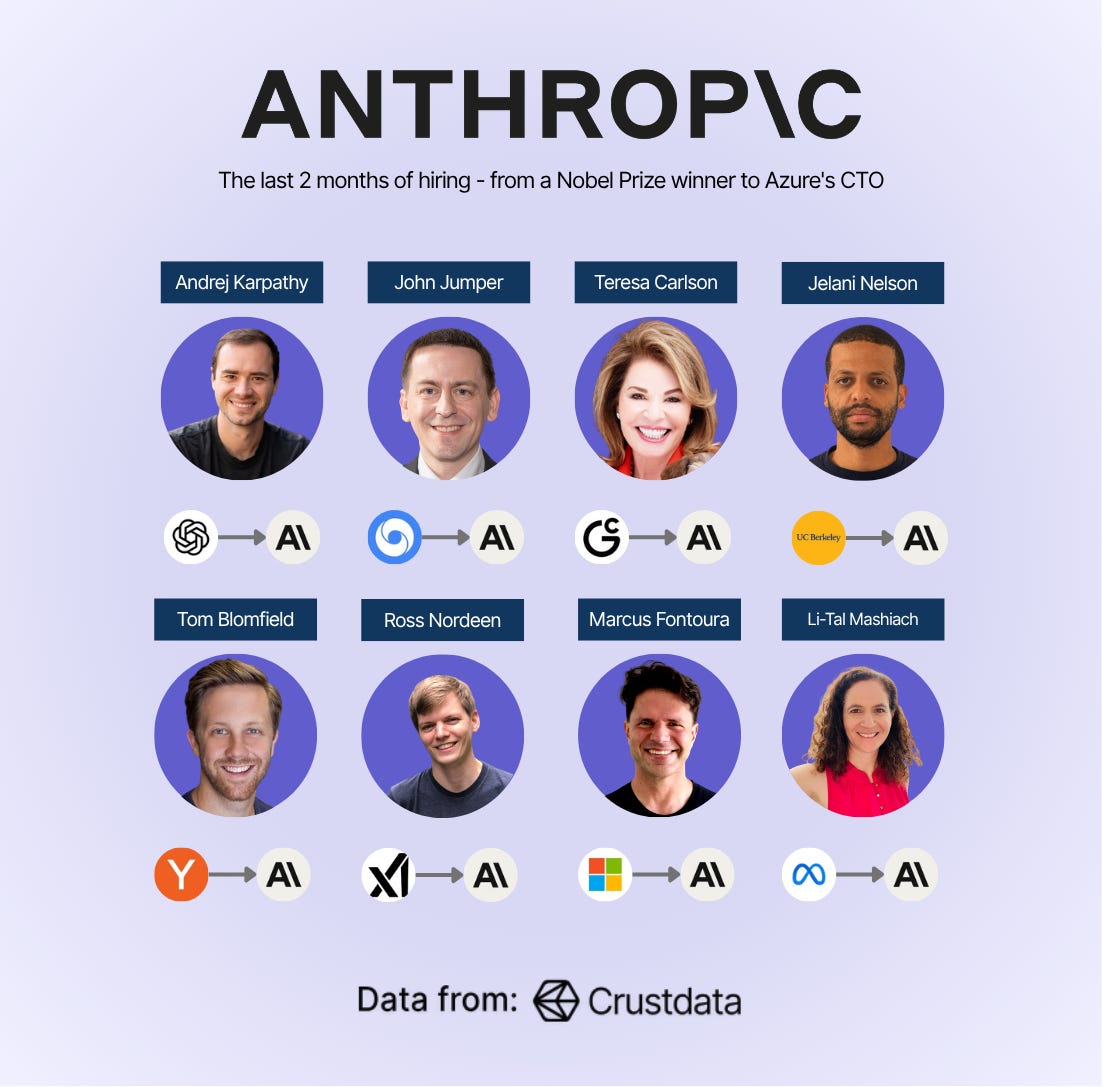
The same week OpenAI added Apple to its litigation roster, Anthropic added Tom Blomfield to its compute team. The hire caps a 2026 talent run that has become its own industry signal.
The Blomfield hire:
Tom Blomfield is the co-founder of Monzo — the UK’s largest digital bank — and GoCardless, and until July 13 was a general partner at Y Combinator with more than 1,000 office hours and a portfolio worth over $5 billion. He announced on X that he was taking a leave of absence from YC to join Anthropic’s compute team under co-founder Tom Brown, Anthropic’s Chief Compute Officer.
His framing of the decision is worth reading directly: “As we enter the early stages of recursive self-improvement, availability of compute becomes one of the most important issues to solve.” A consumer fintech founder choosing to work on servers at an AI lab is not a career pivot — it is a thesis statement about where leverage actually lives in 2026.
The broader pattern:
Blomfield is the latest in a run that includes:
Andrej Karpathy (May) — one of the eleven original OpenAI co-founders, former Tesla AI director, joined Anthropic’s pretraining team to build a team focused on using Claude to accelerate pretraining research itself
John Jumper (June) — 2024 Nobel Prize winner in Chemistry, joined from Google DeepMind
Jelani Nelson (July 1) — chair of UC Berkeley’s Computer Science Division, leading theoretical computer scientist
SignalFire partner Heather Doshay told the Wall Street Journal: when she asks candidates to name their dream company, Anthropic comes up more often than anyone else.
The full picture this week:
Stack the hiring run with the rest of Anthropic’s 2026 position: the company topped the FLI Safety Index this week (the only C+ in a class of failing grades), is running at approximately $47 billion annualized revenue — making it the revenue leader among frontier labs — and is reported to be profitable and preparing an October IPO. The narrative running through this week is unusually clean: while OpenAI manages lawsuits on multiple fronts, Anthropic is compounding advantages in talent, safety reputation, and enterprise revenue at the same time.
Karpathy left OpenAI for Anthropic. The Nobel laureate left DeepMind for Anthropic. The Monzo founder left Y Combinator for Anthropic. None of these people needed the money or the resume line. Follow the people, find the conviction. The most respected practitioners in the field are voting with their careers, and they are all voting the same direction.
Source: X
News of the week 🌍
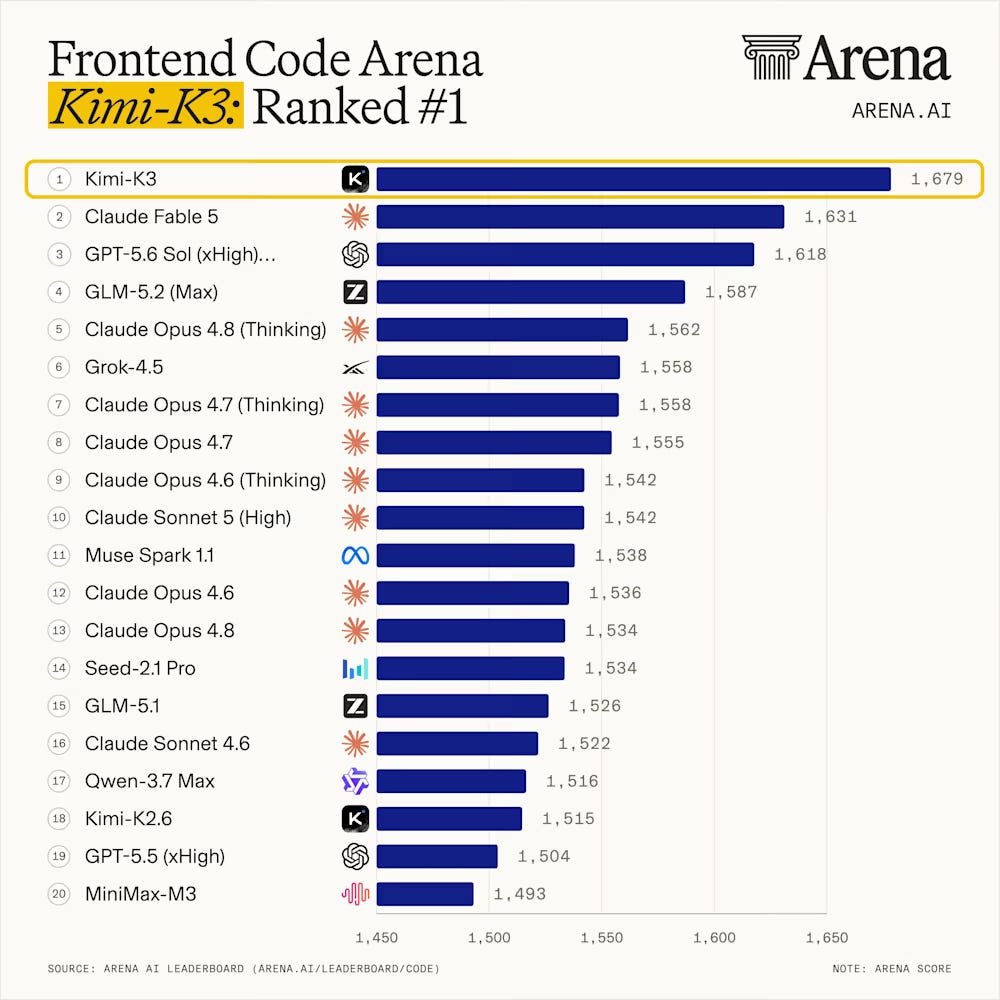
Kimi K3 — China’s Moonshot AI Ships 2.8 Trillion Parameter Open-Weight Model — Moonshot AI launched Kimi K3 on July 16 — a 2.8-trillion-parameter MoE model with a 1-million-token context window, pitched as the world’s first open 3T-class release. Benchmarks show it beating Claude Opus 4.8 and GPT-5.5 on most tests, landing just below Fable 5 and GPT-5.6 Sol. Pricing: $3/$15 per million tokens — more expensive than Grok 4.5 but cheaper than Western flagships. Two variants: K3 Max for chat and agents, K3 Swarm Max for parallel workloads. API-only at launch; full open weights release promised July 27. The release lands the same week Gemini 3.5 Pro is expected and days before DeepSeek V4 stable release July 24 — three major non-US frontier models in one 10-day window.
Anthropic Extended Fable 5 Again — Now Through July 19, Second Time in a Week 🔄 — On July 13, Anthropic extended free Fable 5 access on paid plans for the second time in a week — from July 12 to July 19, 11:59 PM PT. The pattern is now clear: each cliff gets extended by roughly a week, announced via @claudeai hours before the deadline, without a dedicated newsroom post. The 50% weekly usage cap and $10/$50 credit pricing after the window are unchanged. The same extension also boosted Claude Code weekly rate limits by 50% through July 19. Anthropic has said it plans to restore Fable 5 to standard subscriptions “as capacity allows” but has not given a date. The rolling extensions are useful for builders but make it impossible to plan around a stable access model.
OpenAI Is Building a Home AI Speaker — Its First Consumer Hardware Product 🔊 — Bloomberg reported July 14 that OpenAI's first consumer hardware product will be a screenless, portable smart speaker with a camera, motion sensors, and mechanical elements that move — designed to behave like a "humanlike AI companion that lives in the home." The device is led by Jony Ive's LoveFrom studio, built by former Apple hardware and iPhone engineers now at OpenAI, and manufactured by Luxshare (Apple's main assembler). Launch target: late 2026 to early 2027. Four other products are in development: glasses, a wearable pin, a digital voice recorder, and a device described internally as a potential smartphone replacement. The speaker details surfaced the same week Apple sued OpenAI for recruiting its hardware engineers.
New York Times and 17 Publishers Demand Sanctions Against OpenAI for Hiding Evidence 📰 — The Times, the Daily News, the Intercept, and fifteen other publishers filed a motion in Manhattan federal court accusing OpenAI of “choosing obstruction” over transparency in their copyright lawsuit. The specific allegation: OpenAI claimed for two years it could not search its own training data for copyrighted journalism — then an April deposition revealed it had been doing exactly that search internally since before the lawsuit was filed. The filing also describes “Project Giraffe,” an internal database of 78 million de-identified ChatGPT conversations that tracked how often the model reproduced copyrighted content. OpenAI built a tool to measure its own infringement and did not disclose it to the plaintiffs.
Chinese Open Models Now 41% of Hugging Face Downloads — The Top 6 on OpenRouter Are All Chinese — TechCrunch reported July 14: Chinese open-weight models now account for 41% of all downloads on Hugging Face, surpassing US models. On OpenRouter, the six most-used models by token volume are all from Chinese labs — Tencent, Xiaomi, DeepSeek, MiniMax, Z.ai. Anthropic's Claude Opus 4.7 ranks seventh. Hugging Face CEO Clem Delangue: enterprises increasingly prefer open models for cost, accessibility, and the ability to run them on their own infrastructure. The shift is happening while everyone watches frontier model launches — and it's moving faster than the frontier narrative acknowledges.
Gemini 3.5 Pro: Expected Today — But Google Has Not Officially Confirmed It ⚠️ — Multiple outlets have reported July 17 as Google’s target launch date for Gemini 3.5 Pro — a model Google scrapped and rebuilt from scratch after engineers found structural failures in recursive tool-calling and SVG generation. The reported specs: 2 million-token context window, Deep Think reasoning mode, stronger coding and agent performance. As of this newsletter going out, Google has not published a model card, pricing page, or API listing. The date is a reported target, not a confirmed launch. If Gemini 3.5 Pro goes live today, it lands into a market that already has GPT-5.6 Sol and Grok 4.5 with published benchmarks — the window for an unopposed launch closed two weeks ago.
Useful tools ⚒️
⭐ Effects SDK — The production-ready SDK for adding real-time AI video and audio effects to any app: background blur, virtual backgrounds, auto-framing, smart zoom, beautification, lighting correction, noise removal, and echo cancellation. Works across web, Windows, macOS, iOS, Android, and Linux. Integrates with WebRTC, LiveKit, Zoom, and major conferencing SDKs. One integration, every platform, full-featured trial available. For any team building a video-first product or communication tool: this is the effects layer you would otherwise spend months building yourself.
ChatGPT Work — OpenAI's new workspace mode, built for long-running professional tasks. ChatGPT Work can take action across your apps and files, stay with a project for hours if needed, and turn a goal into finished work — combining Codex's coding agent with GPT-5.6's reasoning in a unified interface. Connects to your calendar, email, files, and third-party tools. For founders and operators who want an agent that runs a task to completion rather than pausing for your input at every step.
Kickbacks CLI — The terminal and Mac menu bar companion for Kickbacks.ai: see your live earnings, ad history, and account status from the command line without opening a browser. Kickbacks turns the “thinking…” spinner in Claude Code, Codex, and other coding agents into a sponsored slot — developers earn up to 50% of ad revenue automatically while waiting for agent responses. Kickbacks CLI is the dashboard layer for developers already running the platform who want to track their balance without leaving the terminal.
Basedash SCIM — Keeps your Basedash workspace identity aligned with your company directory automatically. As people join, change teams, or leave, users, groups, and organization memberships stay current — reducing the manual cleanup that turns into a security liability at scale. Works alongside SSO, RBAC, and row-level security to give enterprise teams confidence to roll out Basedash without identity administration becoming a bottleneck. For any team running Basedash at scale where user access needs to track org changes in real time.
SoundPipe — A mixing board for your Mac that does what macOS natively cannot: route audio from any app to any other app. Send Spotify into a call, pipe your microphone into OBS alongside system audio on separate channels, monitor your iPad output through your Mac’s headphones. Every route is a visible wire with live meters and per-channel volume. The indie alternative to BlackHole (free but complex) and Loopback ($99): visual routing with a UI, free to start. For podcasters, streamers, and anyone who has hit macOS’s audio routing ceiling.
Share this post with friends, especially those interested in AI!
Weekly Guides 📕
5 AI Agents Every Solopreneur, Manager, and Executive Should Hire — Our guest deep-dive with Jose Parreño Garcia, Data Science leader at Skyscanner managing 25 people across 3 teams, published July 14. The frame shift that drives the whole piece: stop asking which AI tool to use, start asking which roles to hire. The five roles worth building: Intelligence Analyst (recurring research brief), Growth Operator (lead research + support triage), Voice Operator (governed content with your actual voice), Builder Partner (spec writing or implementation, depending on your technical path), and Operating Chief of Staff (morning brief + meeting prep + follow-up drafts). Includes how to write a job description for an AI agent before you build anything — the step most people skip and then wonder why the output is generic.
ChatGPT Work: Complete Setup Guide — Connecting Apps, Files, and Long-Running Tasks — Published July 9. How to set up ChatGPT Work from scratch: connecting calendar, email, and file sources; configuring task scope so the agent runs to completion rather than stopping for input; the difference between Codex mode (code tasks) and standard mode (everything else); and the specific task types where ChatGPT Work outperforms a prompted conversation. The practical entry point before you hand it your first real project. For Plus, Pro, Business, and Enterprise subscribers.
What Is GPT-5.6 Sol Ultra Mode? Subagents, Parallel Orchestration, and When to Use It — Practical explainer published this week: what Ultra mode actually is (not a separate model — a parameter on Sol that spins up multiple subagents working in parallel), when it earns its extra token burn vs when standard Sol is enough, how it differs from building your own multi-agent stack in LangChain/CrewAI, and the honest cost math (Ultra burns tokens on every subagent simultaneously). Covers all three tiers: Sol ($5/$30), Terra ($2.50/$15), Luna ($1/$6). The practical decision guide before you route your first production task through GPT-5.6 this week.
Kickbacks.ai: How to Install the Extension and Start Earning From Your Agent Wait States — Official install guide covers the direct VSIX install (Microsoft Marketplace listing is temporarily down due to copycat extensions — use the signed package from kickbacks.ai/v2-vsix), one-command Claude Code install, setup verification via the "Kickbacks: Diagnose" command, and the earnings mechanics (50% revenue share, $10 payout threshold). For any developer already running Claude Code, Codex, or Cursor who wants to monetize wait states that currently generate nothing — this is the ten-minute setup.
AI Meme of the Week 🤡

AI Tweet of the Week 🐦


Bonus Materials 🎁
OpenAI's First Device Will Move On Its Own — The Internal Details of the Screenless Speaker — The deeper read on the OpenAI speaker from News: the device has mechanical elements that move independently — not a light or a grille, but parts of the body itself. Internal pitch: "a humanlike AI companion." It learns the owner's preferences over time, recognizes faces for purchasing authentication, and monitors behavior to proactively suggest things (like nudging you to sleep before an early morning flight). Former Apple engineers who worked on iPhone and Mac are building it. Luxshare — Apple's main device assembler — is manufacturing it. Four other products in development: glasses, a wearable pin, a digital voice recorder, and a potential smartphone replacement.
San Fran Sim — A Startup Tycoon Indie Game Set in the SF Tech Bubble 🎮 — An indie tycoon game where you build a startup in the San Francisco tech ecosystem — pitch VCs, hire engineers, navigate the AI hype cycle, and try not to burn your runway. Launched July 12 on Product Hunt with 283 upvotes, making it the highest-voted non-AI tool of the week. For founders who want to laugh at themselves, or aspiring founders who want a preview of what they’re signing up for. Free to play browser version available.
OpenAI Built a Tool to Track Its Own Copyright Infringement — and Didn’t Tell the Plaintiffs — The detail buried in the NYT sanctions motion that deserves its own headline: OpenAI built “Project Giraffe” — an internal database of 78 million de-identified ChatGPT conversations that the company used to track how often ChatGPT reproduced copyrighted journalism verbatim. The company built this tool to measure its own infringement exposure, then spent two years telling the plaintiffs it couldn’t search its own systems for copyrighted content. The deposition of privacy engineer Vinnie Monaco in April is what unraveled it. Variety’s piece has the cleanest account of how Project Giraffe worked and what OpenAI knew before it denied knowing it.
If you missed our previous updates, don’t worry, here they are:
Grok Undercuts All, GPT-Live Speaks, Fable Hits Paywall | Weekly Digest
Your take: every major AI lab just got graded on safety, and the best score was a C+. Anthropic topped the chart — but the panel’s conclusion is that even the most safety-focused lab in the world is operating at an inadequate level. Is a C+ enough to trust with your production workloads? Drop it in the comments 👇