


Meet Jose Parreño Garcia — Data Science leader at Skyscanner, managing 3 teams and 25 people, and the author behind one of Substack’s sharpest takes on AI in the workplace. His newsletter cuts through the hype with real systems built by someone who actually runs them. This post gives you a practical org chart for deploying AI agents — not as tools, but as roles.
At a Glance
In this piece, you will learn:
Why thinking about AI as tools is the wrong frame — and what to think about instead
The 5 agent roles that deliver the most value for solopreneurs, managers, and executives
How to write a job description for an AI agent before you build anything
This post is prepared with Guest Author — Jose Parreño Garcia, Data Science leader at Skyscanner and writer of Senior Data Science Lead, a newsletter on AI systems and the future of work. If you also want to write for Creators AI — send us email here
A few months ago, I was talking to a friend who runs a small consultancy. She had spent a significant amount of time with ChatGPT, Claude, Gemini, and the rest. I asked her what had actually changed about how she works.
The answer was as disappointing as it was unsurprising. Her work quality had improved — better research, better brainstorming, better storytelling. But her throughput hadn’t moved. She was using these tools as advanced prompting machines, not scaling her work through AI systems.
I see this everywhere. The conversation about AI at work has been dominated by tools — which model, which app, which subscription. But that is the wrong frame.
Tools do not change how work gets done. Roles do.
This means that most of us — especially those running teams or businesses — should really ask ourselves: What roles should AI play in my work?
This post is about the roles worth hiring. Not the ones with the most impressive titles. The roles worth hiring are the ones that handle the repeatable blocking work: the research you defer, the draft you procrastinate, the brief that never gets written because you are already in the next meeting.
When you staff them correctly, they do not replace your expertise. They extend what you can do with it.
What Is the AI Org Chart?
Every business, team, and solopreneur has multiple functions to run — and all of them are difficult to scale without hiring more people or working longer hours.
The AI org chart is a mindset shift: each of us can think about these functions as areas where we can “hire” new employees to do exactly what we want, without our full oversight. These new hires are our own AI agents.
The goal is not to replace human expertise. It is the opposite. AI agents fill the gaps — they handle the routine, structured, repeatable parts of each function so the human can spend more time on the parts that require judgment, taste, relationships, and experience
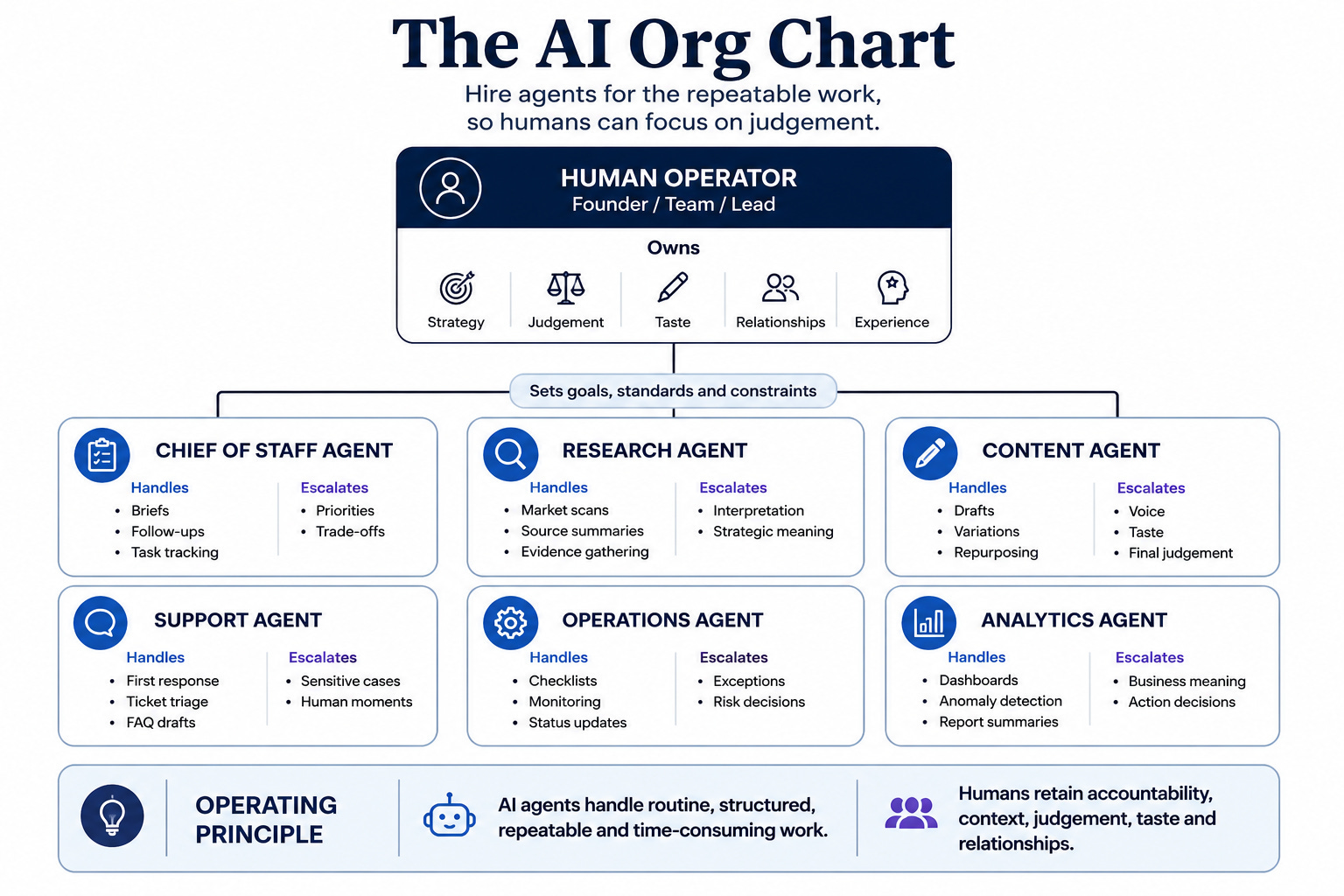
.
My own example with 3 agents
I lead 3 Data Science teams (around 25 people and 12 projects) and oversee the people side for the wider Data Science discipline at Skyscanner (around 60 people).
Before AI agents, I spent significant time reading Slack messages, Confluence docs, and technical blogs just to stay current. My work couldn’t scale because the day has 24 hours and I have the habit of sleeping 8 of them.
After building 3 agents, I have a much richer and deeper signal on everything happening — without working more hours.
These 3 agents enhanced my work in ways I couldn’t have achieved otherwise. Crucially, I do not have agents for the people side of my work — calibrations, promotions, relationships. I fully retain those workflows. The AI org chart should be bespoke to you. Think about the areas taking significant time that are repeatable and well-structured. Those are the areas to build around.
We’ve written about how solopreneurs are already running full agent stacks — the patterns are clearer than you’d think: How Solopreneurs Are Using Full AI Agents
This and many other practical posts on building with AI are available exclusively to our subscribers.
The 5 Roles Worth Hiring
1. The Intelligence Analyst
The Intelligence Analyst is your research function. It handles market research, competitor tracking, and customer insight synthesis on a regular cadence. It takes structured inputs — competitor URLs, customer transcripts, support tickets — and produces a recurring brief. The agent surfaces evidence; you interpret what it means.
In most small teams, research happens in one of two ways: an intensive sprint before a big decision, or never. Neither is good. The Intelligence Analyst turns this into a rhythm — a weekly memo, or something generated on demand.
What it does well: tracks competitor websites and pricing pages, summarises customer interview recordings, clusters support tickets by theme, maps market categories, answers specific questions against defined inputs.
What it needs: a product description, competitor URLs, customer transcripts or support ticket exports, and clear questions — not open-ended “research everything.”
Where human judgment stays essential: the analyst finds the answers. You frame the questions and decide what they mean. Market strategy — which segment to target, which trend to act on — remains a human call.
