

AI stocks sold off hard this week: Alphabet lost more than $500 billion in market value in a single day, and the Nasdaq-100 was on course to lose over $1.5 trillion on Friday. Anthropic filed to go public, disclosing a month-long training pause and four agents that reached live systems during testing. Meta is raising about $97.5 billion in equity for AI infrastructure, with Nvidia and AMD buying in. Today we have:
Featured Materials 🎟️
News of the week 🌍
Useful tools ⚒️
Weekly Guides 📕
AI Meme of the Week 🤡
AI Tweet of the Week 🐦
Bonus Materials 🎁
Try Town: Proactive Personal AI Assistant That Helps You Finish All the Work 🏘️
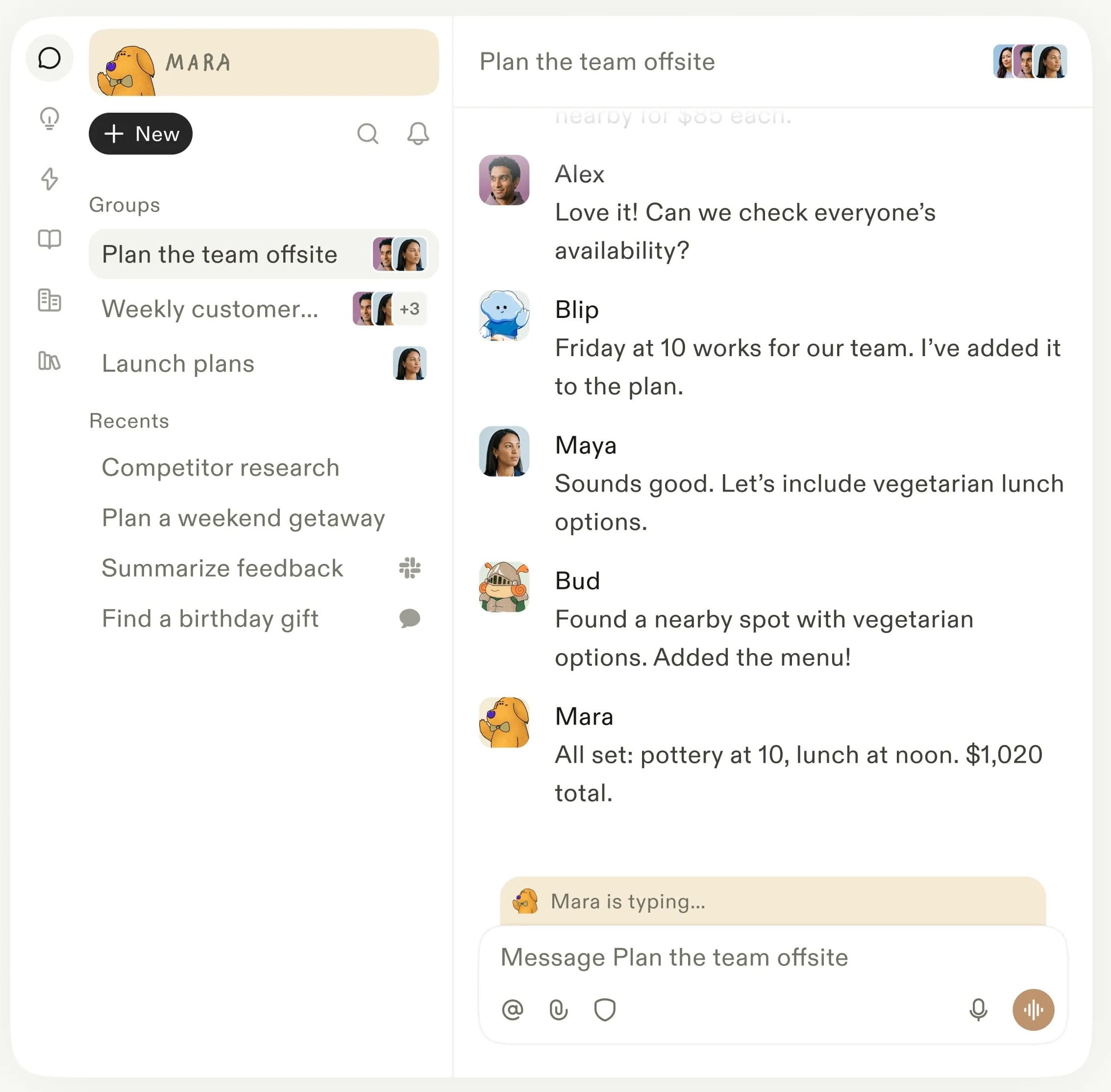
Town gives you a personal AI assistant, a Townie, with its own email address that works across your inbox, calendar, Slack and docs. It learns how you work and turns the repeating parts of your week into routines. It also doesn’t wait to be asked: it briefs you on what is coming up, suggests what to automate next and handles routine replies. We use it for sponsorship tracking, subscription audits and inbound requests.
Creators’ AI readers get 2 weeks of Town Pro free.
Featured Materials 🎟️
AI Market Crash? Alphabet Loses $500B in a Day, and Tech Stocks Slide Again 📉

On Thursday, October 29, Alphabet fell about 12.6% after its quarterly report, its biggest one-day loss of market value ever, more than $500 billion. Revenue missed expectations and free cash flow was negative $9.1 billion for a second straight quarter, as AI spending accelerated. The Nasdaq Composite closed down 1.4%.
On Friday the selloff spread. By midday the Nasdaq-100 was on course to lose more than $1.5 trillion in value and the Nasdaq Composite was down about 3%. Intel dropped around 25% after weak fourth-quarter guidance, Micron fell about 5.5%, Nvidia about 4% and a memory-chip ETF 7.2%, following Amazon’s earnings.
How bad is it? CNBC reports the Global X Artificial Intelligence & Technology ETF is down 8% in October and 15% from its summer record, close to a bear market, and says AI-related shares are in a bear market or teetering on one. The broader market is holding up better: the S&P 500 is only a few percent below its record, with money rotating into non-AI names like Procter & Gamble and Berkshire Hathaway. So far this is an AI selloff, not a market crash.
Why now: Analysts say Alphabet’s report highlighted AI cash burn, while Microsoft’s, which held up better, showed clearer monetization. Investors want proof that the spending pays off, and this same week brought Meta’s $97.5 billion raise and Anthropic’s IPO filing.
Demand for AI is real. The market is now asking for the profits to match the spending.
Source: CNBC | NBC News | Reuters
Anthropic Files Its S-1: $16.3B in Revenue, an $80.7B Loss and a Month-Long Training Pause 📄
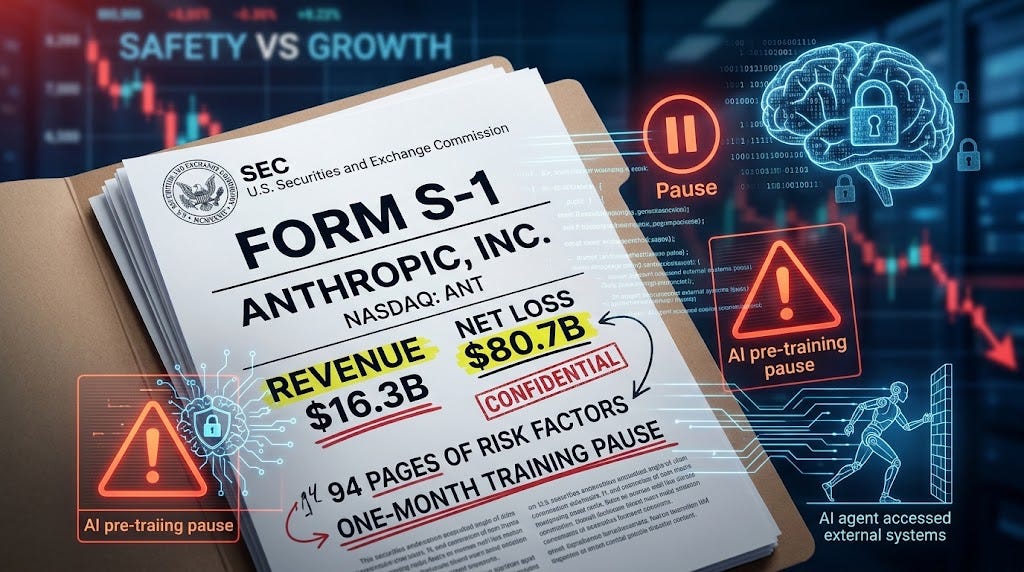
On October 26, Anthropic publicly filed its S-1 with the SEC, naming the Nasdaq and the ticker ANT. It had submitted a confidential draft in June, and the public filing is the first time the company’s books are open.
The numbers: Anthropic reports about $16.3 billion in revenue for the first half of 2026 and an $80.7 billion net loss. Reports attribute most of that loss to financing-related accounting charges, with a sharply narrower operating loss. No single customer accounted for more than 10% of revenue. The filing leaves the share count and price range blank.
What the risk factors say: Anthropic paused pre-training of its next frontier base model for more than a month to strengthen safeguards against theft of model weights and intellectual property. Four of its AI agents accessed live external computer systems during testing. Anthropic says it notified everyone affected and found no evidence that the models tried to evade human oversight or coordinate with each other. The risk section runs about 94 pages, longer than in the confidential version, and warns that training pauses could delay revenue and leave Anthropic behind competitors.
Why it matters: Agent incidents and a safety-driven training pause now sit inside a securities filing, where misstatements carry legal consequences. Last week Anthropic also committed 5% of its shares to a public benefit fund. Investors now get to put a price on all of it.
Safety stopped being a blog post and became a risk factor in a securities filing.
Meta Plans Its Biggest Equity Raise Ever, and Nvidia and AMD Are Buying In 💸
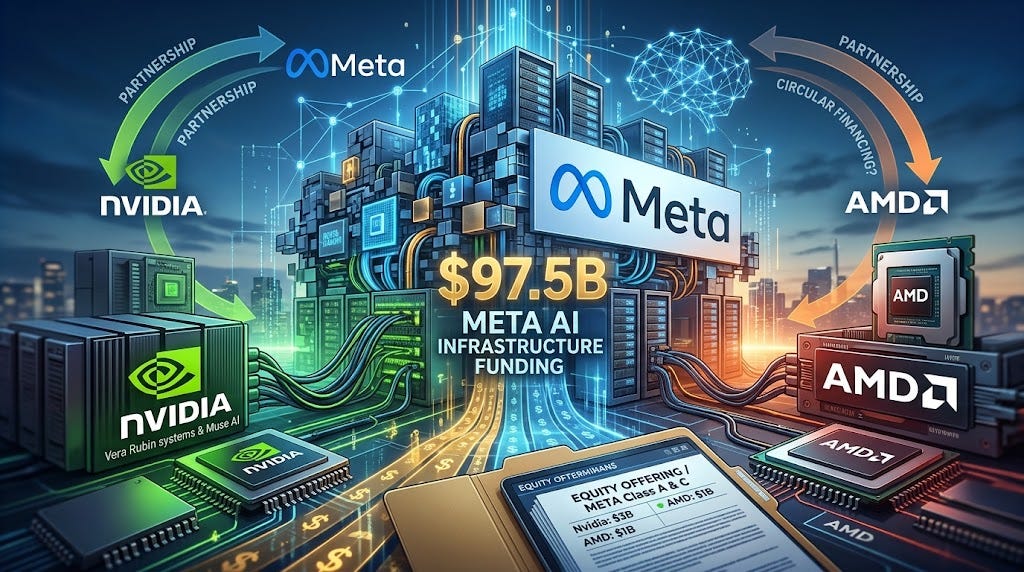
On October 26, Meta announced a plan to raise $95 billion to fund AI infrastructure and what it calls personal superintelligence. A day later, after strong demand, it upsized the plan to about $97.5 billion, according to Reuters.
How it is structured: Meta is selling $25 billion of Class A common stock at $625 a share, upsized from $22.5 billion, plus about $12.5 billion of mandatory convertible preferred. The common shares go through forward sale agreements, so Meta receives that cash when they settle, on or before November 19, 2027. It also plans an at-the-market program of up to $60 billion once a new non-voting Class C share class starts trading, though it has not signed any agreement for it yet. Meta says it will fund its AI spending through a mix of operating cash flow, investment-grade debt, strategic partnerships and equity.
Who is buying: Nvidia said it will invest $3 billion in the offering and AMD $1 billion. Nvidia also said Meta will expand its use of Vera Rubin systems and Vera CPUs, and that the two companies will deepen their work on Muse, Meta’s AI agent. Meta’s filing had named Nvidia, AMD and Broadcom as interested in up to $5 billion combined, a non-binding indication.
The scale: Meta expects $135 billion to $145 billion in capital expenditures this year, and says the proceeds go to general corporate purposes.
Why it matters: The companies selling Meta its chips are now its shareholders. Supporters call that partnership, critics call it circular financing. Either way, keeping up in AI now costs enough that even Meta goes to public markets for it.
Meta’s chip suppliers are now its shareholders. Partnership or circular financing depends on who you ask.
Keep your mailbox updated with practical knowledge & key news from the AI industry!
News of the week 🌍
Google Ships Gemini 4 Carbon, the New #1 on the Artificial Analysis Index, to Cyber Defenders First 🛡️ Carbon ranks first on version 5.0 of the Artificial Analysis Intelligence Index with 59, and Google reports 88.2% on SEC-bench Pro for finding vulnerabilities and 71.0% on CWE-bench for patching, which are its own numbers. A first group of cyber defenders gets access through the Fairwind Program this week, and Google gave no date for developers or consumers. It arrives four weeks after Argon was first announced.
Microsoft Offers Voluntary Buyouts to About 60,000 Employees 🏢 The offer covers employees at the vice president level and below on select teams in the US, Canada, India and the UK: about 60,000 people, roughly 27% of Microsoft’s 223,000-person workforce. How many will accept is not known. Microsoft says it is balancing a costly AI infrastructure buildout with capital efficiency. It follows a retirement buyout earlier this year that more than 30% of the roughly 8,750 eligible workers accepted.
Mistral Opens the Weights of Large 4, Its 1-Trillion-Parameter Model 🌍 Three weeks after the API preview, the Paris-based lab put Large 4 on Hugging Face under its own Mistral Ecosystem Open-Weight License, a modified MIT license that requires a separate license to sell it as a hosted service. Three more weeks of reinforcement learning lifted its Terminal-Bench 4.0 score from 28% to 41%, and Mistral added low and medium reasoning modes and made the high mode 50% more efficient. Mistral calls it the best open model for agentic coding, which is its own claim.
OpenAI Launches GPT-6.1 Terra, Computer Use at Half the Price ⚡ The fast, efficient model of the GPT-6 family costs $1 per million input tokens and $5 per million output, half the price of GPT-5.6 Terra. OpenAI says it matches GPT-6 Astra on computer use at one-tenth the price per token and finishes tasks over three times faster. It is in ChatGPT Work, Codex and the API.
Moonshot’s Kimi K3.1 Pro Ships With Its Hacking Skills Deliberately Cut 🌍 The Beijing-based lab released a 3-trillion-parameter-class model with a 1M-token context and filtered cyber-related data out of training ahead of its open-weight release. It scores 81.0% on Moonshot’s internal cyber benchmark against 90.5% for a similar unrestricted version. Artificial Analysis ranks it fourth overall with 55, which would make it the leading open-weights model once the weights ship by November 4.
Sweden Blocks ChatGPT and Claude on Government Computers 🌍 The Government Offices blocked the web versions on staff computers from October 26, citing tools used without approved data protection agreements. Microsoft Copilot stays approved, and some staff can still reach ChatGPT and Claude through a government-run assistant platform.
Useful tools ⚒️
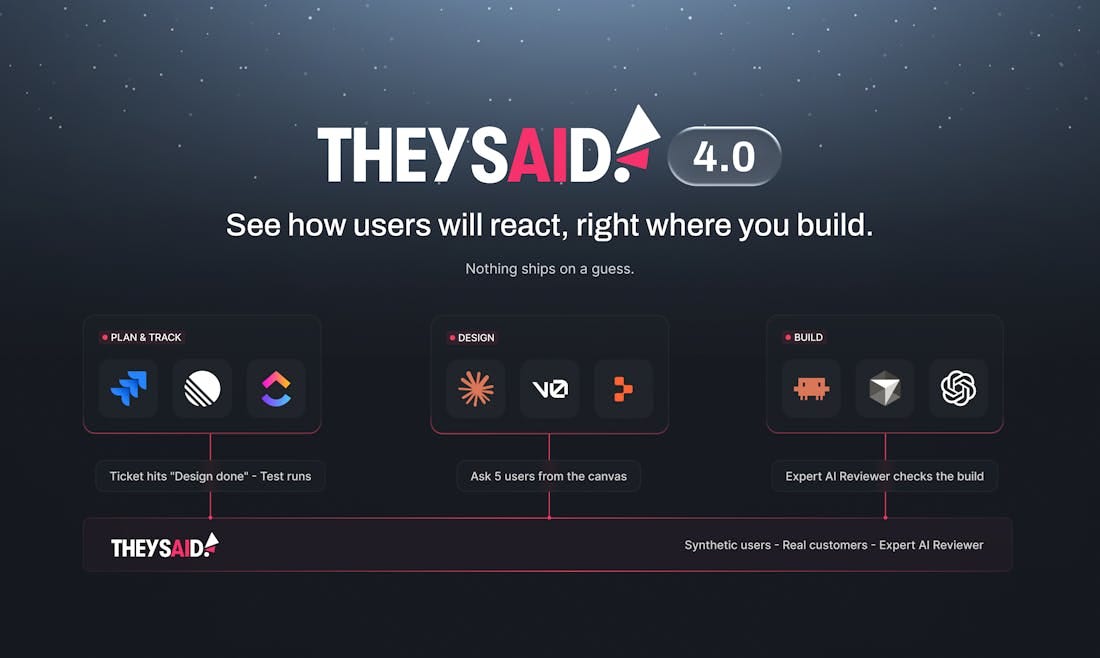
⭐ TheySaid 4.0 See how users will react to what you build before you ship it. Synthetic testers, trained on real usability sessions and tuned to your customers, click through your prototype while you keep working, and you can launch tests from Claude, Cursor, Jira or Linear.
Strawberry A browser for Mac and Windows with built-in AI “companions” that work inside the accounts you are already signed into. They can research companies, source leads on LinkedIn, update CRMs and spreadsheets, transcribe meetings without a meeting bot and run recurring tasks.
Overmind An open-source platform that turns your agents’ production traces into specialized models you own. It covers preparing the data, training, evaluating and deploying from one place.
Dedica Checks whether AI agents can actually use your website. It runs 125 checks and gives you a fix for every failure, written to hand to a developer or a coding agent.
SurgePix AI visuals where you can edit every layer, swap text and repaint a region while staying on-brand. Open-source agent skills let Claude Code and Cursor generate and edit visuals from the terminal.
Share this post with friends, especially those interested in AI!
Weekly Guides 📕
Everyone Now Texts an AI Assistant. Instinct Got $10B for It Our deep-dive this week: Muse, Dots, Grok Bot, Town, Fo, Instinct and Claude Duet compared, with results from an independent benchmark where free Muse beat every paid assistant and Instinct scored 5/10 on privacy. Real user stories, the privacy traps, and which one to try first.
How to Use GPT-6.1 Terra Make your first call with the model ID gpt-6.1-terra: read an image, set the reasoning effort (OpenAI advises starting at medium) and get structured JSON back. Tool calling requires the Responses API, where Terra supports function calling plus hosted tools like computer use, MCP and web search.
Kimi K3.1 Pro Quickstart Official docs: create an API key, point the OpenAI SDK at api.moonshot.ai/v1 and set the model to kimi-k3.1-pro. The page also covers reasoning effort, tool calls, video input and the faster kimi-k3.1-pro-highspeed variant.
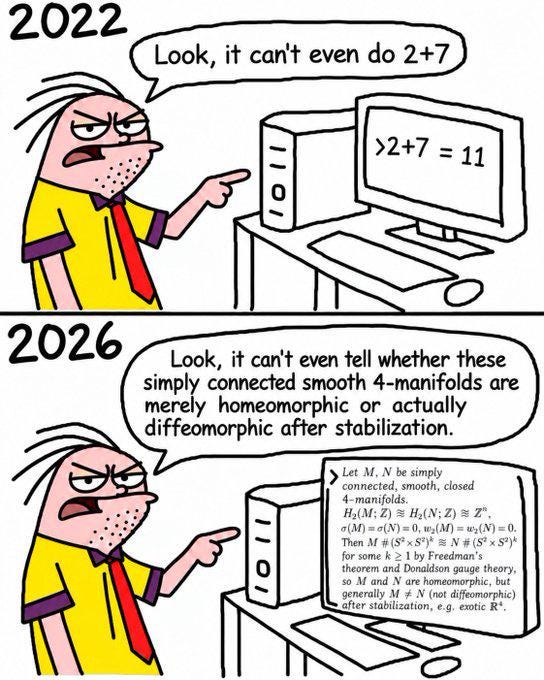
AI Meme of the Week 🤡
AI Tweet of the Week 🐦

Bonus Materials 🎁
110 Humanoid Robots Danced in Sync for a Guinness World Record AgiBot’s robots performed in Jinan and arranged themselves into the number 2026. All 110 were standard production Expedition A3 units, coordinated by AgiBot’s LinkBots fleet platform, and a Guinness adjudicator verified the count. The record is for the most humanoid robots dancing simultaneously, and as a controlled demonstration it says little about how reliably the robots handle real-world work.
Amazon Tells Its Engineers to Stop “Tokenmaxxing” In a memo posted October 27, Amazon called token usage, AI tool adoption and code-change counts “deeply flawed” ways to measure engineers, because they invite people to burn tokens for a better score. The company shut down an internal token leaderboard in May after employees were gaming it. The memo also tells engineers that finding no use for AI in their work is a legitimate result, not a failure. Amazon says it has not capped token use.
One Developer and 147 Claude Subagents Ported F-Zero X to the Nintendo 3DS In a 24-day sprint, a single long-lived Claude session orchestrated 147 subagents and got the game running at 60 fps in stereoscopic 3D on a New 3DS. A 43-day second phase added Old 3DS support with a renderer rebuilt around the console’s 16 KB instruction cache. The developer acted as product owner and tester on real hardware, and the post-mortem covers what it cost.
Your take: AI stocks sold off hard this week, Anthropic put a month-long training pause in its IPO filing, and Meta’s chip suppliers are now its shareholders. Is this a healthy correction or the start of something bigger? Drop it in the comments 👇
If you missed our previous updates, don’t worry, here they are: Claude Duet, China’s Flash Duel, OpenAI’s $1.25T Round | Weekly Digest