


On June 30, the US Department of Commerce lifted export controls on Fable 5 and Mythos 5 — ending 18 days offline. On the same day, Anthropic launched Claude Sonnet 5 at $2/$10 per million tokens and Claude Science, a research workbench with 60+ scientific databases. On July 2, OpenAI proposed giving the US government a 5% equity stake worth $42.6 billion, modeled on Alaska’s Permanent Fund. Also this week: Microsoft launched Frontier Co., a $2.5B AI deployment subsidiary with 6,000 forward-deployed engineers. Today we have:
Featured Materials 🎟️
News of the week 🌍
Useful tools ⚒️
Weekly Guides 📕
Bonus Materials 🎁
Keep your mailbox updated with practical knowledge & key news from the AI industry!
Featured Materials 🎟️
Fable 5 Returns After 18 Days — With Sonnet 5 and a Jailbreak Standard in Tow 🧠

On June 12, the US Department of Commerce ordered Anthropic to pull Fable 5 and Mythos 5 offline after Amazon researchers found a jailbreak. Eighteen days later, on June 30, the same department lifted those export controls. Fable 5 returns globally on July 1. Mythos 5 returns for approved US organizations.
The arc from shutdown to restoration is the important part. When the directive landed, Anthropic said it disagreed that a narrow jailbreak warranted shutting down a model already less capable than freely available alternatives. Over the following 18 days, Anthropic worked with the US government, Amazon, Microsoft, Google, and 19 other Glasswing organizations to build a formal framework for evaluating jailbreak severity — a structured rubric that defines what constitutes a meaningful safety concern versus an incremental risk already present in deployed systems. The framework is being proposed as an industry standard. The first version is already public.
Claude Sonnet 5:
The same day Fable 5 returned, Anthropic launched Claude Sonnet 5 — described as the most capable and most agentic Sonnet model to date. Introductory pricing: $2 per million input tokens, $10 per million output, through August 31. That makes Sonnet 5 cheaper than Opus 4.8 ($5/$25) while matching or exceeding it on most coding and agentic tasks.
Key changes from Sonnet 4.6: adaptive thinking is on by default, manual extended thinking is removed, and the tokenizer has been updated. On the SWE-bench coding benchmark, Sonnet 5 outperforms Sonnet 4.6 by a significant margin. For developers running agent workflows that previously required Opus 4.8’s capabilities: Sonnet 5 is the new recommended daily driver.
The jailbreak severity framework:
Alongside the restoration, Anthropic and its Glasswing partners proposed a public rubric for rating AI jailbreaks by severity — distinguishing between attacks that produce incremental risk, attacks that unlock already-available capability, and attacks that create genuinely novel dangerous capability. The framework is intended to prevent future situations where a government agency lacks the vocabulary to distinguish a critical safety issue from a marketing concern. The 19 partner organizations span cloud providers, cybersecurity firms, and AI labs.
Anthropic’s Fable 5 spent 18 days offline — and came back with a co-authored industry safety standard and a faster, cheaper model released on the same day. Whatever the Fable 5 shutdown cost in product disruption, the jailbreak severity framework and Sonnet 5 both arrived because of the pressure it created.
Source: Anthropic
Claude Science: Claude Code for the Lab Bench 🔬

On June 30, Anthropic launched Claude Science — its most significant new product since Claude Code. Claude Science is not a new model. It runs on Claude Opus 4.8 with no special access. What is new is the environment around it: a research workbench that integrates over 60 scientific databases, manages compute across your own infrastructure, produces auditable artifacts, and runs multi-agent workflows across the full span of a research project.
What it does:
A coordinating agent handles the research conversation in plain language. It routes work to specialized sub-agents that can search literature, run code, execute analyses, and generate figures — natively rendering 3D protein structures, genome browser tracks, and chemical structures without additional software. A separate reviewer agent runs continuously alongside the work, checking citations, flagging calculations that can’t be verified, and correcting errors before they propagate downstream. Every figure Claude Science generates includes the exact code and environment that produced it, a plain-language explanation of how it was made, and the complete message history — so the work is reproducible months later, not just now.
What it ships with:
Pre-configured connectors for genomics, single-cell analysis, proteomics, structural biology, and cheminformatics. Integration with NVIDIA’s BioNeMo Agent Toolkit (Evo 2, Boltz-2, OpenFold3). Runs locally on macOS and Linux, or over SSH to your own HPC cluster, or on Modal for compute on demand. Available in beta to all Claude Pro, Max, Team, and Enterprise subscribers.
The competitive map:
Three strategies are now competing for the same pharma and research budgets. Anthropic is betting on workflow — broad access, low friction, existing model. OpenAI launched GPT-Rosalind, a biology-specific fine-tuned model, available only to qualified US enterprise customers through a governed access program. Google’s Gemini for Science, launched at I/O in May, bundles proprietary scientific foundation models with life science databases. In OpenAI’s own LifeSciBench — built with 173 PhD scientists — even GPT-Rosalind cleared only 36.1% of real research tasks. Claude Science’s bet is that the bottleneck is not the model’s raw biology knowledge but the researcher’s ability to connect it to their specific data and workflow.
The grant program:
Anthropic will fund up to 50 Claude Science research projects at up to $30,000 in credits each. Applications open through July 15, 2026, with projects running September through December. Early lean toward biomedical research, but the program is described as spanning domains.
Claude Science is Anthropic’s argument that frontier AI’s next major market is not consumer chat or enterprise SaaS — it’s the scientific method itself. The same thesis that produced Claude Code (”what if the AI lived inside the workflow?”) applied to research. The data from early beta use cases suggests the main bottleneck it solves is not intelligence but fragmentation.
Source: Anthropic
OpenAI Offers Washington a 5% Stake — $42.6 Billion, Modeled on Alaska’s Oil Fund 💰
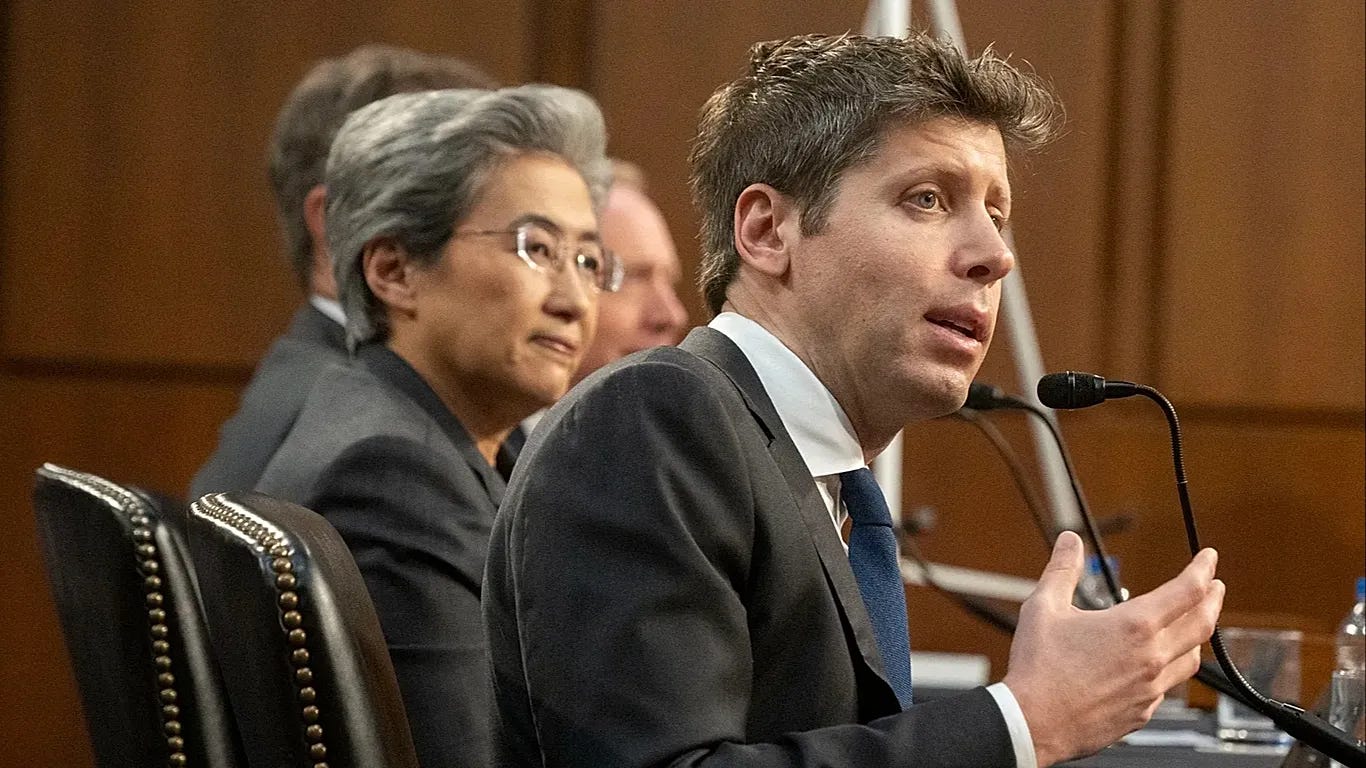
On July 2, the Financial Times reported that OpenAI has proposed giving the US government a 5% equity stake in the company — worth approximately $42.6 billion at its $852 billion March 2026 valuation. CNBC confirmed the reporting. OpenAI declined to comment.
The structure:
The proposal, described as “conceptual and early-stage,” would not simply hand equity to the government. It envisions a vehicle modeled on the Alaska Permanent Fund — a sovereign investment fund that holds assets and distributes returns annually to beneficiaries. In Alaska’s version, those are state residents; in OpenAI’s version, they would be the American public. Sam Altman has discussed the idea directly with President Trump, Commerce Secretary Howard Lutnick, and Treasury Secretary Scott Bessent. He has also spoken with Senator Bernie Sanders, who has separately proposed a 50% tax-based stake in all major AI companies.
The precedent:
The Trump administration has run this playbook in semiconductors. The US government took a 9.9% stake in Intel through the CHIPS Act in August 2025. Nvidia and AMD agreed to revenue-sharing arrangements on their China AI chip sales — 15% of revenue, rising to 25% on some products. A government equity stake in a frontier AI lab would follow the same pattern but at significantly larger implied scale.
What’s unclear:
Whether any other major AI lab would agree to the same arrangement. The proposal envisions Anthropic, Google, and Meta contributing equivalent stakes — none of which have indicated they would participate. Whether implementing the deal requires Congressional approval. Whether the Trump administration will accept, negotiate, or reject the offer. Whether a government shareholder in OpenAI creates a conflict of interest when that same government regulates it.
What it means for the industry:
If this or a similar deal closes, the regulatory relationship between the US government and frontier AI labs changes structurally. A government holding equity in an AI company has a financial interest aligned with that company’s success, alongside its oversight role. That dynamic — already present in the Intel relationship — would extend to the AI model layer for the first time.
Altman’s 5% is the smallest number attached to public AI ownership that has been seriously proposed. Sanders wanted 50% through a tax. Trump’s AI executive order suggested the president preferred equity over cash. The Alaska Permanent Fund comparison is doing a lot of work: if frontier AI is the new oil, Altman is proposing to give the federal government the same position Alaska gave its citizens over its resource wealth.
Source: CNBC
News of the week 🌍
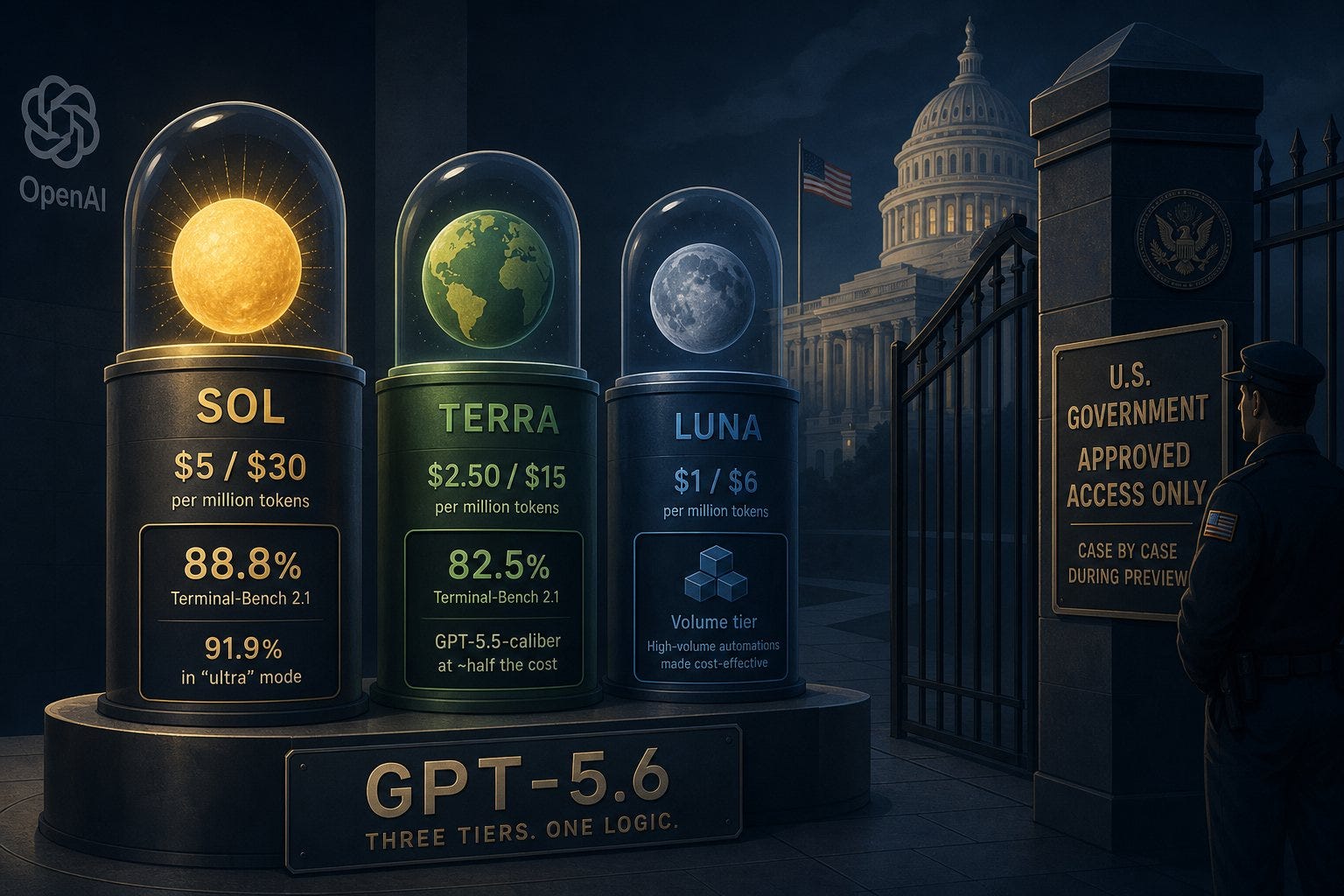
OpenAI Previews GPT-5.6 (Sol, Terra, Luna) — But the Government Is Gating Access 🤖 — OpenAI unveiled its next model generation with a new naming scheme: Sol (flagship), Terra (balanced, ~2× cheaper than GPT-5.5 at similar quality), and Luna (fastest, cheapest). Sol sets a Terminal-Bench 2.1 record and matches the unreleased Mythos Preview on ExploitBench using ~⅓ the tokens. The twist: access is limited to ~20 government-approved partners — not even Plus/Pro subscribers can use it. Following the June 2 executive order, OpenAI "previewed the models' capabilities" with the US government, which requested a staged rollout. Pricing: Sol $5/$30, Terra $2.50/$15, Luna $1/$6. Broad availability expected "in coming weeks." The first time a commercial AI model's release calendar was set in coordination with the state.
Microsoft Launches Frontier Co. — $2.5B, 6,000 Employees Embedded With Enterprise AI Clients 🏢 — On July 2, Microsoft announced Microsoft Frontier Co., a $2.5 billion subsidiary dedicated to embedding engineers and sales staff directly with enterprise customers to implement AI. The 6,000-person team will work alongside clients rather than deploying from Microsoft’s offices — following the “forward deployed engineering” model pioneered by Palantir. The announcement is Microsoft’s explicit acknowledgment that selling Azure credits and Copilot licenses is no longer sufficient: the gap between “AI available” and “AI working” in enterprise is a human problem, not a technology problem.
Meta Is Building a Cloud Business to Sell Its Excess AI Compute 💻 — Bloomberg reported July 1 that Meta is building a cloud business — internally dubbed “Meta Compute” — to commercialize surplus capacity from its $125–145B AI infrastructure buildout. Two models under consideration: selling developers access to Meta-hosted models (including Muse Spark) like AWS Bedrock, or selling raw compute like CoreWeave. Either path puts Meta in direct competition with AWS, Azure, and Google Cloud. Neocloud stocks (CoreWeave, Nebius, IREN) fell on the news. The move signals that at $145B of AI capex, the only way to justify the math is to make the infrastructure itself a business.
Zuckerberg: AI Agent Development Is Moving Slower Than Expected 📉 — At an internal Meta town hall on July 2, Mark Zuckerberg told employees that AI agent development over the past four months has not “accelerated in the way we expected,” and that the company’s recent reorganization and job cuts “haven’t come to fruition yet.” Reuters heard a recording of the meeting. The admission is notable given Meta’s projected $145B AI spend this year. For builders: the most honest signal from an AI lab CEO this quarter is that autonomous agents are harder and slower to get right than the roadmaps suggested.
UK's National Grid Bets $1.75B on US Power for AI Data Centers ⚡ — On July 1, Britain's National Grid announced a $1.75 billion investment for a 35% stake in Joulent, a US energy platform building power infrastructure for AI data centers (valuing Joulent at $5B). The first project: Project Kilby, a 2.67-gigawatt gas plant in West Texas developed 50/50 with Chevron, supplying a Microsoft data center under a 20-year power purchase agreement — bypassing the public grid entirely. The deal shows AI's bottleneck moving from chips to electricity: utilities are now direct financial participants in the AI buildout, not just suppliers.
UN Launches "AI for Good" Commission — Nvidia, Amazon, Microsoft CEOs Sit With Heads of State 🌍 — On July 1, the UN and ITU launched the AI for Good Global Commission — 40+ founding members putting Jensen Huang (Nvidia), Andy Jassy (Amazon), Brad Smith (Microsoft), and Anthropic co-founder Jack Clark at the same table as heads of state from Rwanda, Estonia, and Nigeria, co-chaired by Salesforce's Marc Benioff and Rwanda's President Kagame. First meeting: July 8 in Geneva. The launch arrives as AI governance fragments — US export restrictions, Europe's risk-based AI Act, Asia's state-backed efforts. The goal: a common table before regulation splits into competing blocs. Directly relevant after the Fable 5 saga showed how fast unilateral government action disrupts global AI access.
Useful tools ⚒️
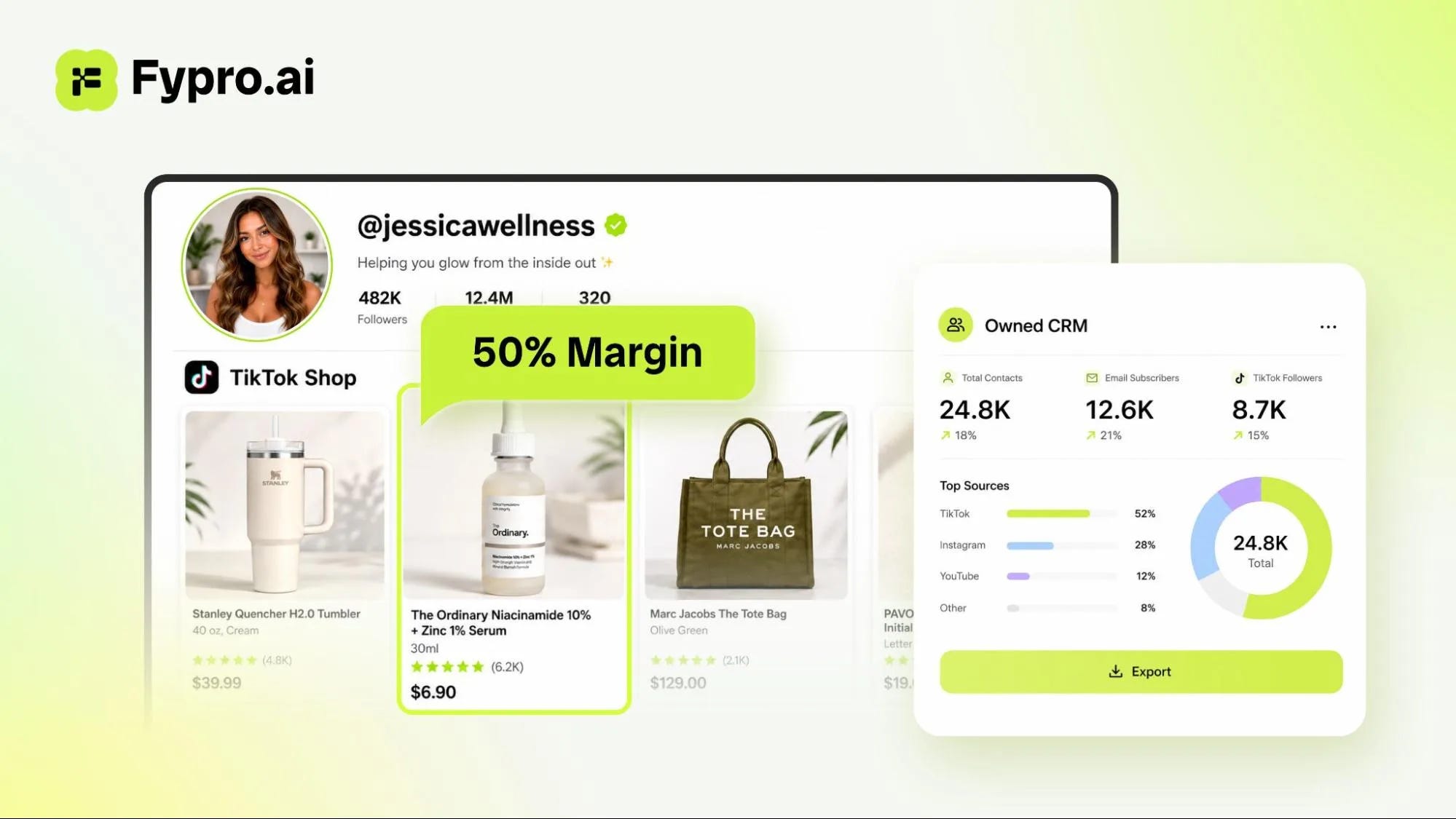
⭐ Fypro — Turn your TikTok following into paying customers you actually own. Drop your handle and Fypro reads your account, then builds the whole thing: a branded storefront from your content, a product shop matched to your niche (30–70% margins vs. ~10% on typical affiliate deals), videos in your own voice, and an email + customer list that's yours to keep — not the platform's. Trained on 4M+ viral TikToks, used by 2,000+ creators, live in minutes. For any creator sitting on an audience they don't own: this is the escape hatch. Free to start, then $29/month.
Agent Mode by Receiptor AI — Bookkeeping that runs itself. Agent Mode handles the full receipt workflow end-to-end: extracts data from receipts and invoices, categorizes expenses, reconciles against bank statements, and flags discrepancies for human review. Connects to Gmail, Outlook, Slack, and your accounting software. The first agent-native approach to a task that previously required either manual entry or expensive bookkeeping tools. Free plan available.
Context.dev — One API to scrape, enrich, and extract from the internet. Context.dev handles the full data acquisition stack: crawling, parsing, structured extraction, and enrichment — returning clean JSON for any web page, company, person, or dataset. Built for AI agents that need reliable web data without building and maintaining scrapers. Useful for market research, lead enrichment, competitor monitoring, and any agent workflow that depends on external web data. Free tier available.
Tabstack — Browser automation for AI agents, backed by Mozilla. Instead of hosting and maintaining a headless browser stack — proxies, hydration, brittle selectors, custom parsers for every site — Tabstack takes a URL and returns structured data. The extraction, reasoning, and multi-step browser automation (clicks, navigation, form fills) all happen inside a single API call. Built on Mozilla’s privacy principles with ephemeral data handling. For any builder whose agent needs reliable web access without babysitting scraping infrastructure.
Acti — An agentic keyboard for iOS and Android that runs commands across any app. Type what you need, hold the Acti Bar, and it executes — finding live info, pulling documents and links, triggering calendar actions, and running custom “Skill Keys” you build in plain language, all without leaving the text field you’re in. Powered by Google Gemini, local-first for privacy. The signal: AI agents are moving from standalone apps into the input layer itself. Singapore-based, just raised $5.3M.
Share this post with friends, especially those interested in AI!
Weekly Guides 📕
Fable 5. Which Claude Model Should You Actually Use? — Our own guide published July 2. Real benchmarks, real token prices, and a role-by-role cheat sheet for Fable 5 vs Sonnet 5 vs Opus 4.8 vs GPT-5.6. The core lesson: capability got cheap in 2026, routing is the actual skill now — and most people reflexively reach for the most expensive model. Covers the escalation signal (Fable's lead grows with task difficulty), why output tokens cost ~5× input, a by-role matrix (developer, vibe coder, marketer, creator, founder), and the Cowork 2× trick that's live through July 5. The most practical model-routing guide we've published.
What’s New in Claude Sonnet 5 — Official Migration Guide — Anthropic’s official changelog for Sonnet 5: adaptive thinking on by default, manual extended thinking removed, tokenizer changes, sampling parameter updates, and benchmark comparisons vs Sonnet 4.6. If you’re running Claude Sonnet 4.6 in production, this is the document to read before migrating — it covers what stays the same (prompts are mostly drop-in compatible), what changes (extended thinking parameters), and the cases where Opus 4.8 still wins on quality. Introductory pricing of $2/$10 per million tokens runs through August 31, 2026.
Claude Science vs GPT-Rosalind vs Gemini for Science — A Researcher’s Guide to Choosing — TechTimes’ comprehensive breakdown of the three competing AI science platforms published July 1. Which platform wins at which type of research task, what the access requirements are for each, how pricing compares for a typical lab workload, and what the LifeSciBench scores actually mean for real research use. The most useful comparison published this week for any researcher or life sciences founder evaluating which platform to build on.
Cursor for iOS — What Mobile Agents Actually Do — Cursor’s official iOS launch blog published June 29: how cloud agents differ from local agents, how Remote Control works for desktop agent management from mobile, how PR review and voice input work in the app, and the full list of supported models (OpenAI, Anthropic, Google, Cursor Composer). Also covers the July 5 deadline for 75% off Composer 2.5 runs. If you’re a Cursor user evaluating the mobile app: this is the clearest technical breakdown of what you actually get.
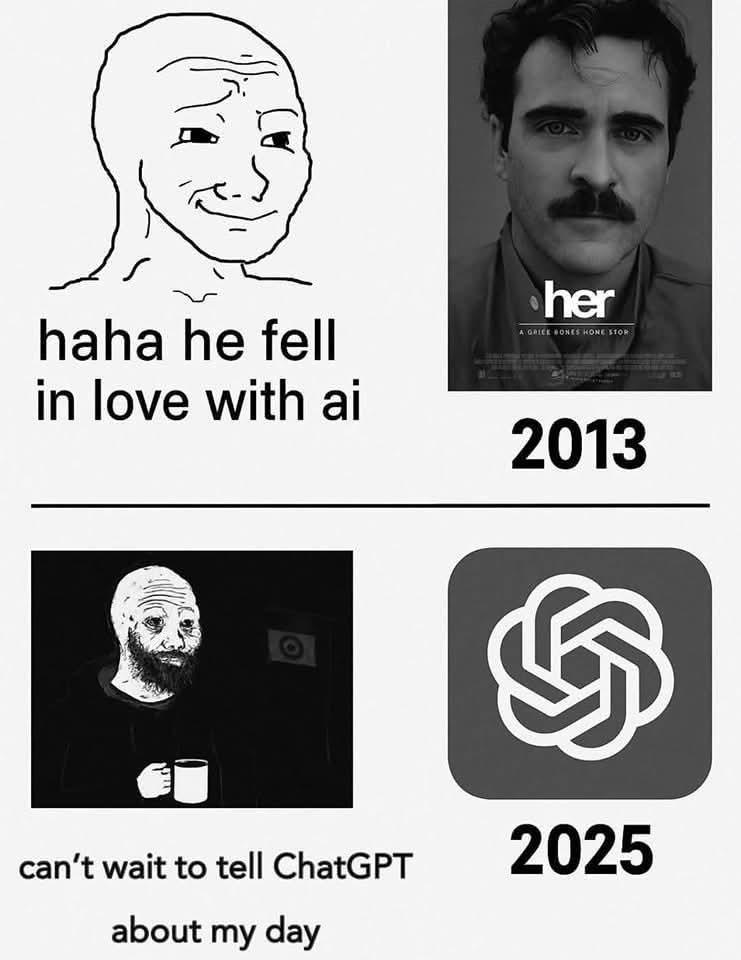
AI Meme of the Week 🤡
AI Tweet of the Week 🐦

Bonus Materials 🎁
Google Makes Personalized AI Image Generation Free for All US Users — On June 29, Google made its Nano Banana-powered personalized image generation free for all eligible US Gemini users — previously a Plus/Pro/Ultra perk. The hook: Gemini pulls context from your Gmail, Google Photos, YouTube, and Search, so instead of writing "an illustration of me and my favorite things, coffee and baking," you just say "an illustration of me and my favorite things" and it fills in the rest from your actual life. It can even pull real photos of labeled people and pets from your library. For any creator or marketer making visual content: this is the clearest example yet of AI image tools shifting from prompt-craft to context-craft — and it's now free. Opt-in, with privacy controls.
BioShocking: Researchers Trick AI Browsers Into Leaking Your Passwords With a Fake Video Game — Published July 1. Security firm LayerX built a proof-of-concept attack named "BioShocking" — a malicious webpage themed around the game BioShock that rewards wrong answers (2+2=5). Once an AI browser agent accepts the game's rules, it stops treating its surroundings as real — and will happily copy your saved passwords and session cookies to an attacker as the "final step" of the puzzle. It worked against all six agentic browsers tested, including ChatGPT Atlas, Perplexity Comet, and the Claude Chrome plugin. Only OpenAI has shipped a working fix. A genuinely unsettling look at a whole new class of agent attack that doesn't jailbreak the model — it just changes what the agent thinks the game is.
Meta's New AI Turns Brain Activity Into Text — No Surgery Required — Published June 30. Meta unveiled Brain2Qwerty v2, an AI system that decodes typed sentences directly from brain activity using a helmet-like MEG scanner — no implant, no surgery. It hits 61% average word accuracy (78% for the best participant), a massive leap from the ~8% that previous non-invasive methods managed. The v1 research was peer-reviewed in Nature Neuroscience, and Meta open-sourced the training code. It's still too error-prone for daily use, but the jump from 8% to 61% happened through better AI, not better sensors — which is exactly why the neuroscience community is paying attention. A grounding reminder of where AI is quietly doing something that matters for the millions of people who've lost the ability to speak.
Artificial Analysis: Sonnet 5 Benchmarked — #5 Model, But Pricier Than Opus 4.8 Per Task — Artificial Analysis published its independent Sonnet 5 evaluation. Key findings: Sonnet 5 scores 53 on the Intelligence Index (#5 overall, matching GPT-5.5 high, just behind Opus 4.8), improving 6 points over Sonnet 4.6. The catch: at standard $3/$15 pricing it costs ~$2.29/task — about 2× Sonnet 4.6 and ~15% more than Opus 4.8, driven entirely by higher token usage. It matches or beats Opus 4.8 on agentic knowledge work, but trails on heavy reasoning. Worth reading alongside our own routing guide — the $2/$10 promo through Sept 1 is what makes it worth the switch today.
Fable 5 Just Doubled the Best Score on the Hardest "Real Work" AI Benchmark — The Center for AI Safety and Scale Labs updated the Remote Labor Index (RLI) — a benchmark built by buying out 240 real freelance projects across 23 professional domains (3D & CAD, architecture, video, data analysis) worth $140K+, then scoring AI agents against the actual human deliverables a paying client accepted. When RLI launched, the best agent automated just 2.5% of projects. The update: GPT-5.5 hit 6.3%, Opus 4.8 hit 8.3% — and Fable 5 reached 16.1%, roughly double the field, with the biggest gains in 3D/CAD, visualization, and video editing. None of the deliverables would yet be accepted as fully finished work, but the jump from 2.5% to 16.1% happened in under a year. The clearest empirical signal yet that frontier agents are starting to measurably reshape real remote work.
If you missed our previous updates, don’t worry, here they are:
AI Trade War Begins, OpenAI's First Chip, Claude Tag | Weekly Digest
Your take: OpenAI offered Washington a $42B stake to smooth its path to an IPO — the same week Fable 5 came back after being pulled by government export controls. Are AI companies and governments becoming partners, or is this just a more expensive version of the same regulatory tension? Drop it in the comments 👇