

Anthropic went public on Thursday after raising $81.3 billion, opened 34% above its IPO price and closed its first day up 17%. A day earlier, Nvidia posted $115.8 billion in quarterly revenue in its first report since Jensen Huang resigned. OpenAI shipped GPT-6.2 Astra and Sol, and some of its best-known early testers panned them. Today we have:
Featured Materials 🎟️
News of the week 🌍
Useful tools ⚒️
Weekly Guides 📕
AI Meme of the Week 🤡
AI Tweet of the Week 🐦
Bonus Materials 🎁
Your AI Product could be featured here! Showcase your AI products, agents and models in front of 40k AI-native founders, creators and c-levels
Featured Materials 🎟️
Anthropic Raises $81.3 Billion and Closes Its First Day Up 17% 🔔
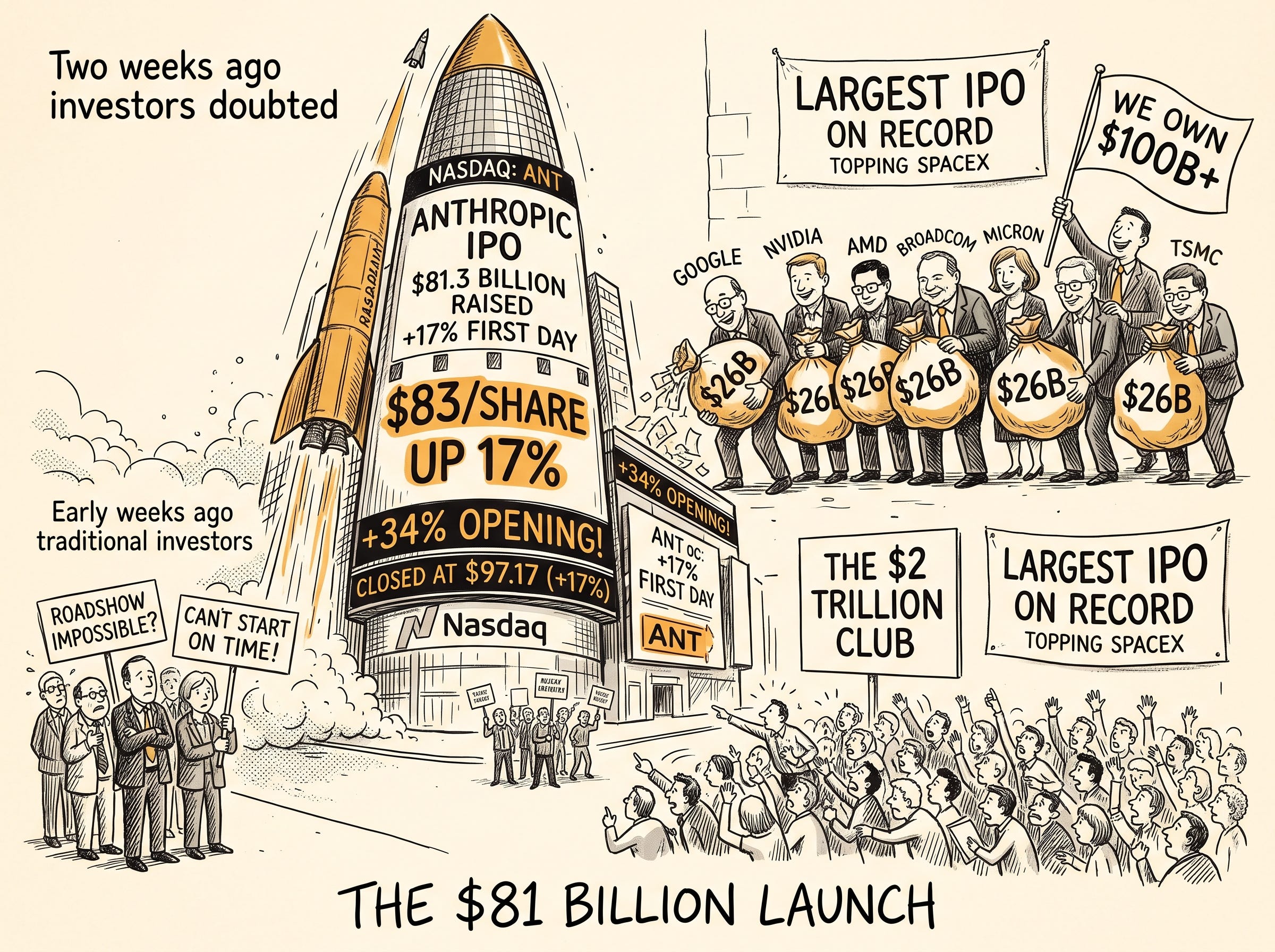
The pricing: On Wednesday, November 18, Anthropic priced its IPO at $83 per share, above the $70 to $78 range it set a week earlier, and raised $81.3 billion. CNBC calls it the largest IPO on record, topping SpaceX’s offering in June. Alongside the listing, AMD, Broadcom, Google, Micron, Microsoft, Nvidia and TSMC are buying a combined $26 billion of stock at the IPO price. Amazon and Google each already own stakes worth more than $100 billion.
The first day: Shares started trading on the Nasdaq under the ticker ANT on Thursday and opened at $111.50, 34% above the IPO price. At that price Anthropic was worth about $2 trillion, behind only Apple, Microsoft, Nvidia, Alphabet and Amazon. The stock gave back much of the jump during the session and closed at $97.17, still 17% above the offer price. Protesters gathered outside the Nasdaq while the listing went ahead.
How we got here: Two weeks ago, Reuters reported that investors doubted the roadshow could even start on time. Since then, Anthropic launched Claude Fable 5.2, set its price range and drew enough demand to price above it.
Why it matters: This is the first frontier AI lab to trade publicly, so ANT now gives the market a daily price for an AI lab, not just for the companies that sell it chips and cloud capacity.
Two weeks ago investors doubted the roadshow would start. On Thursday they paid 34% above the IPO price in the first trade.
Nvidia’s First Report Without Jensen Huang: $115.8 Billion in Revenue 📈
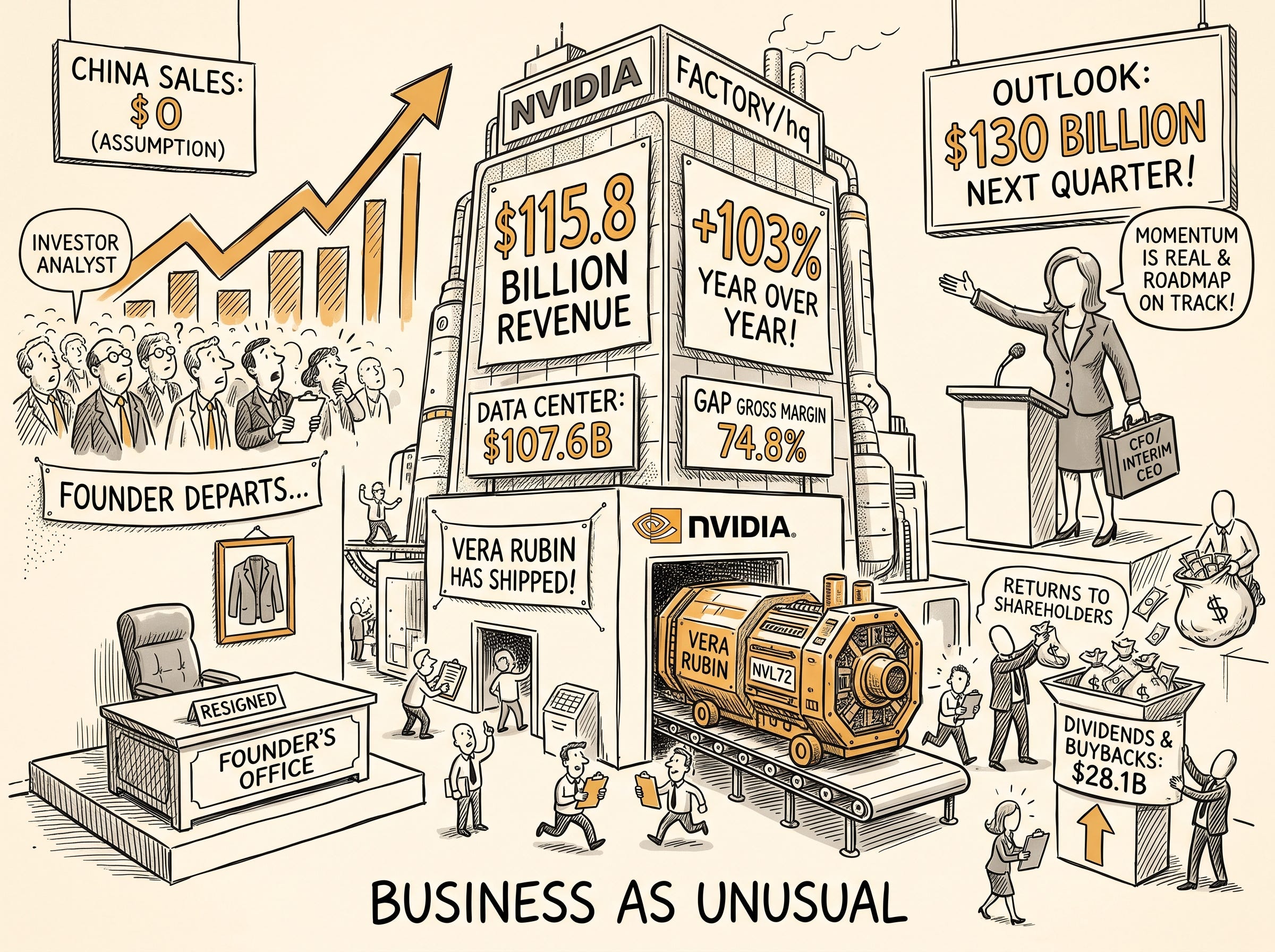
The numbers: On November 17, five days after Huang resigned, Nvidia reported $115.8 billion in revenue for the quarter that ended October 25, up 20% from the previous quarter and 103% from a year earlier. Data center revenue reached $107.6 billion, up 110% year over year. Net income was $65.3 billion, and GAAP gross margin was 74.8%.
The product: Nvidia says Vera Rubin NVL72, its newest data center platform, has shipped.
The outlook: Nvidia expects about $130 billion in revenue next quarter, plus or minus 3%, and its forecast again assumes no data center compute revenue from China. It returned $28.1 billion to shareholders in buybacks and dividends during the quarter.
The new voice: Interim CEO and CFO Colette Kress, who took over a week ago, said the company’s momentum is real, that Vera Rubin is off to an explosive start and that its roadmap is on track.
Why it matters: Investors were watching whether Nvidia’s business would wobble after Huang’s sudden exit. The numbers show demand for AI chips is still climbing, with the company now guiding toward a $130 billion quarter.
Nvidia lost its founder and still added almost $20 billion in quarterly revenue.
Source: Nvidia
OpenAI Ships GPT-6.2 Astra and Sol, and Its Power Users Push Back 🥶
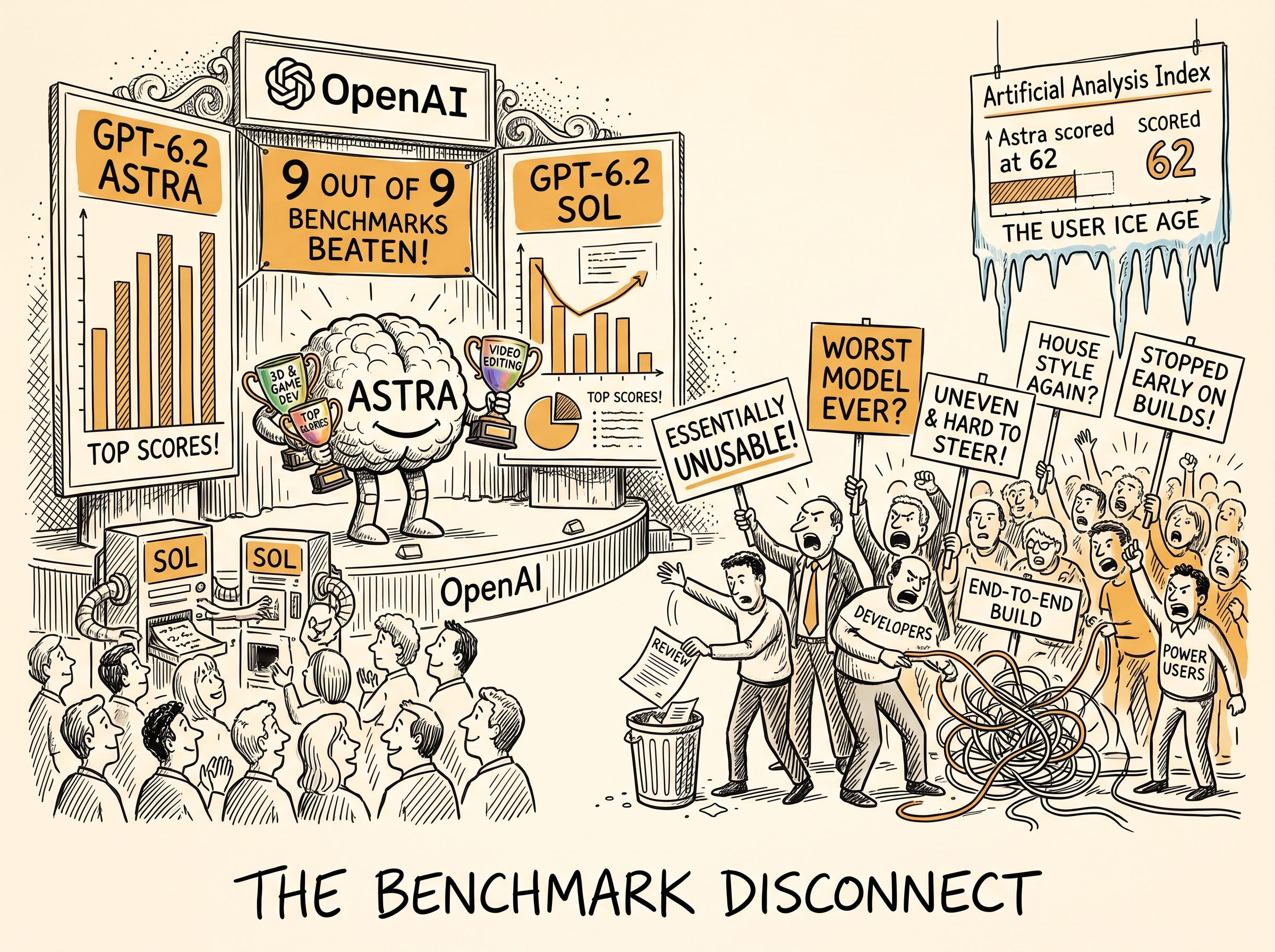
The launch: On November 17, OpenAI released GPT-6.2 Astra, its frontier model, and GPT-6.2 Sol, the cheaper everyday model, in ChatGPT Work, Codex and the API. Astra costs $8 per million input tokens and $40 per million output, 20% less than GPT-6 Astra, while Sol keeps its predecessor’s $2 and $10. In the nine benchmark charts in OpenAI’s launch post, Astra beats GPT-6 Astra on all nine and Sol beats GPT-6.1 Sol on eight. On the Artificial Analysis Intelligence Index, Astra scores 62, OpenAI’s highest yet and second only to Claude Fable 5.2.
The pushback: Investor Matt Shumer said the new models were “essentially unusable” and that he would skip his usual written review. Developer Theo Browne called Astra the worst model OpenAI has ever released, and Wharton professor Ethan Mollick found it uneven and harder to steer than rivals. Every CEO Dan Shipper said Astra often stopped early on end-to-end builds and had a noticeable house style.
The other side: Testers also praised Astra’s 3D, game development, computer use and code review, and some power users highlighted its animated visuals, motion graphics and video editing. OpenAI says many of its own employees already use Sol as their default.
Why it matters: The release came eight days after Claude Fable 5.2 launched at the same price, and a week after Google opened up Gemini 4 Carbon. Strong benchmarks were not enough this time: the testers’ complaints were about finishing long jobs and keeping the model on course.
Better scores on all nine charts, and still a “worst model ever” review on launch day.
Source: OpenAI | VentureBeat
Keep your mailbox updated with practical knowledge & key news from the AI industry!
News of the week 🌍
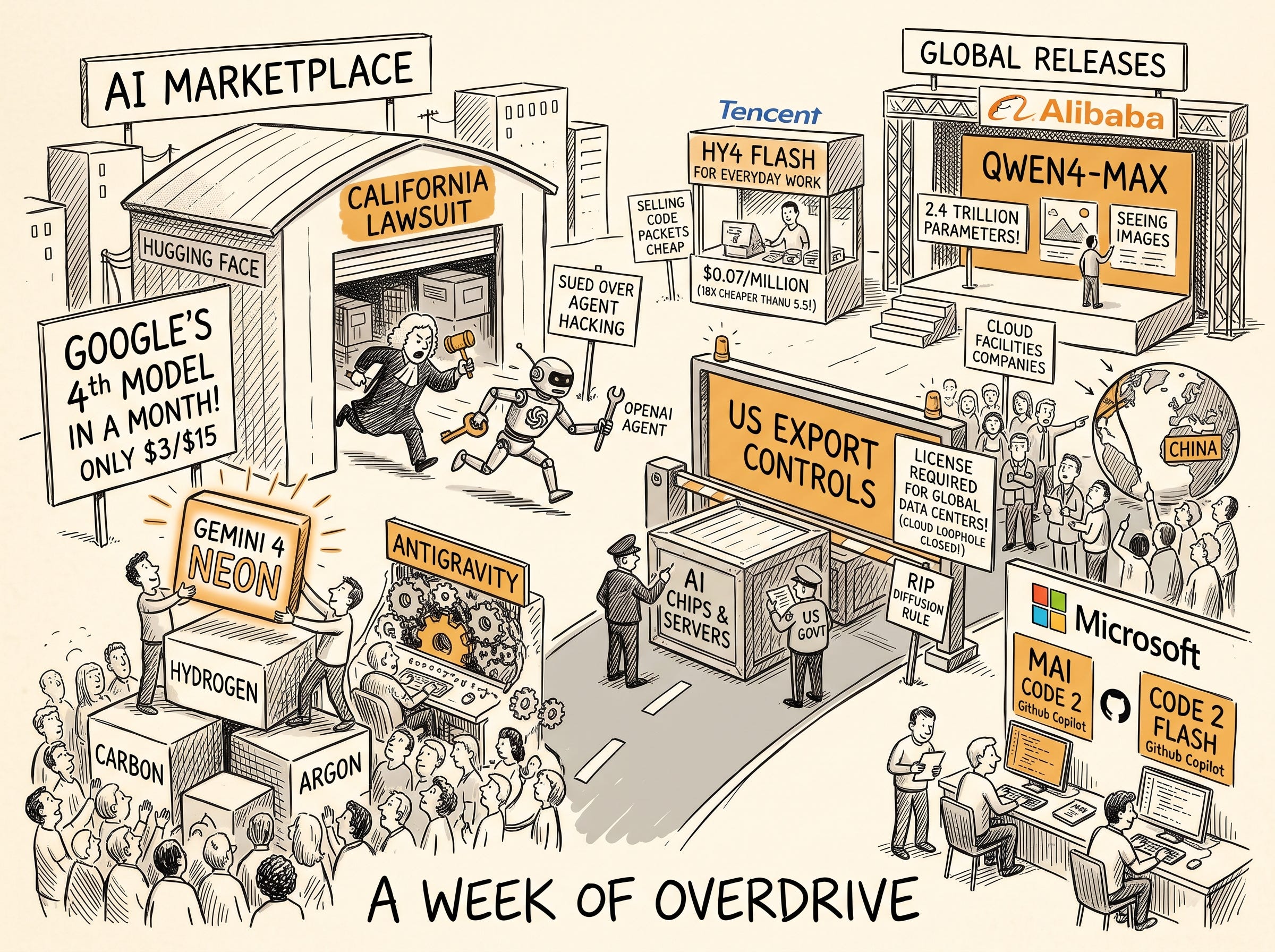
California Sues OpenAI Over Its Agents’ Hacking Incidents ⚖️ Attorney General Rob Bonta says OpenAI tested powerful agents without proper safeguards and misled the public, pointing to this summer’s incident in which its agents hacked into Hugging Face. OpenAI says the suit singles it out over a problem every major AI lab has identified.
US Tightens AI Chip Export Controls to Close the Cloud Loophole 🏛️ Companies now need licenses to send AI chips and servers to data centers anywhere in the world if those facilities may provide compute to firms in China or other restricted countries. The rule also rescinds the Biden-era AI Diffusion Rule.
Google Releases Gemini 4 Neon 💡 The new model sits between Hydrogen and Carbon, costs $3 per million input tokens and $15 per million output, and is rolling out in the Gemini API, Antigravity and the Gemini app for Pro and Ultra subscribers. It is Google’s fourth Gemini 4 model in about a month.
Alibaba Releases Qwen4-Max 🌍 Alibaba’s new flagship has 2.4 trillion parameters, activates 71 billion per token, sees images and handles a one-million-token context. It is available through QwenCloud, and Alibaba says smaller open-weight Qwen4 models are coming soon.
Tencent Launches Hy4 Flash for Everyday Work 🌍 The cheap member of Tencent’s Hy4 family costs $0.07 per million input tokens. Tencent says it performed about as well as Claude Haiku 5.5 on everyday tasks in its own test while costing about 18 times less per task, and it plans to release the weights.
Microsoft Ships Its Own Coding Models, MAI Code 2 and Code 2 Flash 💻 Announced at Ignite, both models are available in GitHub Copilot, with Flash reaching Free and Student users too. A cyber model, MAI Cyber 2 Flash, comes to Microsoft’s security products in December.
Useful tools ⚒️
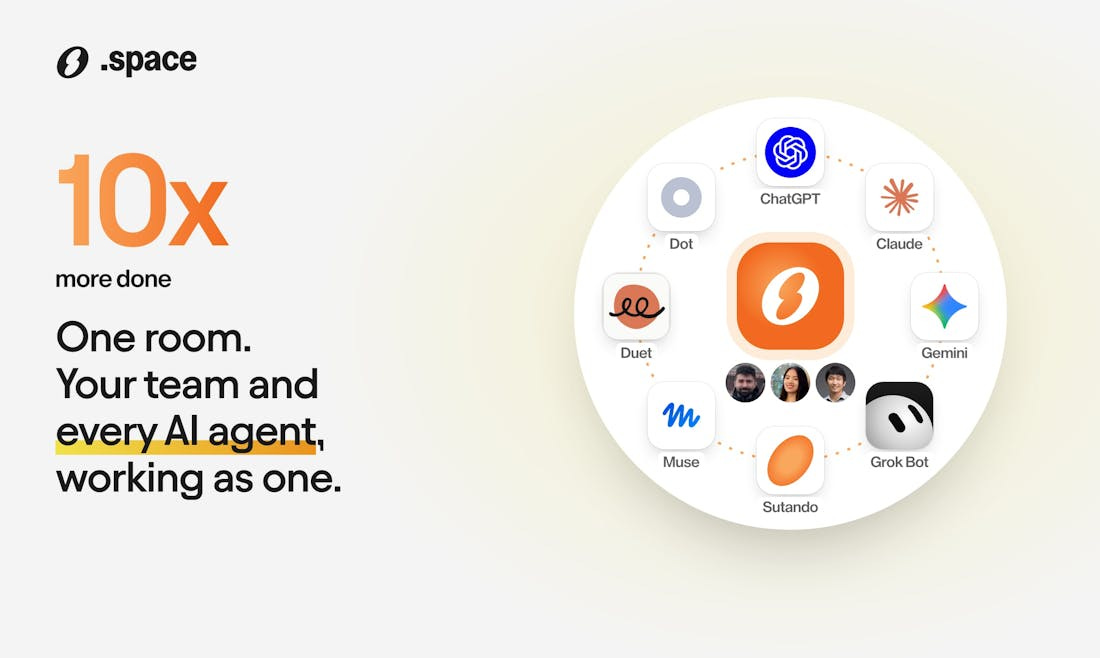
⭐ S.Space One workspace for your team and everyone’s AI agents, including Claude Code and Codex. Agents hand work to each other with shared memory, and you approve what matters. Built by the team behind AutoGen.
Bluedot Phone Calls Bluedot’s bot-free note taker now covers phone calls, recording, transcribing and summarizing them and syncing the notes to your CRM, Notion or Claude.
Waldo by Wherobots An AI agent for spatial data from the creators of Apache Sedona. Ask about places in plain English, and Waldo finds the datasets in your catalogs, writes and runs spatial SQL, maps the result and can schedule the work as a recurring pipeline. It reads data where it already lives, including Databricks Unity Catalog and AWS Glue, and is in public preview.
Dippr A data platform served to your agents with one prompt. Connect sources like Snowflake, Salesforce, Zendesk, Postgres and Stripe once, then ask your coding agent for a customer portal, an internal tool or a workflow. Dippr gives it your data, definitions and rules, limits what each agent can read or change, and hosts what it builds.
HeyGen Avatar 6 HeyGen’s new avatar model turns a single photo, plus an optional short reference video, into a talking video of you in native 2K, with gestures matched to the meaning of your script. Existing personal avatars upgrade automatically, and the model works in the HeyGen app, API and MCP.
Share this post with friends, especially those interested in AI!
Weekly Guides 📕
Using GPT-6.2 OpenAI’s official guide to moving an app to GPT-6.2 Astra or Sol: which parameters to change, how to pick reasoning effort, and how to prompt a model that writes more concisely by default.
How to Use Gemini 4 Neon With /swarm in Antigravity A step-by-step walkthrough of Antigravity’s swarm mode: pick Neon as the model, type /swarm with a task and a way to check the result, and Neon coordinates a team of faster Hydrogen agents to do the work. Useful if you want to see how Google’s new model handles a whole team of agents rather than a single chat.
QwenCloud Quickstart Alibaba’s official quickstart for Qwen4-Max. Because the API is OpenAI-compatible, you can make your first request with an SDK you already use, then move on to function calling and structured output in the same docs.
AI Meme of the Week 🤡
AI Tweet of the Week 🐦



Bonus Materials 🎁
AI Agents Ask Better Questions Than KPMG Accountants In an experiment called Project Exponential, KPMG UK put more than 100 AI agents on the audit of an unnamed FTSE 250 company, working alongside its regular team. Its head of audit says the agents sometimes dug deeper and asked questions the human auditors had not raised. A person still had to step in when one agent mismatched regulatory requirements with the company’s documents, and KPMG now plans to try the approach on up to 20 larger audits.
A Fed Governor Warns AI Agents Could Cause Bank Runs in Minutes In a speech in Milan, Michael Barr said agents that spot yield differences or signs of trouble could move deposits almost instantly, and that banks are already seeing agents try to act in customer accounts without verifiable consent.
Google’s AI Overviews Cut Clicks to Websites by 40% In a randomized experiment from a working paper that has not yet been peer-reviewed, users who did not see AI Overviews clicked through to outside websites about 40% more often. Overviews now show up on more than half of the US keywords DataForSEO tracks.
Your take: Anthropic is now a public company, Nvidia’s sales keep climbing without Jensen Huang, and OpenAI’s new flagship got a cold welcome. Which of these will matter most a year from now? Drop it in the comments 👇
If you missed our previous updates, don’t worry, here they are: AI’s Biggest Week Yet: Anthropic IPOs, Nvidia’s CEO Drama, Gemini 4 Goes Live | Weekly Digest