


China blacklisted 56 American companies on June 24 in direct retaliation for US AI export controls — the AI trade war just became bidirectional. OpenAI and Broadcom unveiled Jalapeño, the first OpenAI-designed inference chip, built in 9 months using OpenAI’s own models and targeting 50%+ cost reduction vs. Nvidia GPUs. And Anthropic launched Claude Tag for Slack — giving teams an always-on Claude that builds context from your channels, delegates work, and already generates 65% of Anthropic’s own product team’s code. Today we have:
Featured Materials 🎟️
News of the week 🌍
Useful tools ⚒️
Weekly Guides 📕
Bonus Materials 🎁
Keep your mailbox updated with practical knowledge & key news from the AI industry!
Featured Materials 🎟️
China Fires Back — 56 US Firms Blacklisted in AI Trade War Escalation 🌍

Twelve days after the US Department of Commerce ordered Anthropic to take Fable 5 offline under export control authority, China formally retaliated. On June 24, China’s Ministry of Commerce issued two simultaneous actions: it added 10 American companies to its export control list — restricting what those firms can import from China — and banned 46 additional US companies from government procurement contracts. Combined, 56 US firms were hit in a single day.
The targeting reflects deliberate precision. The companies on the procurement ban include aerospace and defense contractors, drone manufacturers, and rare earth processing companies — not AI labs, but the infrastructure layer that AI depends on. The message is not “we will ban ChatGPT.” The message is “we will cut off the supply chains your AI hardware requires.”
Why this is different from previous China-US tech friction:
Prior rounds of the tech war were largely asymmetric — the US restricting exports to China (chips, equipment, software). This action is China explicitly labeling it a tit-for-tat response. The Ministry of Commerce statement cited “US unilateral export control measures on Chinese entities” as the direct trigger. This is the first time China has framed a retaliation as being specifically about AI export controls.
The AI infrastructure dimension:
Two of the 10 companies added to the export control list manufacture components used in Nvidia GPU cooling and data center construction. The signal: even if China cannot match OpenAI’s models, it can make the hardware that runs those models significantly more expensive and difficult to procure. Rare earth restrictions are the second lever — the materials used in GPUs, server components, and memory fabrication are overwhelmingly sourced from China.
What it means for builders:
Short term, very little changes. The blacklisted companies are not direct suppliers to most AI development teams. Medium term — if these restrictions expand to memory, advanced packaging, or other semiconductor components — the economics of running AI at scale in the US start moving. The Jalapeño chip (see Featured below) and Micron’s partnership with Anthropic announced this week are not coincidences in this context.
Twelve days after the US used export controls to force a commercial AI lab to pull its best model offline, China responded with its own version: hardware supply chain restrictions targeting the foundation the US AI industry is built on. The AI cold war has its first formal exchange of fire.
Source: ABC News
OpenAI Builds Its Own Silicon — Jalapeño Is the First OpenAI Chip 🌶️
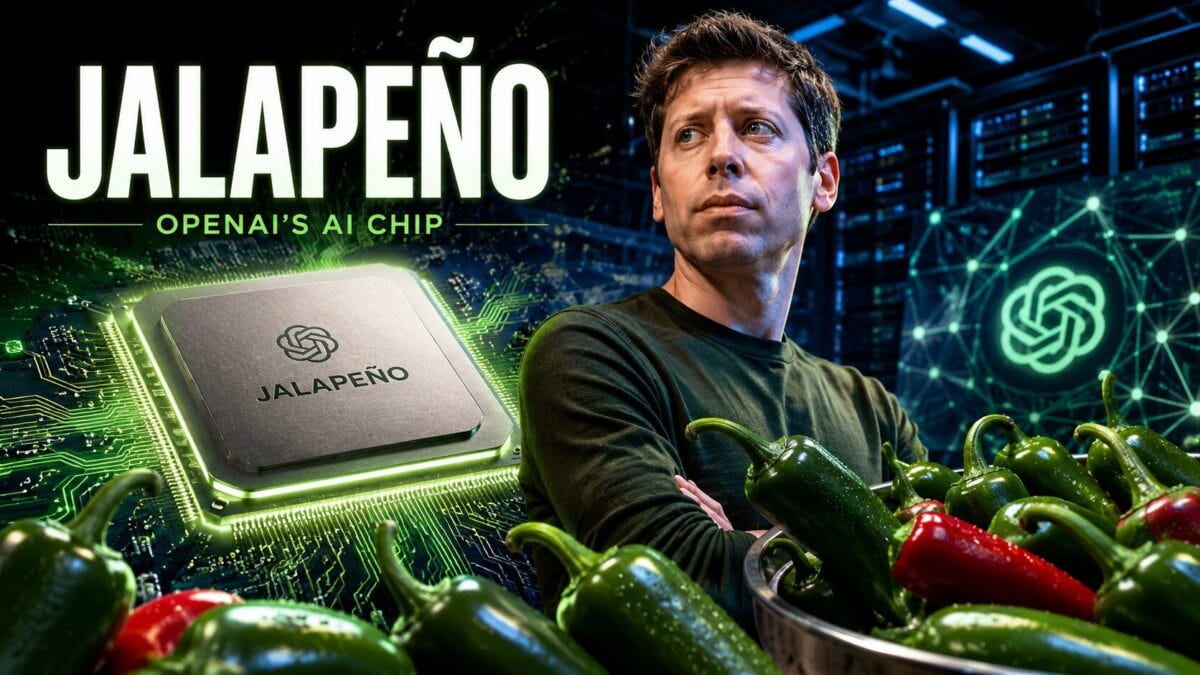
On June 24, OpenAI and Broadcom unveiled Jalapeño — the first chip OpenAI designed from the ground up. It is an inference-optimized processor built specifically for running ChatGPT, Codex, the API, and OpenAI’s coming agentic products. Production runs through TSMC. Target volume: hundreds of thousands of chips in the first production run.
Why this is significant:
OpenAI currently spends approximately $6-7 billion per year on compute — overwhelmingly on Nvidia GPUs. Jalapeño is explicitly built to reduce that dependency. Broadcom CEO Hock Tan said in the joint announcement that Jalapeño targets performance-per-watt that surpasses current state-of-the-art inference hardware, and that the chip’s architecture is optimized for the specific numerical precision and memory access patterns of transformer inference — not general GPU workloads.
The part that will get buried:
OpenAI completed the chip design in 9 months. The normal semiconductor design cycle for a chip this complex is 18-24 months. OpenAI says its own models were used throughout the design process: for architecture search, layout optimization, power modeling, and bug detection in HDL code. The chip was built using AI tools trained on chip design to accelerate chip design. That feedback loop — AI making AI infrastructure faster — is the actual frontier story here, not the chip itself.
The competitive map:
Google has been running its own inference chips (TPUs) since 2016. Microsoft’s Maia chip is in early deployment with Azure. Amazon has Trainium and Inferentia. Meta has MTIA. The pattern: every major AI consumer that can afford the investment is building its own silicon. Nvidia’s revenue still grows because demand grows faster than the vertical integration. But the strategic dependency is clearly something every major lab considers existential risk.
For builders:
Jalapeño will not change API pricing next week. But it signals that OpenAI intends to own its compute economics within 2-3 years. That changes the long-term pricing floor for its API — and the long-term negotiating position of every developer who has built their product on OpenAI’s infrastructure.
OpenAI just announced that it used AI to design an AI chip that will be used to run AI. The 9-month design cycle is the most important number in the announcement — not the performance metrics.
Source: OpenAI
Claude Moves Into Team Chat 🧵
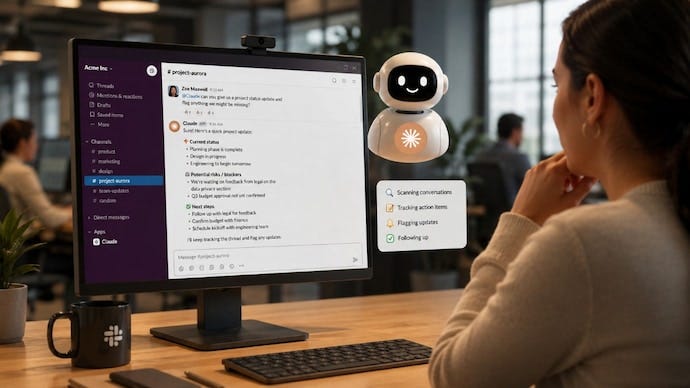
On June 23, Anthropic launched Claude Tag — a new way for teams to work with Claude that starts in Slack, where work already happens. Claude Tag is not a Slack bot. It joins your workspace as a team member, gets access to the channels and tools you choose, and can be mentioned with @Claude in any message thread.
What Claude Tag does that previous Claude integrations didn’t:
Earlier Claude-in-Slack integrations responded to explicit queries and forgot the conversation when the session ended. Claude Tag builds a persistent model of your team’s work — the projects in progress, the open questions, the decisions made last month — from the channels it has access to. When you tag it, it responds with that context already loaded, without you having to re-explain your situation.
The new capabilities:
Asynchronous work — Claude Tag handles multi-step tasks that take hours or days, not just responses to single prompts
Proactive flagging — when ambient behavior is enabled, Claude Tag can surface relevant information you didn’t ask for but should probably see
Tool access — connect it to your codebase, your documentation, your data sources; Claude Tag can execute actions, not just generate text
Team memory — context from past threads informs current responses, so you’re not starting from zero every time
The internal number Anthropic disclosed:
65% of the code merged into Anthropic’s own product codebase is currently created by an internal version of Claude Tag. That is not “AI assists with coding.” That is AI as primary author of the majority of production code for a frontier AI lab — within the same team building and maintaining the model.
Available now:
Beta access for Claude Enterprise and Team subscribers. The team size cap was not disclosed. Slack is the first platform; additional platforms are coming.
Claude Tag is the first Anthropic product that answers the question most founders have been asking: “How do I actually give my team an AI that works while we work, instead of another thing we have to context-switch to?” The answer is: it moves into the place where your team already is.
Source: Anthropic
Share this post with friends, especially those interested in AI!
News of the week 🌍
OpenAI Launches Daybreak: GPT-5.5-Cyber, Patch the Planet, and AI-Powered Vulnerability Patching 🔐 — On June 23, OpenAI expanded Daybreak with GPT-5.5-Cyber (85.6% on CyberGym, the highest score of any public model), Codex Security (which has already scanned 30M+ commits across 30,000+ codebases), and Patch the Planet — a new initiative to automatically patch open-source vulnerabilities in cURL, Python, the Linux kernel, and 30+ other critical projects, with human oversight at each fix. OpenAI frames Daybreak as its answer to Anthropic’s Glasswing: not just finding bugs, but closing them. 500,000+ findings have already been automatically confirmed as fixed.
Nobel Prize Winner and AlphaFold Creator John Jumper Leaves Google DeepMind for Anthropic 🧬 — John Jumper — who shared the 2024 Nobel Prize in Chemistry with Demis Hassabis for AlphaFold, and spent nine years at Google DeepMind — announced he is joining Anthropic. This follows Noam Shazeer (Transformer co-author, Gemini co-lead) leaving Google for OpenAI last week. In the same seven-day window, Google has lost two of its most credentialed AI researchers to its two main rivals. Alphabet shares fell 2.1% on Jumper’s announcement.
Getty Images and OpenAI Strike Multi-Year Deal — Licensed Photos Now Inside ChatGPT 📸 — On June 22, Getty Images and OpenAI announced a multi-year partnership to integrate Getty’s licensed content libraries into ChatGPT search and discovery features. GETY stock surged up to 145% on the announcement — the largest single-day move in the stock’s history. The deal resolves the copyright question that had kept major stock libraries out of AI search, and it sets a licensing model template that Reuters, Associated Press, and other content owners are watching closely.
Mistral Launches OCR 4 — Turning Document Extraction Into a Full Enterprise AI Play 📄 — Mistral’s OCR 4 launched June 24 with support for 170 languages, bounding box output, block classification, inline confidence scores, and a single-container self-hosted deployment option for enterprise data privacy requirements. In head-to-head annotation tests, independent evaluators preferred OCR 4 over leading document-AI systems at a 72% win rate. Mistral’s framing: not a standalone OCR tool but a RAG and document pipeline foundation. Relevant for any team running document ingestion, contract analysis, or invoice processing.
Micron and Anthropic Sign AI Infrastructure Deal — HBM Supply and Series H Investment 💾 — Micron Technology signed a strategic supply agreement with Anthropic this week covering High Bandwidth Memory allocation and a direct investment in Anthropic’s Series H round. Memory is the current bottleneck for long-context inference — the kind Fable 5 and Opus 4.8 rely on for 200K+ token windows. The deal guarantees Anthropic priority access to Micron’s HBM3E production line. Together with Jalapeño (OpenAI), it confirms the pattern: every major AI lab is now vertically integrating down to the component level.
Useful tools ⚒️
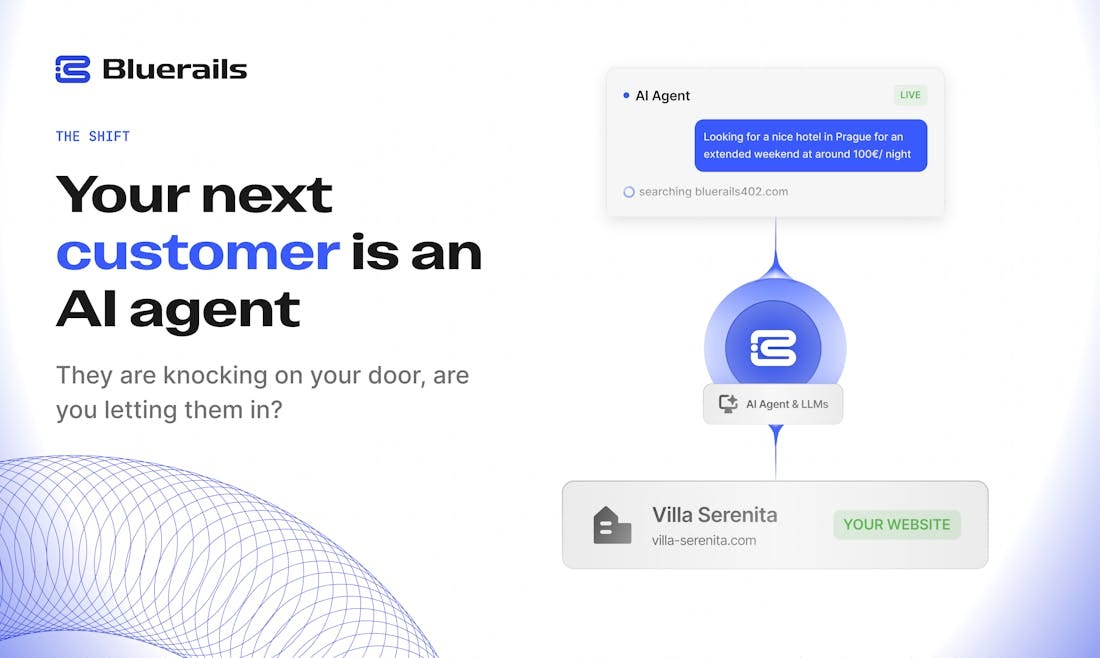
⭐ Bluerails Discovery — The payment and discovery infrastructure that lets AI agents find and pay your business. Bluerails gives your product or service a structured, machine-readable endpoint that AI agents can discover through MCP and pay through without human authorization for each transaction. Instead of waiting for a customer to search for you, your business becomes callable by any AI agent with access to the Bluerails network — and gets paid automatically when the agent completes a transaction. For any creator or founder building a product that agents will use rather than people: this is the commerce layer. Free tier available.
Skybridge — The open-source, full-stack React framework for building MCP Apps — complete AI-powered applications that run inside Claude, ChatGPT, and any MCP-compatible host. Instead of building a standalone web app and then adding an AI integration, Skybridge lets you build the whole product as an MCP App from the start: UI, logic, and agent capabilities in one codebase. Open source, MIT license.
Propane — Automatic customer context for product teams and agents. Propane connects to your CRM, support tickets, and product analytics and builds a live, structured customer intelligence layer that your team and your AI agents can both query in real time. Before a customer call, your agent knows their usage, their open issues, their billing tier, and their last five interactions — without you or the agent having to look it up. For product teams and customer-facing operators running AI workflows. Free trial available.
Oxlo.ai — Scale across AI models without scaling your bill. Oxlo is an intelligent API gateway that routes your requests to the best-performing and cheapest model for each task type — Claude for writing, GPT-5.5 for coding, Gemini Flash for high-volume summarization — automatically, based on prompt analysis and real-time pricing. Unified billing, full observability, and a fallback layer that catches model outages without you building your own redundancy. Particularly useful this week as the Jalapeño announcement and Fable 5 pricing changes make multi-model routing the default strategy rather than the advanced one.
Cotypist — Local AI autocomplete that learns your voice and works in every Mac app without a cloud subscription. Cotypist runs entirely on-device, adapts to how you phrase sentences, and surfaces completions as you type in Notion, Slack, email, Linear, code editors — anywhere on macOS. No pasting into a chat window, no context-switching. Over time it patterns from your writing and starts predicting your exact phrasing. For any creator or founder who types a lot: the productivity gain compounds daily. Free trial available.
Weekly Guides 📕
Most Intelligence Is Search — And What That Means for Your Edge as a Creator — Our own guest post published June 23 by Tomas Pueyo (Uncharted Territories, 800K+ subscribers). Why most human thinking has always been a form of search — and what changes now that LLMs do it cheaper than any person. Where the real human advantage lies when AI can out-search any single domain. And why the polymath, not the expert, wins in the agentic era. The clearest framework we've published for understanding what your actual edge is when intelligence becomes a commodity.
Claude Tag: How to Set Up, Configure, and Control Your Team Agent in Slack — Anthropic’s full Claude Tag documentation: how to install Claude Tag in Slack, how to configure channel access permissions, how to grant tool integrations (codebase, docs, data), how to turn ambient behavior on and control what it proactively surfaces, and how to scope Claude Tag’s capabilities to specific teams or workflows. The setup is covered step by step including the Slack OAuth flow, Enterprise Managed Users configuration, and the trust model for tool permissions.
Patch the Planet: How Open-Source Maintainers Can Get Their Project Scanned and Patched for Free — TechCrunch’s practical breakdown of the Patch the Planet initiative launched June 22. If you maintain any open-source project: how to apply for the free Codex Security scan, what the output looks like (vulnerability report + auto-generated patch proposals), how to review and merge fixes, and which projects are already enrolled (cURL, Python, Linux kernel). The clearest practical entry point into automated vulnerability patching for any developer maintaining public repos.
AI Meme of the Week 🤡
AI Tweet of the Week 🐦


Bonus Materials 🎁
How Agents Are Transforming Work — OpenAI Research — OpenAI’s research report published this week: 80.6% of individual Codex users made at least one request estimated to exceed 30 minutes of human work in May 2026. 25.6% made a request exceeding 8 hours. Internally, Codex accounts for 99.8% of weekly output tokens at OpenAI. The data behind the narrative: AI coding agents aren’t assistants anymore, they’re the primary producers in some organizations. The most concrete public evidence of what the “agentic era” actually looks like in practice.
Five Eyes Intelligence Alliance Warns: New AI Models Pose Urgent Cyber Risk — Published June 22. The intelligence agencies of the US, UK, Canada, Australia, and New Zealand issued a joint advisory warning that AI systems capable of providing “significant uplift” to cyberattacks are no longer years away — they are here, and adversaries are already using them. Reuters June 22 coverage of the formal advisory. The advisory specifically names frontier model capabilities in vulnerability discovery and exploitation, and is written in unusually direct language for a government intelligence release. Required reading for anyone building on AI infrastructure — or whose infrastructure other people build on.
A Practical Guide to Building AI Agents — OpenAI — OpenAI's comprehensive framework for designing, orchestrating, and deploying AI agents — published alongside the Daybreak launch this week. Covers: when to use single agents vs. multi-agent systems, how to pick the right model for each layer of your stack, how to design tools that agents can actually use reliably, how to set guardrails without breaking agent autonomy, and the full multi-agent orchestration patterns (manager, decentralized, and pipeline). The most complete practical reference OpenAI has published on agents, covering everything from first principles to production architecture.
If you missed our previous updates, don’t worry, here they are:
Fable 5 Goes Dark, SpaceX Buys Cursor, OpenAI Recruits McKinsey | Weekly Digest
Your take: China just fired back at US AI export controls by blacklisting 56 American companies — the same week OpenAI announced its own chip and Anthropic moved Claude into your team’s Slack. Is AI infrastructure now a national security asset, or is this geopolitical noise that won’t affect how you build? Drop it in the comments 👇